Use this section to confirm heading fidelity, spot spacing artifacts, inspect first-class table content, and
understand how nearby paragraphs and tables were sequenced during parsing. Matched in-text citations now jump to
their reference entries, while unresolved citations route to open citation issues.
paragraph
Order 1
Style Comment
word/document.xml:/w:document[1]/w:body[1]/w:p[1]
Use this form to tell us important information about this document, then start the text on the following page. All information you give in this form will appear in the document, or affect the way it is handled online.
paragraph
Order 4
Style Comment
word/document.xml:/w:document[1]/w:body[1]/w:p[3]
Note: for “Document Type”, choose only one of the following: appendix, chapter, dedication, foreword, front-matter-part, glossary, preface, ref-list, or section.
paragraph
Order 7
Style Comment
word/document.xml:/w:document[1]/w:body[1]/w:p[5]
Blank or “Yes” is the default value, indicating these features will apply to the document.
paragraph
Order 10
Style Comment
word/document.xml:/w:document[1]/w:body[1]/w:p[7]
Use one row for each author. List authors in order of appearance in the document. Add rows to add more authors. For institutional author, enter the name of the institution in the Given Name(s) column.
paragraph
Order 13
Style Comment
word/document.xml:/w:document[1]/w:body[1]/w:p[9]
Use one row for each affiliation. Link affiliations by label to the respective author. Add rows to add more affiliations.
heading
Order 18
Level 1
Style Heading1
word/document.xml:/w:document[1]/w:body[1]/w:p[14]
H1. Biosensor Assays for Measuring the Kinetics of G-Protein and Arrestin-Mediated Signaling in Live Cells
paragraph
Order 19
Style AbstractHeader
word/document.xml:/w:document[1]/w:body[1]/w:p[15]
paragraph
Order 20
Style Abstract
word/document.xml:/w:document[1]/w:body[1]/w:p[16]
G-protein-coupled receptors transmit signals through cascades of cellular signaling molecules to orchestrate physiological responses. Measuring the time course (kinetics or dynamics) of GPCR signaling is revealing new spatiotemporal paradigms of signaling with biological and therapeutic implications. Kinetics also impact drug activity measurements, for example biased agonism. Biosensors greatly facilitate the measurement of signaling kinetics by detecting signaling in live cells in real time; a ligand is applied to cells, the cells placed in a reader, and the change in light emission measured repeatedly over time. In this chapter, methods are presented for assaying signaling molecules using genetically-encoded fluorescent biosensors. Protocols are provided for the most common G-protein pathways (Gs and Gi, detecting cAMP; Gq, detecting diacylglycerol and Ca2+), and also for arrestin recruitment. Methods for analyzing the time course data are required to obtain kinetic drug signaling parameters useful for lead optimization and large-scale receptor research. One such parameter is the initial rate of signaling by the ligand bound receptor (k), a biologically-meaningful and familiar metric. Straightforward curve fitting methods are described for measuring the initial rate by analyzing the whole time course without the need to isolate the linear portion of the curve. Biased agonism is quantified using this approach, providing a simple metric that takes into account differential kinetics of signaling. These experimental and analysis methods enable investigators to routinely measure and quantify the kinetics of signaling in their receptor research and drug discovery projects.
heading
Order 22
Level 2
Style Heading2
word/document.xml:/w:document[1]/w:body[1]/w:p[18]
paragraph
Order 23
word/document.xml:/w:document[1]/w:body[1]/w:p[19]
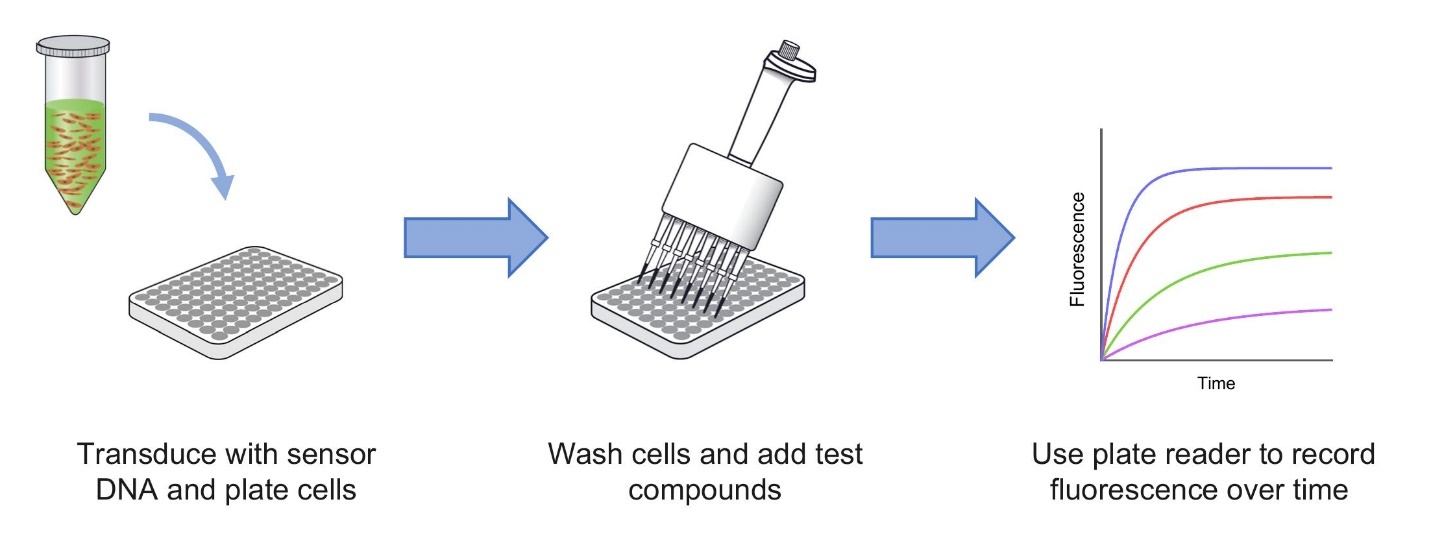
The superfamily of G-protein-coupled receptors comprise the largest family of signaling proteins in the human genome, transducing a remarkable diversity of extracellular stimuli into intracellular signaling networks that modulate and control physiological responses (1-3). Methods for measuring the intracellular signaling molecules have been evolving for sixty years. Laborious chemical methods were used in the discovery of second messengers and elucidation of their function, such as cAMP and inositol phospholipids (4,5). The development of immunoassays to quantify second messengers greatly improved throughput, enabling functional assays to be used routinely in drug screening (6). Biosensors are the latest advance in the measurement of GPCR signaling (7-12) (comprehensively reviewed in refs. (13,38)). These agents enable noninvasive detection of signaling molecules such as second messengers; the biosensor produces an optical signal on binding the target signaling molecule, which can be detected in plate readers. This technology provides three advances - the workflow for detecting the signal is minimal (Figure 1); signaling can be measured in live cells; and signaling can be measured routinely over time. Biosensors greatly facilitate time course assays because a single plate can be used for all the time points. In the workflow, ligands are applied to the cells, the plate placed in the plate reader, then the optical signal from the biosensor measured repeatedly in the same plate (Figure 1). This modality is referred to colloquially as “Real time” or “Continuous read” detection.
paragraph
Order 28
word/document.xml:/w:document[1]/w:body[1]/w:p[24]
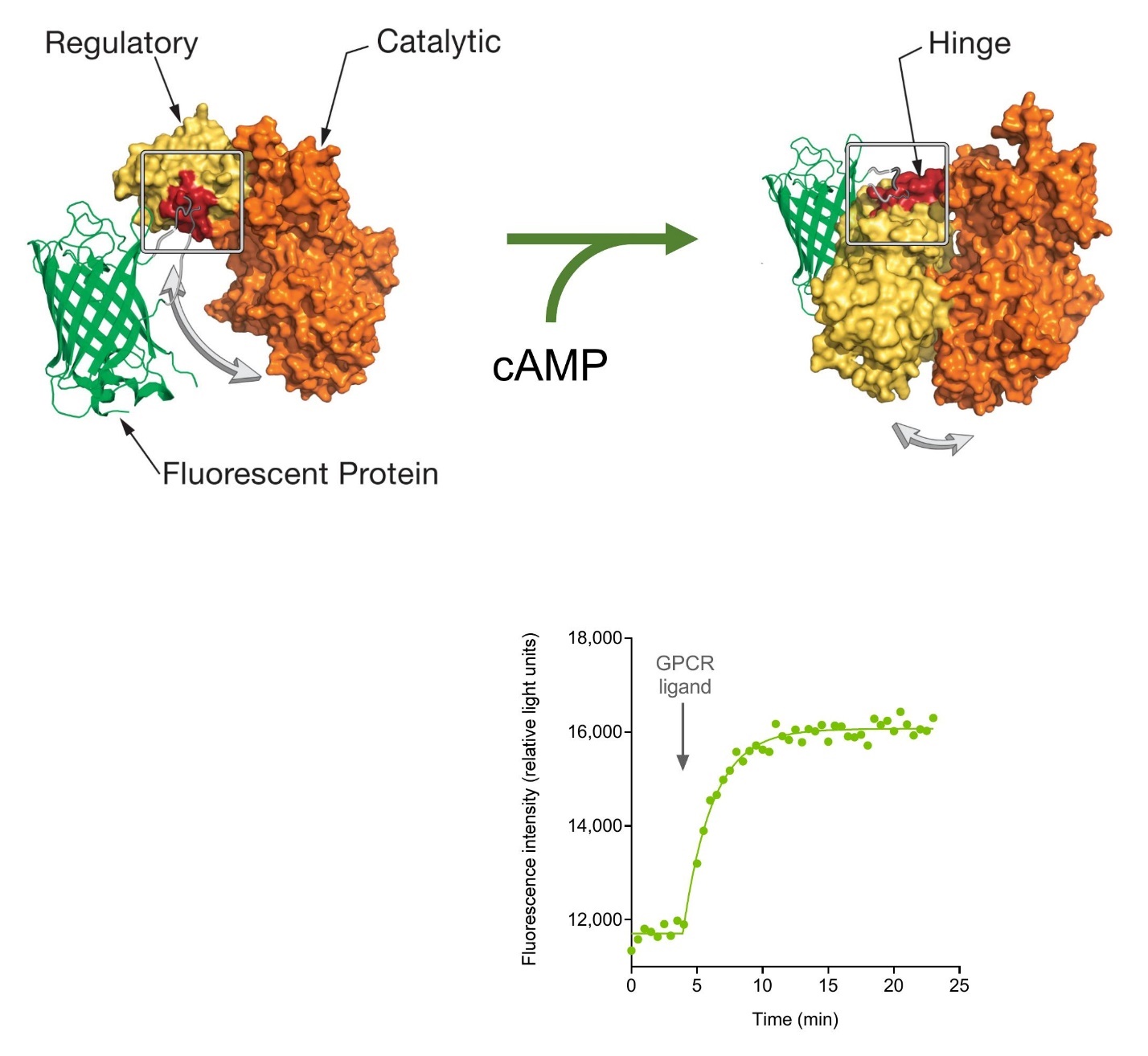
A genetically-encoded biosensor is a protein, transcribed from DNA delivered into cells, usually comprising two components (Figure 2) (13). First is a domain that binds the target molecule being detected, for example cAMP. The second is a fluorescent or luminescent reporter protein that produces a light signal. The biosensor is designed in such a way that the binding of the target molecule to the sensor causes a change in the optical properties of the reporter, e.g. emission of a photon or a change of fluorescence emission intensity (Figure 2) (13). In this way, a biological signal is converted to a light signal that can be easily detected. For GPCR signaling, numerous biosensors have been developed, the second messengers that can be detected including cAMP, Ca2+, diacylglycerol (DAG) and phosphatidylinositol 4,5-bisphosphate (PIP2) (see Table <?escape?>2 of ref. (13)). In this chapter, the biosensors used are fluorescent - they are excited with an external light source at one wavelength and emit light at a second, longer wavelength. Binding of the target molecule causes a change of the intensity of the emitted light (Figure 2), which can be detected using a plate reader. The first goal of this chapter is to provide experimental protocols for employing the biosensors to measure GPCR signaling (see Measuring GPCR Signaling Using Genetically-Encoded Fluorescent Biosensors).
paragraph
Order 29
word/document.xml:/w:document[1]/w:body[1]/w:p[25]
Measuring signaling over time is valuable for two reasons - discovering new signaling mechanisms and optimizing new therapeutics. Measuring the time course reveals new mechanisms of GPCR signaling and regulation. For example, in the late 1960’s and 1970’s it was discovered, by measuring cAMP over time, that the signal fades after reaching a peak (15-17). This phenomenon, termed desensitization, contributed to the discovery of the molecular machinery of GPCR regulation, including GPCR kinases and arrestins (reviewed in refs (14,18). More recently it was shown that some GPCR signals endure after the ligand has been washed out, evident from measuring the time course of signaling before and after washout (10,19-23). This led to the discovery of sustained signaling by internalized receptors, a new spatiotemporal dimension of GPCR signaling of potential therapeutic utility (24-26). From the perspective of optimizing new therapeutics, time course pharmacological studies have revealed that drug activity in signaling assays can change over time (27-30). For example, for the D2 dopamine receptor, the rank order of efficacy for a series of ligands was shown to change over time, which resulted in measurements of biased agonism changing over time (27). Biased agonism is the capacity of a ligand to stimulate selectively only some of the signaling pathways stimulated by the GPCR and is of considerable interest in development of next-generation GPCR therapeutics (see this section) (31-35). This time problem can be solved by using the rates of signaling activity in the bias calculation (29).
paragraph
Order 32
word/document.xml:/w:document[1]/w:body[1]/w:p[28]
Data analysis methods are required for time course data to extract useful pharmacological parameters, of a form that can be used to guide medicinal chemistry and basic research on GPCR signaling. Specifically, curve-fitting methods are needed to reduce the raw data to useful parameter values. One such parameter is the initial rate of signaling by the ligand occupied receptor, termed k (29,36,37). This parameter was developed by applying enzyme kinetics to GPCR signaling, and is analogous to the initial rate of enzyme activity. k is determined as the initial rate of signaling produced by a maximally-stimulating concentration of ligand (37). First, the whole time course curve is fitted to an equation in familiar curve-fitting software (e.g. Prism from GraphPad Software). The fitted parameters are then used to calculate the initial rate using a simple formula. The initial rate is then used to determine k.
paragraph
Order 33
word/document.xml:/w:document[1]/w:body[1]/w:p[29]
In this chapter we describe the experimental methods for measuring signaling using biosensors (Measuring GPCR Signaling Using Genetically-Encoded Fluorescent Biosensors). Hundreds of biosensors have been developed by numerous laboratories, as comprehensively reviewed in refs (13,38). In this chapter we exemplify the methods for fluorescent biosensors using sensors developed and/or distributed by Montana Molecular. These sensors have been optimized to be simple and routine to use, with a high brightness enabling detection using plate readers, and employing the Bacmam viral vector to ensure consistent, reproducible expression from well to well and plate to plate in numerous cell types. Next, the data analysis methods for analyzing time course data are presented, by which the initial rate and k are determined (Analyzing Signaling Time Course Data). Finally, the approach is applied to biased agonism (Simplifying Biased Agonism Assessment Using Signaling Kinetics) and it is shown how quantifying the initial rate simplifies bias quantification, enabling a simple ratio of signaling rates to be employed. By combining the biosensor assay protocols and initial rate analysis, we aim to provide investigators a straightforward, streamlined method to routinely measure the kinetics of GPCR signaling, facilitating research into GPCR signaling mechanisms and the kinetic optimization of new therapeutics.
heading
Order 36
Level 2
Style Heading2
word/document.xml:/w:document[1]/w:body[1]/w:p[32]
H2. Measuring GPCR Signaling Using Genetically-Encoded Fluorescent Biosensors
heading
Order 38
Level 3
Style Heading3
word/document.xml:/w:document[1]/w:body[1]/w:p[34]
H3. Biosensor Architecture
paragraph
Order 40
word/document.xml:/w:document[1]/w:body[1]/w:p[36]
Genetically encoded, fluorescent biosensors offer many advantages. They provide real-time measurements of signaling dynamics, they can be genetically targeted to specific cell types, and these proteins can be directed to particular subcellular signaling domains. In this Chapter, we are focused on fluorescent biosensors, and to understand how the different types of fluorescent biosensors work, it is important to start with some basic photophysics. Imagine a fluorophore in solution in a cuvette. There are fundamentally only three ways in which the fluorescence intensity can change. The first is that the concentration of the fluorophore can increase or decrease. The second would be that the cross section of the fluorophore will change, and finally, it is always possible that the quantum efficiency will change (39).
heading
Order 42
Level 4
Style Heading4
word/document.xml:/w:document[1]/w:body[1]/w:p[38]
H4. Ratiometric, Two Color Sensors
paragraph
Order 44
word/document.xml:/w:document[1]/w:body[1]/w:p[40]
The first fluorescent biosensors typically generated a change in Förster resonance energy transfer, or FRET, between two different fluorescent proteins (40). The chameleon Ca2+ sensor is an excellent example (41). In this sensor cyan and yellow fluorescent proteins were connected to one another by a linker that would change shape when bound to Ca2+. Resonance energy transfer between two fluorophores is exquisitely sensitive to the distance between the fluorophores, and their relative orientation, so Ca2+ induced changes produced detectable changes in energy transfer. Here the underlying photophysics involves changes in the quantum efficiency of the donor fluorophore. This can be measured either by a change in the donor fluorescence intensity, or by the excited state lifetime of the donor, each of which will decrease as FRET efficiency increases. Many early sensors were created with the cyan/yellow pair of fluorescent proteins, but newer pairs of more efficient green and red proteins are being adopted (42,43). The fluorophore is buried in the middle of the fluorescent protein barrel, so FRET efficiency is quite limited. Indeed, the signal is so small that FRET-based sensors are not practical for use on automated fluorescence plate readers.
paragraph
Order 45
word/document.xml:/w:document[1]/w:body[1]/w:p[41]
Beyond FRET sensors, two color ratiometric sensors have been designed to detect changes in the environment. For example, there is a chloride sensor in which the yellow fluorescent protein - venus - is halide sensitive while the cyan protein is not, so the ratio of fluorescence becomes a measurement of the chloride concentration (44). The Fucci biosensor beautifully reports the cell cycle by fusing different degradation signals to green and red proteins (45), and the unfolded protein response can be detected through color changes produced by mRNA splicing (46). The beauty of two color sensors, whether they work through changes in FRET, or simply through environmental sensitivity, is that the ratio of the two signals can be used to adjust for cell volume changes or differences in expression. The cost, however, of using two colors is that the absorption and emission bands of fluorescent proteins are quite broad, so using two different colors typically consumes much of the visible spectrum, making multiplex recordings with multiple sensors quite difficult.
heading
Order 47
Level 4
Style Heading4
word/document.xml:/w:document[1]/w:body[1]/w:p[43]
paragraph
Order 48
word/document.xml:/w:document[1]/w:body[1]/w:p[44]
Bioluminescent resonance energy transfer (BRET) biosensors have been introduced for quantifying GPCR signaling, including G-protein activation, arrestin recruitment and second messenger production (see for example refs (11,12)). GPCR signal transduction involves intermolecular interaction between signaling molecule proteins and BRET provides an ideal means to detect intermolecular interaction. One of the two interacting proteins is tagged with a luminescent protein (the donor) and the other tagged with a fluorescent protein (the acceptor). When the two proteins are in close enough proximity, the energy transfer between the donor and acceptor can be detected (8).
heading
Order 50
Level 4
Style Heading4
word/document.xml:/w:document[1]/w:body[1]/w:p[46]
H4. Single Fluorescent Protein, Intensiometric Sensors
paragraph
Order 52
word/document.xml:/w:document[1]/w:body[1]/w:p[48]
Fusions to the original N- or C-termini of the fluorescent protein. The fluorescent proteins in use today are all barrel-shaped protein structures that are remarkably inert. The sequences, photophysical properties, and protein structures are easily viewed and analyzed in the fpbase database (47) (www.fpbase.org). Briefly, eleven staves of beta sheet create a warped barrel that contains the fluorophore. The N- and C- termini of the protein are the same end of the barrel, and these can readily be fused to other proteins. While these sorts of fusions have been used to “tag” proteins, they don’t typically produce biosensors in the sense that the fusion partner doesn’t produce a change in the photophysical properties of the fluorophore. There are two exceptions to this general rule. First, the dimeric and tetrameric forms of fluorescent proteins have larger cross sections and quantum yields than the monomeric forms. The dimerization-dependent fluorescent proteins take advantage of this phenomenon, and have been used to create a variety of sensors (48). The voltage sensors are another example of how fusing a single fluorescent protein to the end of another protein can create a sensor. In a seminal paper, Siegel and Isacoff showed that that a single fluorescent protein can be positioned in the C-terminus of a voltage-gated ion channel subunit to create a sensor that changes fluorescence intensity as transmembrane voltage was altered (49). This led to numerous voltage sensors, reviewed in ref. (50), that iteratively improved performance.
paragraph
Order 53
word/document.xml:/w:document[1]/w:body[1]/w:p[49]
Fusions to circularly permuted fluorescent proteins. The interface of a dimer of fluorescent proteins is largely centered around the seventh barrel stave of the protein barrel. This stave is positioned close to one end of the fluorophore within the barrel, and it has important effects on the fluorophore. Baird and colleagues showed that protein domains can be successfully inserted into the seventh stave of the fluorescent protein barrel structure, close the fluorophore. The original N- and C-termini of the protein are connected and new N- and C-termini engineered into the seventh stave to create a circularly permuted fluorescent protein (51). Many different protein domains have been fused to the new termini of circularly permuted fluorescent proteins such that changes in the conformation of these proteins produce changes in fluorescence. A good example of this is the GCaMP6 Ca2+ sensor, which is widely used in neuroscience (52). In this case calmodulin is fused to one of the termini, and the M13 peptide is attached to the other. In the presence of Ca2+, calmodulin binds to the M13 peptide and in some way influences the fluorescence intensity of the sensor. Recently, the photophysics of how this works has become clearer (53). In the case of GCaMP6, the cross section and quantum yield changes very little, but the concentration of the chromophore changes dramatically. The chromophore can exist in a protonated state where it absorbs light at 400 nm, or in an anionic state where it absorbs at 480 nm. The GCaMP6 sensor in the absence of Ca2+ is largely in the protonated state, so it doesn’t absorb, or return fluorescence, when interrogated with 480 nm light. In the presence of Ca2+, the chromophore is rapidly de-protonated and the concentration of anionic chromophore increases dramatically, producing a remarkable increase in 480 nm excited fluorescence. This increase is so large, and so rapid, that this remarkable biosensor has been used to image the activity of thousands of neurons in living brains at remarkable frame rates (54,55). The red fluorescent biosensors appear to work in much the same way (56). A significant advantage of this design is that in the absence of the second messenger, the chromophore resides in a different form that does not absorb the excitation light and does not photocycle or bleach.
paragraph
Order 54
word/document.xml:/w:document[1]/w:body[1]/w:p[50]
Since the sensors constructed with circularly permuted fluorescent proteins work by shifting between the neutral and anionic states, it is also true that they can signal through either a decrease in fluorescence or an increase. Using GCaMP6 as an example, the Ca2+ binding causes an increase in the 480 nm excited fluorescence as the chromophore pool shifts to the anionic state. At the same time, the 400 nm excited fluorescence decreases as the pool of protonated fluorophore vanishes. Now there are numerous examples of biosensors that signal through either an increase or decrease in fluorescence excited at a particular wavelength, so it is worth considering the merits of each. Upward-going fluorescent biosensors are particularly useful in applications where photobleaching is anticipated, for example high content imaging or confocal microscopy applications. Downward going sensors offer the experimentalist the opportunity to adjust the acquisition parameters (gain, exposure time, slit width etc.) to place the baseline fluorescence in the most sensitive, or most linear, range of the instrument before beginning an experiment.
heading
Order 56
Level 3
Style Heading3
word/document.xml:/w:document[1]/w:body[1]/w:p[52]
H3. Choosing the Right Biosensor, Signal to Noise Considerations
paragraph
Order 58
word/document.xml:/w:document[1]/w:body[1]/w:p[54]
Fluorescent biosensors can measure the amount of second messenger present in a living cell at any moment in real time. Ideally, the sensor fluorescence is bright, and the change in fluorescence intensity produces a large signal to noise ratio (SNR). There are different ways to calculate the SNR. Here we take a simple approach and define the signal as the amplitude of fluorescence change upon maximal stimulation, and the noise as the standard deviation of the baseline fluorescence before addition of a drug. With the latest generation of bright fluorescent proteins (57), and the large change in fluorescence produced in circularly permuted versions of these proteins, a SNR close to 80 can be observed on standard fluorescent plate readers. Many biosensors, however, are barely detectable on fluorescence plate readers. These can be detected on more sensitive microscopes, and produce SNR values of 8 (58). In choosing a biosensor assay, SNR is one of the most important considerations, and there are several other important considerations that we will discuss in this Chapter.
heading
Order 60
Level 4
Style Heading4
word/document.xml:/w:document[1]/w:body[1]/w:p[56]
paragraph
Order 62
word/document.xml:/w:document[1]/w:body[1]/w:p[58]
In setting up an assay, there are several sources of noise. First, there are many ways of introducing genetically encoded, fluorescent biosensors. Transient transfection is often used, but this introduces a great deal of cell to cell variability in terms of expression. Cells overexpressing the sensor often do not respond, but they contribute to the baseline fluorescence. Viral expression, or stable cell lines, reduce cell to cell variability, thereby reducing noise and improving assay reproducibility.
paragraph
Order 63
word/document.xml:/w:document[1]/w:body[1]/w:p[59]
Beyond the cells, fluorescence detection typically involves either a photomultiplier tube or a CCD/CMOS camera. In the green fluorescent emission part of the spectrum, these detectors work well, but green auto-fluorescence in many formulations of cell media often diminishes the size of the signal and raises the noise. Automated plate washers that carefully replace the media with a non-fluorescent buffer like PBS are often important in reducing this sort of noise. Red fluorescent sensors are less prone to autofluorescence artifacts, but many PMTs are insensitive in the red, so it is important to match the choice of fluorescent protein with the sensitivity of the detector. Near infrared sensors are currently being developed that may circumvent the problems associated with auto fluorescent media. However, they are not yet mature enough for deployment on automated plate readers, and their emission wavelengths will pose new problems for the PMT detectors on many instruments.
heading
Order 65
Level 4
Style Heading4
word/document.xml:/w:document[1]/w:body[1]/w:p[61]
H4. Applying Compounds and Collecting Kinetic Data, How Often Should You Sample, and with What Instrument?
paragraph
Order 67
word/document.xml:/w:document[1]/w:body[1]/w:p[63]
Ultimately one would like to acquire time course data as quickly as possible, to capture rapid changes in second messenger levels. In practice, there are experimental trade-offs to consider. The more you sample fluorescent cells, the more the fluorophores will photocycle and eventually bleach irreversibly. In the case of Ca2+, PIP2 and DAG signaling, the events occur in seconds, so applying compounds and collecting kinetic data needs to occur in that time scale. The FLIPR (59) and FDSS (Hamamatsu Photonics) plate readers can simultaneously add 384 different compounds and record from all of the wells at the 1 - 4 second intervals necessary to capture the salient features of rapid signaling events. The very transient nature of Ca2+, PIP2 and DAG signaling place constraints on which equipment can deliver the necessary kinetic information. Cyclic AMP and arrestin signaling occur on slower time scales that are well within the capabilities of most automated plate readers.
heading
Order 69
Level 4
Style Heading4
word/document.xml:/w:document[1]/w:body[1]/w:p[65]
paragraph
Order 70
word/document.xml:/w:document[1]/w:body[1]/w:p[66]
Fluorescent proteins undergo both reversible and irreversible photobleaching. Some of the proteins visit long lived “dark” states only to return to a fluorescent state later. Irreversible photobleaching occurs as well, which can decrease the sensitivity of the assay. Every time the fluorophore within a fluorescent protein is excited, there is some chance that it will be damaged. Photobleaching can be minimized by: 1) expressing a great deal of the sensor, 2) using as little excitation light as possible, 3) collecting as much of the fluorescent emission as possible with optimized emission filters, and 4) using very sensitive detectors. Very bright, photo-stable fluorescent proteins used in the biosensor examples here, produce large signals and minimize bleaching. However, when they are used in the context of insensitive instruments, or very low expression levels, photobleaching will be significant.
paragraph
Order 71
word/document.xml:/w:document[1]/w:body[1]/w:p[67]
Photobleaching is a particular concern when analyzing the time course of the response because it affects the curve shape of the time course. As described in Analyzing Signaling Time Course Data, the shape of the time course can be diagnostic of regulation of signaling mechanisms. If the shape is also affected by photobleaching this will cloud the interpretation of the data. Fortunately, photobleaching can be detected, if there is a sufficient baseline signal of the sensor (i.e. fluorescent signal in the absence of stimulating GPCR ligand). The approach is to run a vehicle control. If the response to the vehicle control falls over time, this indicates photobleaching. While photobleaching is best avoided, it can be accommodated within the kinetic data analysis – an example is shown in Example 2: Ca2+ Mobilization via the AT1 Receptor.
heading
Order 74
Level 3
Style Heading3
word/document.xml:/w:document[1]/w:body[1]/w:p[70]
paragraph
Order 76
word/document.xml:/w:document[1]/w:body[1]/w:p[72]
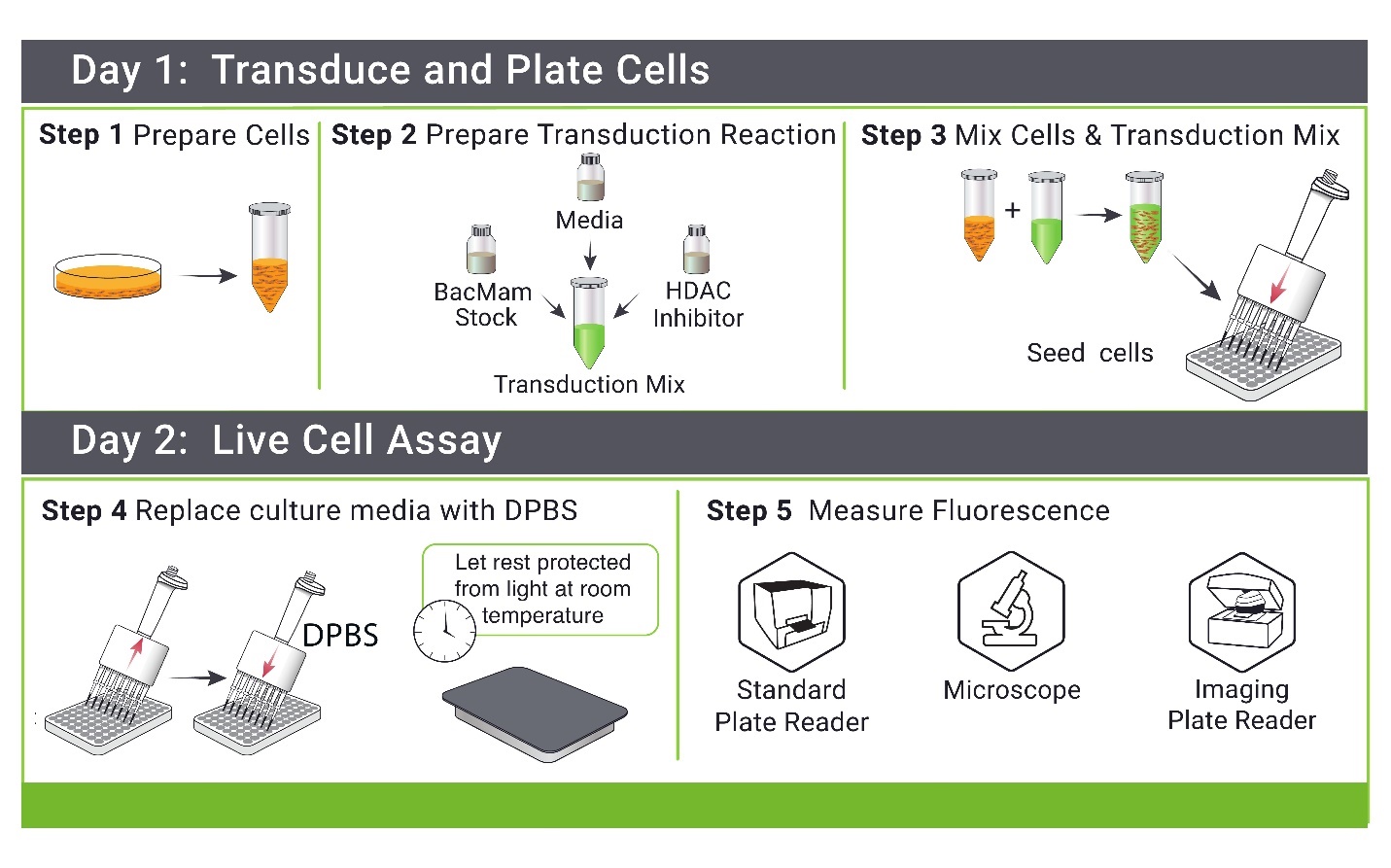
Numerous biosensors have been developed by many laboratories for measuring GPCR signaling (13,38). In this section we exemplify the measurement of GPCR second messengers using fluorescent biosensors developed and/or distributed by Montana Molecular. These sensors were developed to be straightforward to use by those investigators interested in GPCR signaling but not necessarily well-versed in optical biotechnologies. The sensors are bright, enabling detection using standard plate readers. The sensors are delivered using the viral vector Bacmam, which enables highly reproducible and robust expression in numerous cell types. The protocol described here is generally applicable to fluorescent biosensors developed by other laboratories, although the technical details specific to each sensor will vary. A generalized protocol is shown in Figure 3 and video presentations are at https://youtu.be/S-oHwesM37U and https://youtu.be/lTcOdi9wL9E . The protocols below are designed for rapidly-dividing, immortalized cell lines and work especially well in HEK293 cells. However these sensors are often used in primary cultures and iPSC-derived cell lines. The protocols described here are for 96-well assays and are scalable for 384-well format. The sensors are also compatible with detection by fluorescence microscopy and other imaging systems.
paragraph
Order 77
word/document.xml:/w:document[1]/w:body[1]/w:p[73]
One common source of variability in live cell biosensor assays is gene expression. One solution to this issue is the BacMam viral expression system, which produces more consistent expression than a plasmid vector and is a good tool for delivering the biosensor to a wide variety of difficult to transfect cell types. The amount of BacMam used is determined from a preliminary titration experiment as described in Timeframe of Response Measurement. A troubleshooting guide is provided in the supplementary file Troubleshooting guide.
heading
Order 81
Level 4
Style Heading4
word/document.xml:/w:document[1]/w:body[1]/w:p[77]
list
Order 83
Style ListParagraph
word/document.xml:/w:document[1]/w:body[1]/w:p[79]
- Biosensor in BacMam vector (specific sensor for each second messenger specified in Table 1)
list
Order 84
Style ListParagraph
word/document.xml:/w:document[1]/w:body[1]/w:p[80]
list
Order 85
Style ListParagraph
word/document.xml:/w:document[1]/w:body[1]/w:p[81]
- Sodium butyrate (an HDAC inhibitor) (500 mM stock solution)
list
Order 86
Style ListParagraph
word/document.xml:/w:document[1]/w:body[1]/w:p[82]
- Cell culture medium: Eagle’s minimum essential media (EMEM) supplemented with 10% fetal bovine serum (FBS) and penicillin-streptomycin
list
Order 87
Style ListParagraph
word/document.xml:/w:document[1]/w:body[1]/w:p[83]
- Assay buffer: Dulbecco’s phosphate buffered saline (DPBS) supplemented with Ca2+ (0.9 mM) and Mg2+ (0.5 mM). (It is very important that the assay buffer is not autofluorescent, which precludes the use of colored tissue culture media which contain indicator dyes.)
list
Order 88
Style ListParagraph
word/document.xml:/w:document[1]/w:body[1]/w:p[84]
- Microtiter tissue culture plate: Black, clear-bottom, with low autofluorescence, e.g. Greiner Cell Coat (#655946)
heading
Order 91
Level 4
Style Heading4
word/document.xml:/w:document[1]/w:body[1]/w:p[87]
paragraph
Order 93
word/document.xml:/w:document[1]/w:body[1]/w:p[89]
Examples of automated fluorescence plate readers that are ideal for detecting the fluorescent biosensors discussed here include the Synergy MX and Cytation readers from BioTek Instruments (Winooski, VT); CLARIOStar from BMG Labtech (Cary, NC); Enspire from PerkinElmer (Waltham, MA); FDSS from Hamamatsu Photonics (Bridgewater Township, NJ); and Flexstation and FLIPR from Molecular Devices (San Jose, CA).
paragraph
Order 94
word/document.xml:/w:document[1]/w:body[1]/w:p[90]
The green fluorescent sensors are best excited with light between 480 - 510 nm, and most of the emission occurs between 515 - 550 nm. The red fluorescent sensors are best excited at 560 nm (550 - 575) and the emission is captured with either 590 nm long pass filters, or very wide band pass emission filters (590 - 660).
heading
Order 96
Level 4
Style Heading4
word/document.xml:/w:document[1]/w:body[1]/w:p[92]
H4. Cell Culture and Viral Transduction
paragraph
Order 98
word/document.xml:/w:document[1]/w:body[1]/w:p[94]
The transduction protocol below is for HEK293 cells. It can be modified for CHO cells (in which viral transduction efficiency is often lower) and a protocol is provided in the supplementary file CHO cell transduction.
list
Order 100
Style ListParagraph
word/document.xml:/w:document[1]/w:body[1]/w:p[96]
- Detach cells using standard trypsinization protocol. Re-suspend cells in cell culture medium and determine cell count.
list
Order 101
Style ListParagraph
word/document.xml:/w:document[1]/w:body[1]/w:p[97]
- Prepare a dilution of cells at your desired concentration. 100 μl of this cell re-suspension will be required for a single well in a 96-well plate, so prepare enough of the dilution to seed the desired number of wells in the plate. A typical cell number is 50,000 cells per well.
list
Order 102
Style ListParagraph
word/document.xml:/w:document[1]/w:body[1]/w:p[98]
- Prepare viral transduction reaction. Prepare the transduction solution by mixing the appropriate volume of the sensor BacMam stock (as determined from the titration experiment, see Box 1) with 0.6 μl of the sodium butyrate 500 mM stock solution and add cell culture medium for a total volume of 50 μl per well. Mix gently.
list
Order 103
Style ListParagraph
word/document.xml:/w:document[1]/w:body[1]/w:p[99]
- Mix the cells from Step 2 with the transduction mix from Step 3 in a 2:1 ratio, preparing sufficient volume for all the wells of the assay and the dead volume. Mix gently, then dispense 150 μl into the wells of the 96-well plate.
list
Order 104
Style ListParagraph
word/document.xml:/w:document[1]/w:body[1]/w:p[100]
- Cover plate to protect from light and let rest at room temperature for 30 minutes.
list
Order 105
Style ListParagraph
word/document.xml:/w:document[1]/w:body[1]/w:p[101]
- Incubate cells for 20-24 hours under normal growth conditions (5% CO2, 37°C), protected from light.
heading
Order 110
Level 4
Style Heading4
word/document.xml:/w:document[1]/w:body[1]/w:p[106]
H4. Assay for Signal Transduction
list
Order 112
Style ListParagraph
word/document.xml:/w:document[1]/w:body[1]/w:p[108]
- Replace culture medium with 150 μl assay buffer and leave at room temperature for 30 min. During this time, inspect cells for cell health.
list
Order 113
Style ListParagraph
word/document.xml:/w:document[1]/w:body[1]/w:p[109]
- Immediately before addition of stimulating compounds, measure the baseline fluorescence intensity in all the wells at multiple time points for five minutes. This baseline recording is necessary for the data normalization step in Data Normalization below.
list
Order 114
Style ListParagraph
word/document.xml:/w:document[1]/w:body[1]/w:p[110]
- Add stimulating compound to the wells in assay buffer in a volume of 50 μl, and immediately commence reading the fluorescence intensity. Measure repeatedly, with the read frequency appropriate for the time course of the response (see Timeframe of Response Measurement).
list
Order 115
Style ListParagraph
word/document.xml:/w:document[1]/w:body[1]/w:p[111]
- Continue reading fluorescence intensity until the response level has stabilized or decayed back to baseline.
heading
Order 117
Level 4
Style Heading4
word/document.xml:/w:document[1]/w:body[1]/w:p[113]
paragraph
Order 118
word/document.xml:/w:document[1]/w:body[1]/w:p[114]
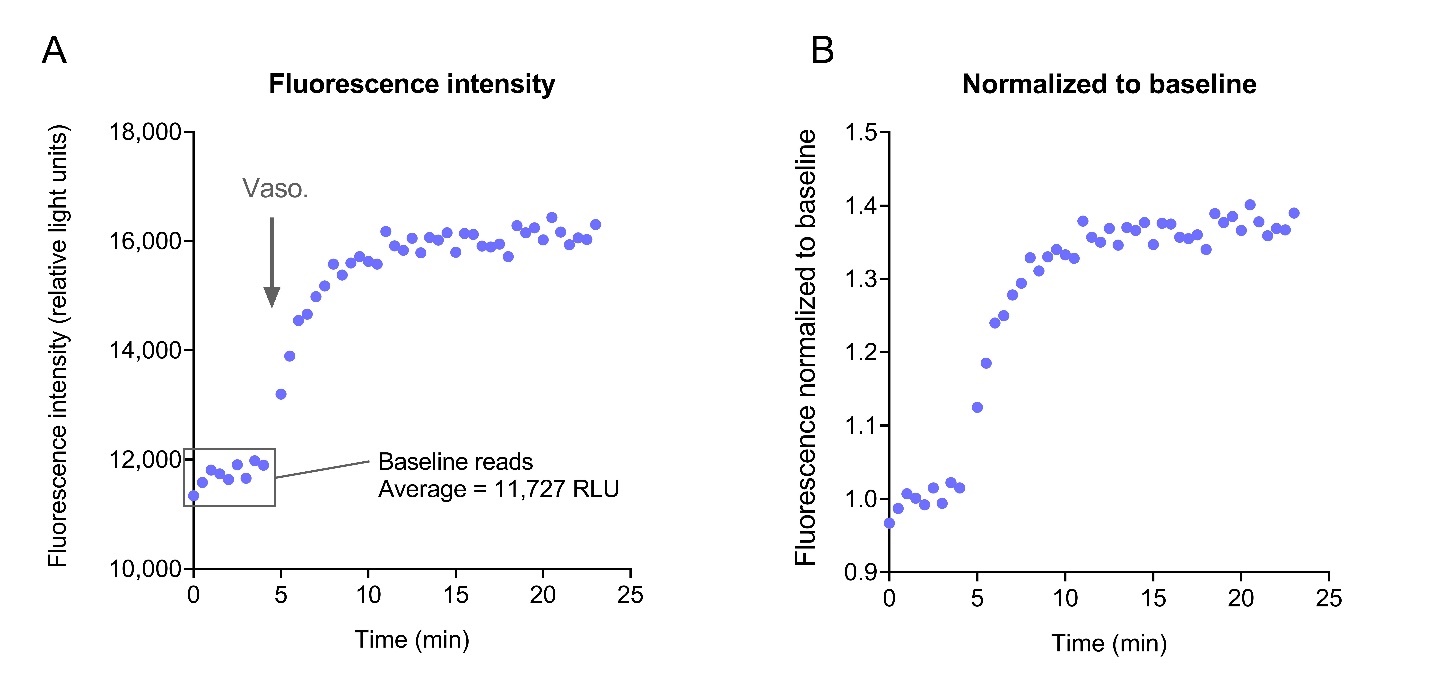
The raw data generated by the reader is fluorescence intensity in relative light units. It is standard practice in the biosensor field to normalize these data before they are further analyzed (Figure 4). The type of normalization used is normalization to baseline. Baseline means the fluorescence intensity before the addition of a stimulating ligand. (This is why the baseline is recorded, as described in Assay for Signal Transduction.) The average of the fluorescence intensity readings before ligand addition is taken as the baseline (Figure 4). Then the fluorescence intensity after ligand addition is divided by this mean baseline signal (Figure 4). This metric is described as “Fluorescence normalized to baseline“ and is often termed F / F in the biosensor literature. The data are handled in this way because it enables a convenient intra-well control, minimizing error due to any slight well-to-well differences in the number of cells or amount of sensor.
paragraph
Order 119
word/document.xml:/w:document[1]/w:body[1]/w:p[115]
Biosensor responses can sometimes be difficult to interpret because of the use of downward sensors (which decrease in signal as the analyte increases) and also because some GPCRs signals are inhibitory (for example the decrease of cAMP produced by Gi). We advocate normalizing the data in such a way that the signal value reflects the concentration of the analyte being detected. In other words, the direction of the sensor data should be the same as the direction of the analyte concentration. This means that for downward sensors we convert the downward baseline-normalized fluorescence values to upward values. In this way, an increase of the signaling analyte is represented by an increase of the biosensor response value. The conversion can be done as follows:
paragraph
Order 120
Style Equation
word/document.xml:/w:document[1]/w:body[1]/w:p[116]
paragraph
Order 123
word/document.xml:/w:document[1]/w:body[1]/w:p[118]
This formula yields upward data with baseline equal to 1.
paragraph
Order 124
word/document.xml:/w:document[1]/w:body[1]/w:p[119]
This normalization recommendation means that when the signal itself is inhibitory, e.g. inhibition of cAMP by Gi, the signal will decrease in response to the agonist. This results in the Y value of the time course decreasing over time (see for example Figure 5).
heading
Order 127
Level 4
Style Heading4
word/document.xml:/w:document[1]/w:body[1]/w:p[122]
H4. Timeframe of Response Measurement
paragraph
Order 129
word/document.xml:/w:document[1]/w:body[1]/w:p[124]
The timeframe of the response varies considerably between the signaling molecules being measured, the receptor being tested, and the host cell type. Because it is being measured in live cells in real time, the signal is susceptible to the cellular mechanisms that change the signal over time. Some signaling analytes are transient - they are rapidly cleared by the cell and the duration of the signal is short (for example, Ca2+ and DAG, which can be cleared within a couple of minutes, Figure 6). For these analytes, it can be erroneously concluded there is no signal if the biosensor response is measured at 10 minutes as the first time point; by this time, Ca2+ and DAG are usually completely cleared (Figure 6). This exemplifies that some knowledge of the signaling time course is required when using the sensor for the first time. Fortunately, the typical time ranges are well established for the familiar signaling molecules measured in this study (cAMP, DAG, PIP2 and Ca2+). The time ranges are given in Table 1 and illustrated in the graphs in Figures 4-6.
paragraph
Order 130
word/document.xml:/w:document[1]/w:body[1]/w:p[125]
Another aspect of the timeframe is that it is desirable to record long enough to capture the entire time course curve shape (the waveform), particularly for rise-and-fall curve shapes. This means recording until the level of response has stabilized (or disappeared for transient responses). As detailed in ref. (37), fitting data to a waveform equation can provide estimates of regulation of signaling rate constants such as the rate of receptor desensitization. This requires the entire waveform to be collected, for example, for the level of the plateau to be well defined (Figure 6B and D). It is recommended the data be collected for as long as possible (given there is no extra cost using this continuous read modality), within the constraints of cell health, environmental control of the cells, and photobleaching.
heading
Order 132
Level 4
Style Heading4
word/document.xml:/w:document[1]/w:body[1]/w:p[127]
H4. Determining Amount of Biosensor in a Titration Experiment
paragraph
Order 133
word/document.xml:/w:document[1]/w:body[1]/w:p[128]
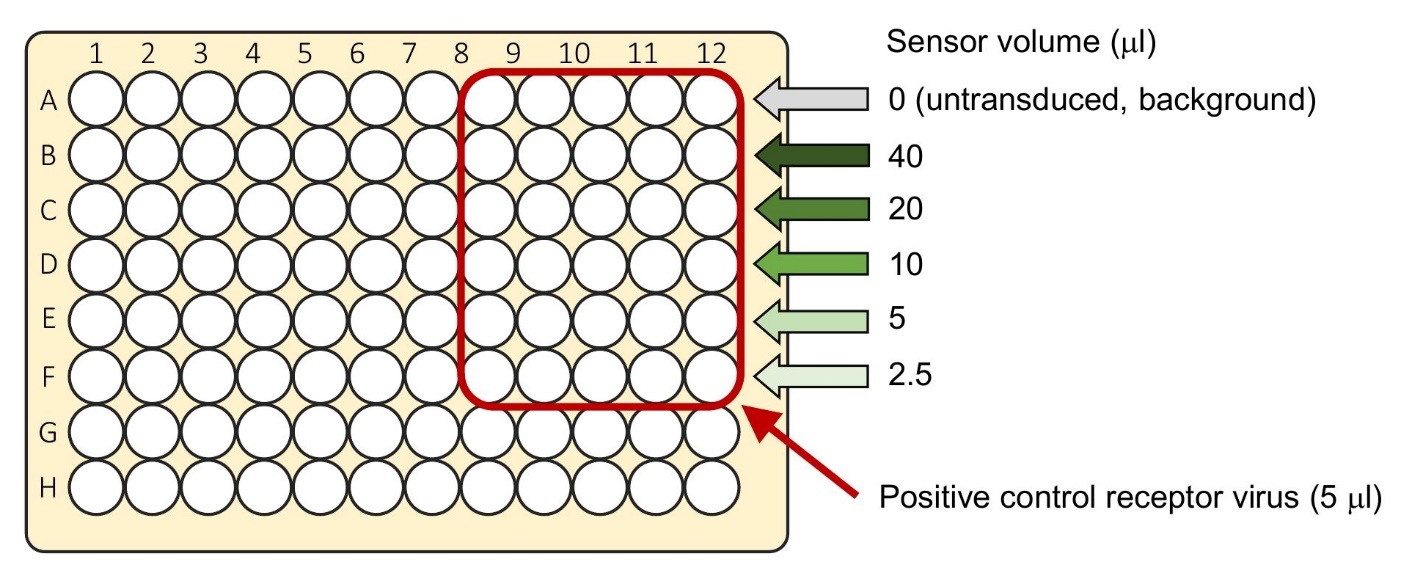
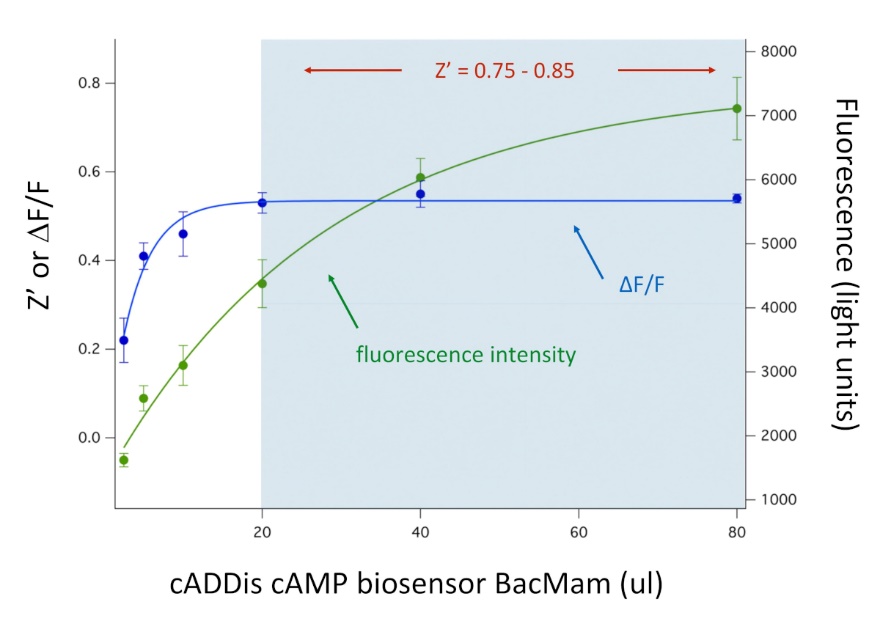
The optimal amount of biosensor is dependent on numerous experimental variables including the cell type, plate format, and GPCR type. This variability is too great to permit a single amount of sensor to be recommended, however an initial titration experiment is done to determine the optimum number of virus units applied in the transduction step. A stock solution is supplied with commercially-available kits that is within range of the optimum for most applications. The titration experiment applies various volumes of this stock in order that the optimum volume can be determined. The experiment is detailed in Box 1.
heading
Order 134
Level 3
Style Heading3
word/document.xml:/w:document[1]/w:body[1]/w:p[129]
H3. cAMP biosensor properties
heading
Order 136
Level 4
Style Heading4
word/document.xml:/w:document[1]/w:body[1]/w:p[131]
paragraph
Order 138
word/document.xml:/w:document[1]/w:body[1]/w:p[133]
In the cAMP signaling cascade, GPCRs stimulate cAMP production by first activating Gs-family G-proteins, which then go on to activate adenylyl cyclase, resulting in the production of cAMP. Numerous biosensors have been developed for detecting changes in cAMP concentration in living cells (13,38,60). These typically couple a protein that naturally binds cAMP with a second module that transduces cAMP binding into a light signal. Examples include the cADDis sensor family (61) (“cAMP difference detector in situ”). These sensors incorporate red or green fluorescent proteins into the cAMP-binding protein EPAC2 (Figure 2). Binding of cAMP causes an increase or decrease of fluorescence intensity, depending on the sensor variant (listed in Table 1). These sensors are very bright, and designed to be used in plate-based assays for drug discovery applications, such as lead optimization. The performance of the cADDis sensors has been evaluated using the Z’ statistic. Typically, values of 0.6-0.9 have been observed. One important difference between biosensor assays and the more traditional endpoint measurements of cAMP is the absence (typically) of phosphodiesterase inhibitors when using biosensors. This enables the kinetics of cAMP to be detected in a more physiological context.
paragraph
Order 139
word/document.xml:/w:document[1]/w:body[1]/w:p[134]
Representative data for the sensor Red Up cADDis are shown in Figure 4, for cAMP production via the V2 vasopressin receptor stimulated by vasopressin. Before addition of the vasopressin, the average fluorescence intensity was 11,727 relative light units (RLU) (Figure 4A). After addition of vasopressin the fluorescence intensity increased. The time course shape was an exponential association curve - there was an initial rapid increase then the rate slowed then finally the fluorescence intensity approached a plateau (Figure 4A). The highest fluorescence intensity at the plateau was 16,431 RLU. The data were normalized to baseline as described in Data Normalization. The time course of baseline-normalized fluorescence is shown in Figure 4B, indicating an increase from 1.0 (the baseline) to 1.41 at the plateau.
paragraph
Order 140
word/document.xml:/w:document[1]/w:body[1]/w:p[135]
The timeframe of the V2 receptor response was about 20 minutes (Figure 4). The initial rise phase took place within the first 2 min and the plateau was reasonably well defined 20 min after ligand addition. The frequency of measurement was every 30 seconds in this experiment, which was sufficient to capture the waveform. For complete kinetic analysis, 30 second reads for 60 minutes is sufficient to capture the signaling dynamics for most Gs responses. In some cases, the curve shape is a rise-and-fall curve, where the fluorescence intensity rises to a peak then declines, either to a new plateau (Figure <?escape?>8D) or to zero (Figure <?escape?>8C).
paragraph
Order 141
word/document.xml:/w:document[1]/w:body[1]/w:p[136]
Detailed protocols and videos can be found at the following links:
paragraph
Order 142
word/document.xml:/w:document[1]/w:body[1]/w:p[137]
paragraph
Order 143
word/document.xml:/w:document[1]/w:body[1]/w:p[138]
heading
Order 146
Level 4
Style Heading4
word/document.xml:/w:document[1]/w:body[1]/w:p[141]
paragraph
Order 148
word/document.xml:/w:document[1]/w:body[1]/w:p[143]
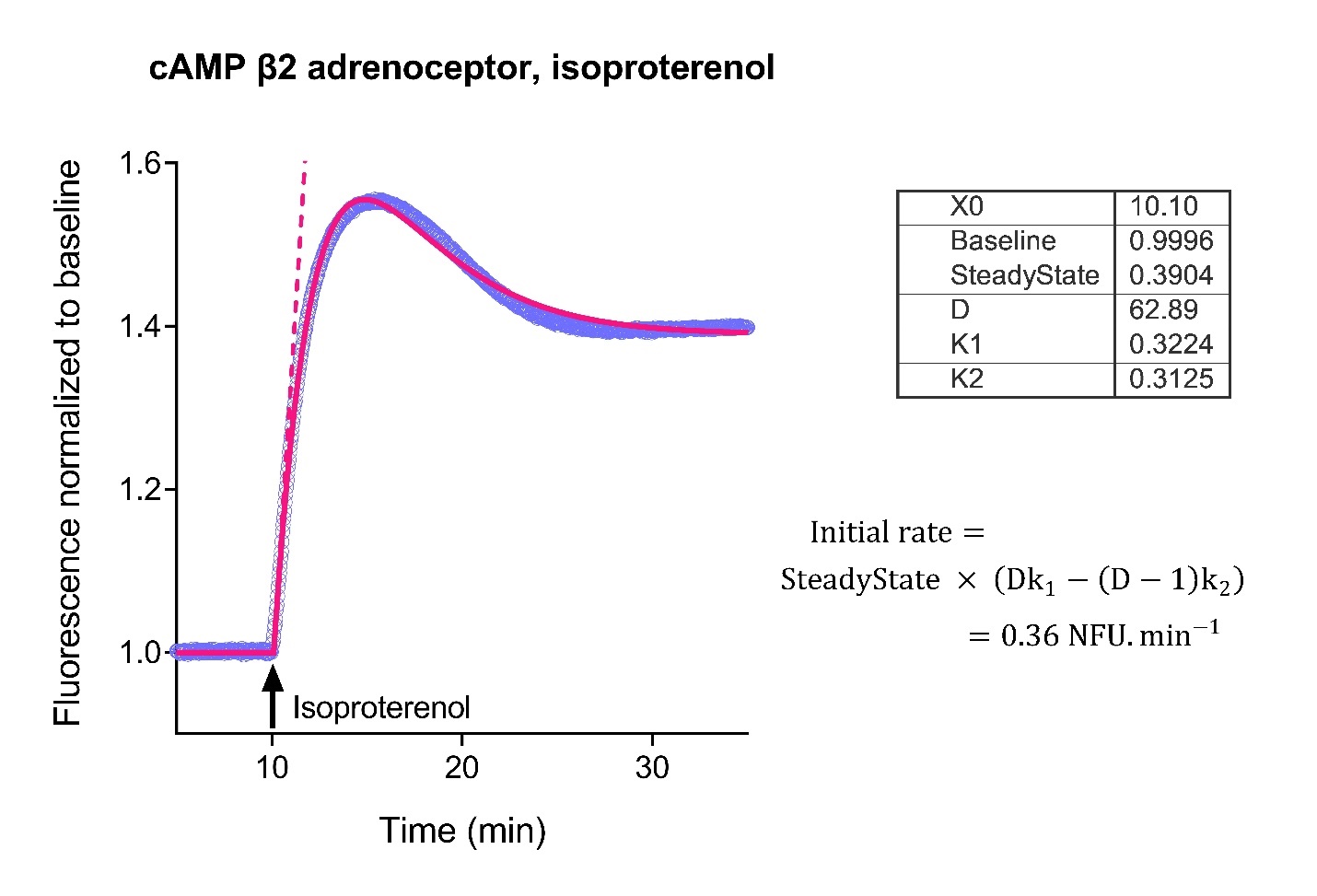
As is well known, some GPCRs inhibit the production of cAMP. This results from the GPCR activating Gi-family G-proteins, which go on to inhibit adenylyl cyclase activity. cAMP biosensors have been used to record this inhibition of cAMP production resulting from Gi signaling. The assay requires the presence of a stimulating agent that generates a cAMP signal, which can then be inhibited by Gi-activated receptors. The stimulating agents typically used include forskolin, which binds adenylyl cyclase and activates it; and isoproterenol, which generates cAMP via the Gs pathway activated by the 2 adrenergic receptor (endogenously expressed on most cell types, including HEK293 cells).
paragraph
Order 149
word/document.xml:/w:document[1]/w:body[1]/w:p[144]
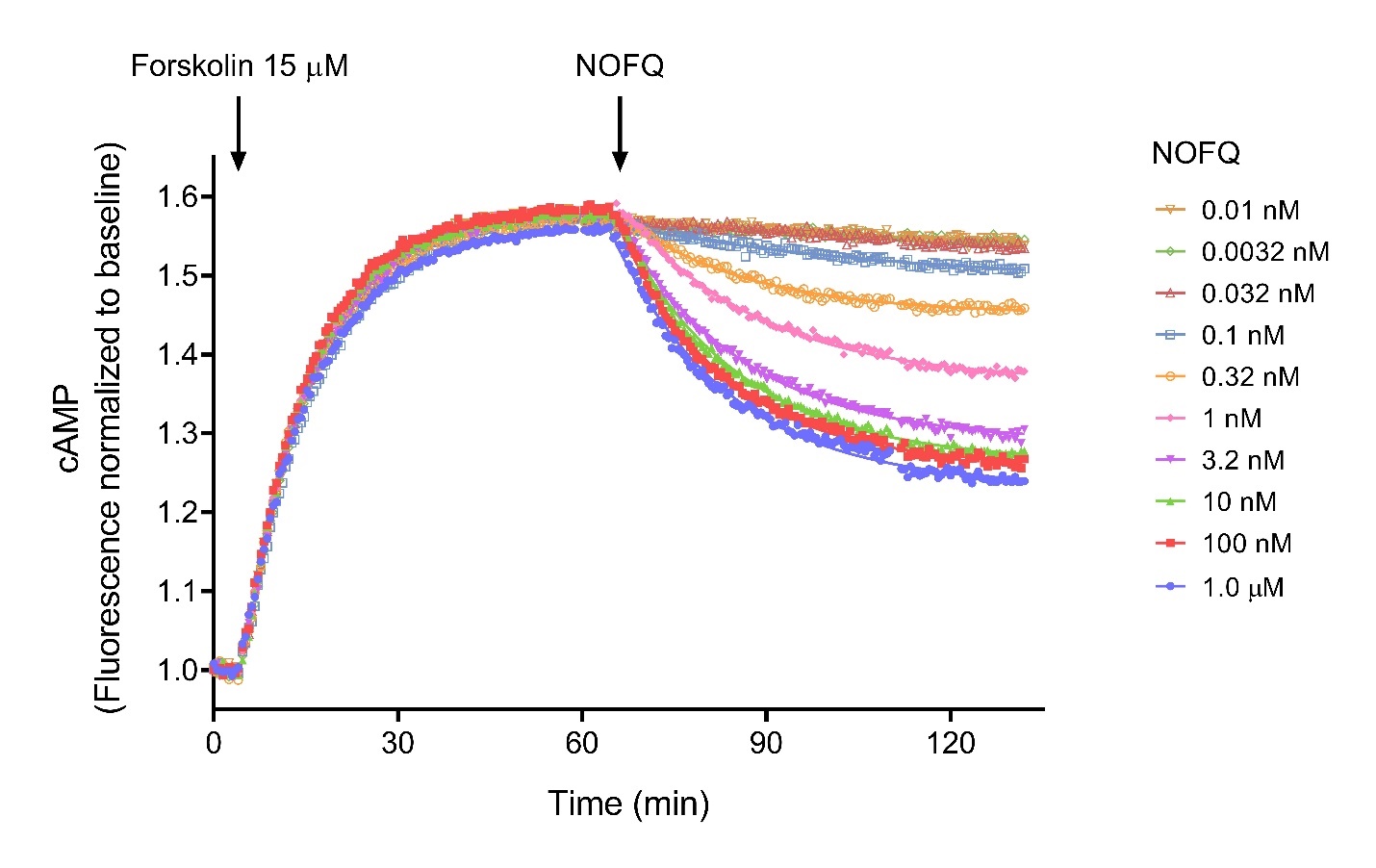
An example employing forskolin is shown in Figure 5, for the Gi-coupled nociceptin/orphanin FQ NOP receptor. Forskolin stimulates cAMP production, then upon addition of the receptor agonist NOFQ there is a dose-dependent reduction of cAMP (Figure 5). Traditionally in cAMP assays, forskolin and the receptor ligand are added simultaneously, or there is a short pre-incubation with forskolin. While this approach works for end-point assays, for kinetic analysis experiments it is best to pre-incubate with forskolin until a steady-state of cAMP has been reached, and then add the test compound. (Determining this is readily achievable using the continuous-read capability of the biosensors - the plate is simply left in the reader and the signal observed until the plateau level of cAMP response has been reached.) This is shown in the time course data in Figure 5. This greatly simplifies the kinetic data analysis because it removes the kinetics of forskolin activity from the equations (since this activity has reached steady-state when the test compound is added).
paragraph
Order 150
word/document.xml:/w:document[1]/w:body[1]/w:p[145]
An alternative method is to employ a constitutively-active Gs G-protein to stimulate cAMP production (62). The day before assay, cells are co-transduced with the cAMP biosensor and a mutant Gs alpha protein that tonically activates adenylyl cyclase. There are pros and cons with this method. It is unfamiliar to most investigators and it requires more assay development to optimize expression of both biosensor and mutant Gs. However, for those investigators committed to quantifying the kinetics of Gi signaling, it offers the substantial benefit to assay workflow of avoiding the pre-incubation with the forskolin step; the test compound is simply applied by itself and Gi activity recorded by the reduction of the tonically-elevated cAMP produced by the mutant G-protein.
paragraph
Order 151
word/document.xml:/w:document[1]/w:body[1]/w:p[146]
heading
Order 155
Level 3
Style Heading3
word/document.xml:/w:document[1]/w:body[1]/w:p[150]
H3. Calcium Signaling Pathway Biosensors
paragraph
Order 157
word/document.xml:/w:document[1]/w:body[1]/w:p[152]
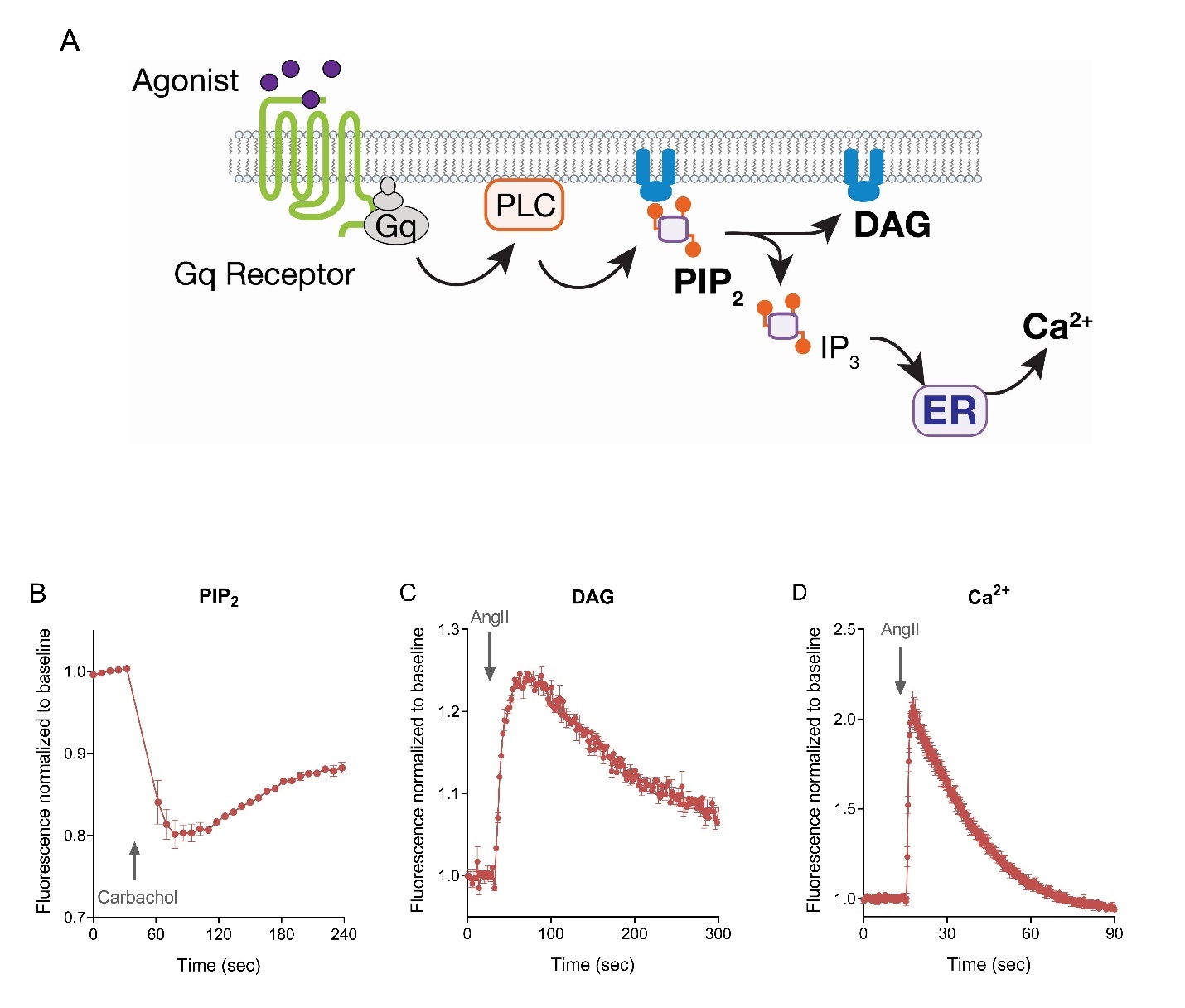
GPCRs stimulate Ca2+ signaling pathways via Gq/11-family G-proteins. In this pathway, shown in Figure 6A, the G-protein activates the enzyme phospholipase C, which converts its substrate phosphatidylinositol 4,5-bisphosphate (PIP2) to inositol 1,4,5-trisphosphate (IP3) and diacyglycerol (DAG). IP3 then binds to and opens Ca2+ channels in the endoplasmic reticulum, resulting in a rapid, large increase in cytoplasmic Ca2+ concentration. Numerous biosensors have been engineered to detect the signaling molecules in this pathway, including PIP2, DAG and Ca2+ (13,38).
paragraph
Order 159
word/document.xml:/w:document[1]/w:body[1]/w:p[153]
Three biosensors for this pathway are shown in Figure 6. The PIP2 sensor (Figure 6A) is formed of dimerization-dependent green fluorescent proteins (48) (Green PIP2, Table 1). The DAG sensor (Figure 6B) is formed of the DAG substrate PKC𝛿 fused to a circularly permuted green fluorescent protein (63) (Green Up DAG, Table 1). The Ca2+ sensor GECO (Figure 6C), developed by Campbell and colleagues, is formed of calmodulin, the M13 peptide, and circularly permuted mApple (64) (Red GECO, Table 1). The choice of sensor will be dependent on issues including the research question, therapeutic relevance in a compound screen, sensitivity for detecting partial agonists, and assay performance for the GPCR target. Of interest, these sensors can be multiplexed, i.e. two sensors can be expressed in the same cells, and this allows simultaneous interrogation of two points on the same pathway (63).
paragraph
Order 160
word/document.xml:/w:document[1]/w:body[1]/w:p[154]
The time course of the sensor response for all three sensors is both short and reversible (Figure 6B-D). These are transient responses, not accumulation responses, so care must be taken to collect the data in the appropriate time range. DAG and Ca2+ increase in response to agonist, whereas PIP2 decreases because it is the substrate for PLC. The first phase is very rapid, occurring within seconds, so if possible time points should be collected on the second timescale (see Figures 6, <?escape?>11 and <?escape?>12). For accurate quantification of the kinetics by curve fitting (see Analyzing Signaling Time Course Data) we have used a recording frequency of 0.25 seconds using a plate reader (Figure <?escape?>12). The DAG and Ca2+ response peaks and then rapidly declines. The PIP2 response troughs and then rises. For DAG and Ca2+ the response returns either to baseline or close to it (Figure 6C,D), whereas for PIP2 the response approaches a plateau (Figure 6B). The whole signaling event is complete within 2-5 minutes.
paragraph
Order 161
word/document.xml:/w:document[1]/w:body[1]/w:p[155]
Detailed protocols and videos are available at the links in Table 1.
heading
Order 165
Level 3
Style Heading3
word/document.xml:/w:document[1]/w:body[1]/w:p[159]
paragraph
Order 167
word/document.xml:/w:document[1]/w:body[1]/w:p[161]
The arrestin proteins are principal regulators of GPCR signaling (14,18) . Arrestins can block G-protein signaling and in this way prevent overstimulation of the cell, through the classical process of receptor desensitization. In this process, the agonist-bound GPCR becomes phosphorylated by kinase enzymes and subsequently interacts with arrestin. Arrestins can also mediate downstream signaling, acting as scaffolding proteins to recruit signaling molecules such as extracellular signal–regulated kinase, or translocating the receptor to endosomes to enable persistent signaling (19,65).
paragraph
Order 168
word/document.xml:/w:document[1]/w:body[1]/w:p[162]
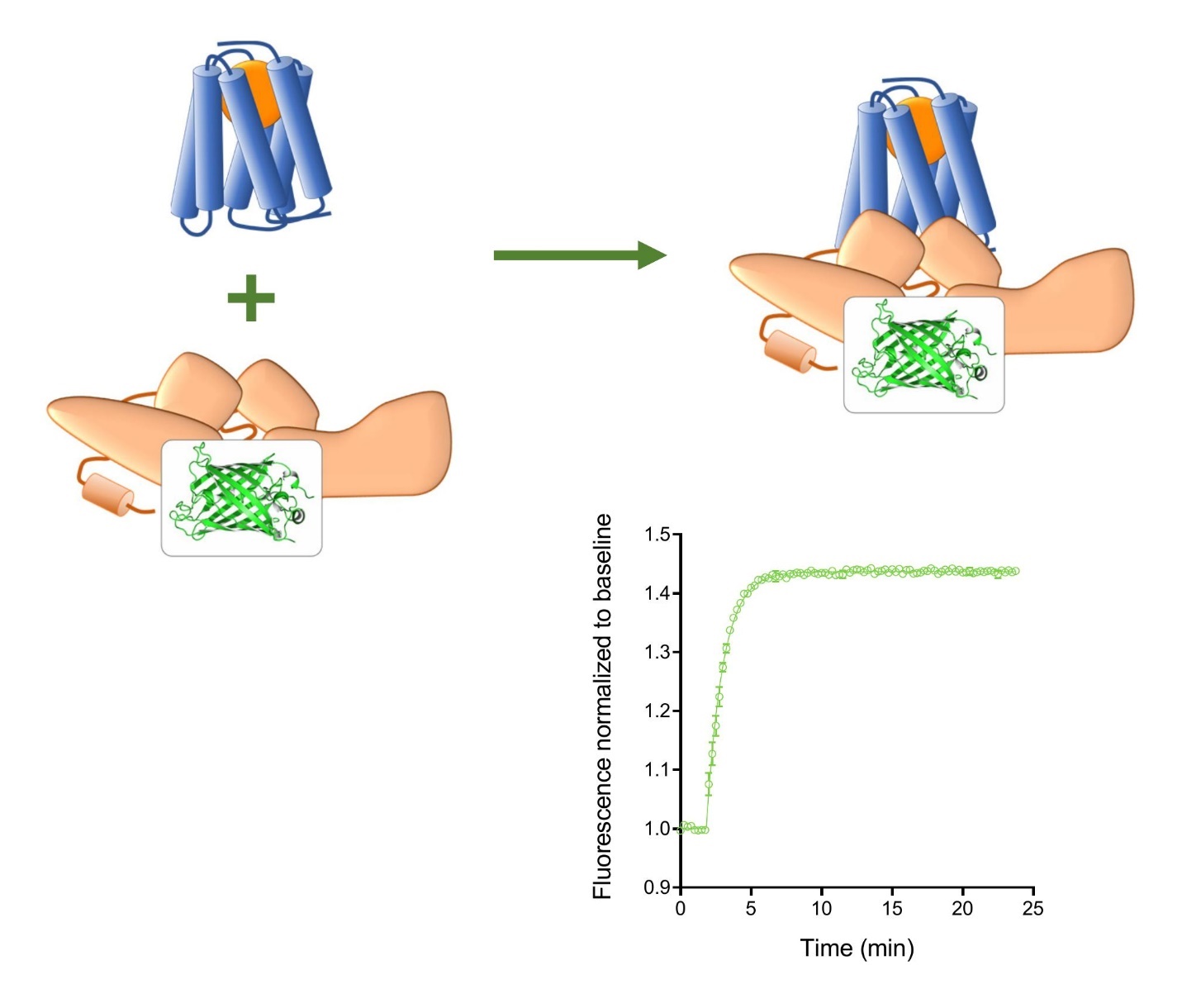
Numerous assays for measuring the arrestin pathway have been created (66). Resonance energy-transfer sensors have been utilized, for example refs (11,67). The direct fluorescence modality described in this chapter is ideal for measuring the kinetics of receptor-arrestin interaction. We developed a sensor that directly reports receptor-arrestin interaction, in which the receptor interaction changes fluorescence intensity of a modified arrestin-3 ( arrestin-2) incorporating the fluorescent mNeonGreen protein (Figure 7A) (29). There is no time delay between the interaction event and the signal generation, the signal generation by the fluorescent protein occurring almost instantly. This is in contrast to enzyme complementation or reporter gene assays where there is a temporal disconnect between the interaction and the signal recording, and BRET-based assays where it can take time for sufficient light to build up to be measured robustly. The continuous read capability of the fluorescence modality enables the kinetics to be efficiently recorded. However, the absence of signal amplifying steps in this direct measurement of arrestin interaction impacts arrestin sensor sensitivity. Robust windows of response have been recorded in plate readers for GPCRs that strongly couple to arrestin (e.g. the AT1 receptor), while the responses are smaller for GPCRs known to couple more weakly (2 adrenergic receptor) (29). Further optimization of the arrestin sensor is ongoing, and needed to increase the signal for weaker interactions.
paragraph
Order 169
word/document.xml:/w:document[1]/w:body[1]/w:p[163]
Figure 7B shows the data obtained with the arrestin sensor and the AT1 receptor, in response to AngII. Arrestin recruitment rises rapidly at first then approaches a plateau for this receptor. The rise phase occurs within a couple of minutes and the response reaches steady state within 20 minutes of application. A read interval of 30 seconds and a read time of up to 60 minutes captures the waveform of arrestin recruitment for most receptors examined. (In some cases the signal declines from a peak.) The robustness of the sensor response has been quantified using the Z’ statistic. For the AT1 receptor, Z’ values approaching 0.9 have been obtained.
heading
Order 174
Level 2
Style Heading2
word/document.xml:/w:document[1]/w:body[1]/w:p[168]
H2. Analyzing Signaling Time Course Data
paragraph
Order 176
word/document.xml:/w:document[1]/w:body[1]/w:p[170]
The goal of this section is to demonstrate how to measure the initial rate of signaling and the k parameter (initial rate stimulated by agonist-bound receptor). This requires an explanation for why we use the initial rate analysis; a description of the curve shapes encountered in the time course data for GPCR signaling; and an overview of how the initial rate can be estimated by curve fitting.
heading
Order 178
Level 3
Style Heading3
word/document.xml:/w:document[1]/w:body[1]/w:p[172]
H3. Why Use the Initial Rate?
paragraph
Order 180
word/document.xml:/w:document[1]/w:body[1]/w:p[174]
The biosensor technology enables the time course of signaling to be measured in an efficient, streamlined manner. Now a data analysis method is required in order to reduce the time course data set to useful drug parameters that describe the kinetics of signaling. This reduction strategy is familiar in pharmacology generally. For example, concentration-response data are analyzed using the sigmoid curve equation, reducing the dataset to the pharmacological parameters EC50 and Emax (68). A useful parameter that can be extracted from time course data is the initial rate of signaling, analogous to the initial rate of enzyme activity (37). This parameter has several benefits. First, it is biologically-meaningful, being the initial burst of signaling by the receptor. Second, it can be measured regardless of the shape of the time course, providing a common metric across different responses (e.g. Ca2+ mobilization and arrestin recruitment, see below). Third, from a receptor theory perspective it is likely a pure efficacy parameter, being minimally impacted by regulation of signaling mechanisms that impact the later part of the time course. Finally, from a practical perspective the initial rate is a familiar concept for investigators who learned the basics of enzyme kinetics in undergraduate biochemistry courses.
heading
Order 182
Level 3
Style Heading3
word/document.xml:/w:document[1]/w:body[1]/w:p[176]
H3. Time Course Curve Shapes
paragraph
Order 184
word/document.xml:/w:document[1]/w:body[1]/w:p[178]
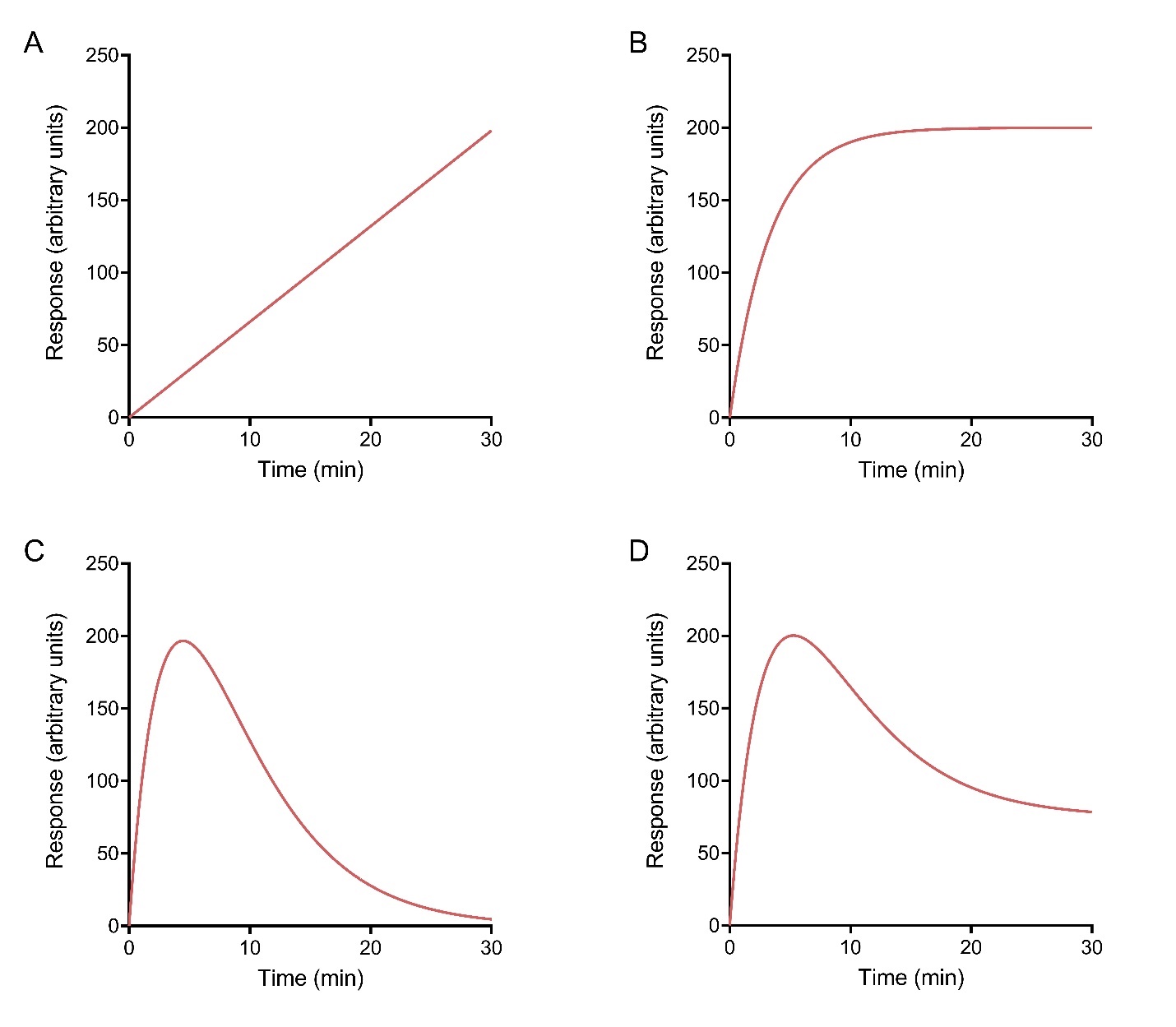
Kinetic data take the form of time course plots, where activity is measured over a range of time points. Analyzing time course data is more complicated than analyzing concentration-response data. The latter conform to just a single curve shape, the sigmoid curve, which is almost universally analyzed using the sigmoid curve equation. By contrast, time course data do not conform to a single shape. Fortunately, however, the number of shapes is limited to just four (37). Two of these are familiar, and all four are amenable to analysis in standard curve-fitting software. The four curve shapes for responses that initially increase are shown in Figure 8 and are:
list
Order 185
Style ListParagraph
word/document.xml:/w:document[1]/w:body[1]/w:p[179]
- The straight line. Response increases continuously over time, without limit (Figure 8A).
list
Order 186
Style ListParagraph
word/document.xml:/w:document[1]/w:body[1]/w:p[180]
- The association exponential curve. Response increases rapidly at first, then slows, then approaches a limit at which the level of the response remains constant over time (Figure 8B)
list
Order 187
Style ListParagraph
word/document.xml:/w:document[1]/w:body[1]/w:p[181]
- The rise-and-fall to baseline curve. Response rises to a peak, then falls, eventually declining to the baseline response before addition of ligand (Figure 8C).
list
Order 188
Style ListParagraph
word/document.xml:/w:document[1]/w:body[1]/w:p[182]
- The rise-and-fall to steady-state curve. Responses rises, peaks, then declines to a steady-state level that is above the baseline (Figure 8D).
paragraph
Order 190
word/document.xml:/w:document[1]/w:body[1]/w:p[184]
Different formats of these curve shapes are often observed and a comprehensive list of the formats and equations is provided in the supplementary file Time course equation list. First, descending versions of these four curve shapes are observed when the receptor stimulates a decreases of signaling molecules / responses, e.g. inhibition of cAMP by Gi stimulation (Figure 5). Second, there is usually a baseline run-in period in biosensor assays (before the addition of receptor agonist) and this can be incorporated into the equation used to analyze the data (see below). Finally, occasionally the baseline drifts upwards or downwards over time and this too can be incorporated into the analysis (see Example 2: Ca2+ Mobilization via the AT1 Receptor). These equations are available in Prism templates which can be downloaded from this Google Drive.
paragraph
Order 196
word/document.xml:/w:document[1]/w:body[1]/w:p[189]
The time course curve shape is sculpted by regulation of signaling mechanisms (37,69-71). GPCR signaling is regulated, to limit the level of response and prevent over-stimulation of the cell. The canonical mechanisms are receptor desensitization (14,18) (involving receptor phosphorylation and arrestin binding) and signal degradation (for example, metabolism of second messengers, such as breakdown of cAMP by phosphodiesterases (72)). The shape is dependent on the number and nature of the regulation mechanisms (37). Without regulation, the signal increases indefinitely (the linear profile). A single regulation mechanism limits the signal to an association exponential curve - rather than continuing indefinitely, the signal level reaches a steady-state. When both mechanisms are in operation, the rise-and-fall curve results - the signal is transient, peaking then falling to zero. More complicated mechanisms result in the rise-and-fall to steady-state curve, including signaling by internalized receptors and receptor resensitization (37).
heading
Order 199
Level 3
Style Heading3
word/document.xml:/w:document[1]/w:body[1]/w:p[192]
H3. Equations Defining the Time Course Curve Shapes
paragraph
Order 201
word/document.xml:/w:document[1]/w:body[1]/w:p[194]
Each of the curve shapes is defined by an equation that can be used to fit the data. The equation contains parameters that define the curve. The curve fitting procedure provides fitted values of these parameter values. These values are then used to calculate the initial rate. The equations are used in familiar curve fitting software, e.g. Prism (GraphPad Software, Inc.), SigmaPlot (Systat Software, Inc.) and XLfit (ID Business Solutions Ltd.). They are either built-in or can be entered as user-defined equations. In this chapter we exemplify the analysis methods using Prism version 8, but they can be applied using any suitable curve-fitting program. The general form of the equations are written below and a complete set of equations is provided in the supplementary file Time course equation list. Note the equations are likely to be formatted slightly differently depending on the software used. Note also the baseline (i.e. signal without ligand) is assumed to be constant over time in the equations immediately below. (Equations that allows for baseline drift, as may occur with photobleaching, are in Example 2: Ca2+ Mobilization via the AT1 Receptor.) The equations are:
paragraph
Order 203
word/document.xml:/w:document[1]/w:body[1]/w:p[196]
paragraph
Order 204
Style Equation
word/document.xml:/w:document[1]/w:body[1]/w:p[197]
paragraph
Order 205
Style Equation
word/document.xml:/w:document[1]/w:body[1]/w:p[198]
paragraph
Order 206
word/document.xml:/w:document[1]/w:body[1]/w:p[199]
where Y is response, Slope is the gradient of the line and t is the time of response measurement. Baseline is the response in the absence of ligand.
paragraph
Order 208
word/document.xml:/w:document[1]/w:body[1]/w:p[201]
Association exponential curve (Eq. 2):
paragraph
Order 210
Style Equation
word/document.xml:/w:document[1]/w:body[1]/w:p[203]
Y=SteadyState×1-e-kt + Baseline
paragraph
Order 211
Style Equation
word/document.xml:/w:document[1]/w:body[1]/w:p[204]
paragraph
Order 212
word/document.xml:/w:document[1]/w:body[1]/w:p[205]
where SteadyState is the steady-state response, specifically the ligand-specific response as time approaches infinity. Note the Y asymptote value (as time approaches infinity) is SteadyState + Baseline. k is the observed rate constant in units of t-1.
paragraph
Order 214
word/document.xml:/w:document[1]/w:body[1]/w:p[207]
Rise-and-fall to baseline curve (Eq. 3):
paragraph
Order 216
Style Equation
word/document.xml:/w:document[1]/w:body[1]/w:p[209]
Y=Ck1-k2e-k2t-e-k1t + Baseline
paragraph
Order 217
Style Equation
word/document.xml:/w:document[1]/w:body[1]/w:p[210]
paragraph
Order 218
word/document.xml:/w:document[1]/w:body[1]/w:p[211]
where C is a fitting constant in units of Y units.t-1 and k1 and k2 are observed rate constants in units of t-1.
paragraph
Order 220
word/document.xml:/w:document[1]/w:body[1]/w:p[213]
Rise-and-fall to steady-state time curve (Eq. 4):
paragraph
Order 222
Style Equation
word/document.xml:/w:document[1]/w:body[1]/w:p[215]
Y=SteadyState×1-De-k1t+D-1e-k2t + Baseline
paragraph
Order 223
Style Equation
word/document.xml:/w:document[1]/w:body[1]/w:p[216]
paragraph
Order 224
word/document.xml:/w:document[1]/w:body[1]/w:p[217]
where D is a fitting constant (that is unitless).
paragraph
Order 226
word/document.xml:/w:document[1]/w:body[1]/w:p[219]
Note the equations are for responses that initially rise over time. The corresponding equations for responses that initially fall over time are in the supplementary file Time course equation list.
paragraph
Order 227
word/document.xml:/w:document[1]/w:body[1]/w:p[220]
Many of the equations are not included as built-in equations in curve fitting software and instead are entered as custom equations. This is easy to do in the program Prism and an overview of the custom equations and how they are entered is provided in the supplementary files Time course equation list and Loading equations into Prism from a file. Prism files containing all the equations can be downloaded from this Google Drive.
heading
Order 230
Level 3
Style Heading3
word/document.xml:/w:document[1]/w:body[1]/w:p[223]
H3. Curve Fitting Strategy for Measuring the Initial Rate
paragraph
Order 232
word/document.xml:/w:document[1]/w:body[1]/w:p[225]
The familiar method for measuring the initial rate is to examine the time course and then select the “linear portion of the curve”, that region of the time course at the earliest time points when the response increases linearly over time. Unfortunately, this method does not work well for GPCR signaling because the response rapidly deviates from linearity, owing to regulation of signaling mechanisms (37). A second issue is that manual selection of the linear time points is not suitable for high-throughput analysis and is prone to selection bias. An alternative method, described here, utilizes the whole time course data set and comprises two parts (37). First, the whole time course data set is fit to the relevant time course equation and the fitted parameter values obtained. Second, the fitted parameter values are entered into a formula that calculates the initial rate value. These initial rate values are then used to calculate k. This process is summarized in Table 2 and exemplified below using biosensor time course data. Step-by-step guides for how to do the analysis in Prism are provided in supplementary files.
paragraph
Order 233
word/document.xml:/w:document[1]/w:body[1]/w:p[226]
The formulas for calculating the initial rate from the curve fit parameter values are:
paragraph
Order 235
word/document.xml:/w:document[1]/w:body[1]/w:p[228]
Straight line initial rate (Eq. 5):
paragraph
Order 236
Style Equation
word/document.xml:/w:document[1]/w:body[1]/w:p[229]
paragraph
Order 238
word/document.xml:/w:document[1]/w:body[1]/w:p[231]
Association exponential curve (Eq. 6):
paragraph
Order 239
Style Equation
word/document.xml:/w:document[1]/w:body[1]/w:p[232]
Initial rate = k × SteadyState Eq. 6
paragraph
Order 241
word/document.xml:/w:document[1]/w:body[1]/w:p[234]
Rise-and-fall to baseline curve (Eq. 7):
paragraph
Order 242
Style Equation
word/document.xml:/w:document[1]/w:body[1]/w:p[235]
paragraph
Order 244
word/document.xml:/w:document[1]/w:body[1]/w:p[237]
Rise-and-fall to steady-state time curve (Eq. 8):
paragraph
Order 245
Style Equation
word/document.xml:/w:document[1]/w:body[1]/w:p[238]
Initial rate=SteadyState × Dk1-D-1k2 Eq. 8
heading
Order 248
Level 3
Style Heading3
word/document.xml:/w:document[1]/w:body[1]/w:p[241]
H3. Data Normalization and Entry Into Curve-Fitting Program
paragraph
Order 250
word/document.xml:/w:document[1]/w:body[1]/w:p[243]
The steps involved in the initial rate determination are given in Table 2. The first step is normalizing the data to a format appropriate for the analysis. The raw fluorescence intensity data is normalized to baseline, as described in Data Normalization. If a downward sensor is used, the data are converted to upward data, as described in Data Normalization.
paragraph
Order 251
word/document.xml:/w:document[1]/w:body[1]/w:p[244]
Next, the data are entered into the curve-fitting program. In the data table, the x values are time and the y values are the baseline-normalized fluorescence intensity data. The data for different ligand concentrations are entered in separate y columns. This is shown for Prism in the step-by-step analysis guides in the supplementary files.
heading
Order 255
Level 3
Style Heading3
word/document.xml:/w:document[1]/w:body[1]/w:p[248]
H3. Association Exponential Curve Fitting, Initial Rate Calculation and k Determination
paragraph
Order 257
word/document.xml:/w:document[1]/w:body[1]/w:p[250]
The most-commonly observed time course shape is the association exponential curve (Eq. 2). This waveform can be easily analyzed using equations built in to familiar curve-fitting software. Here we employ Prism (version 8). This program has a built-in association exponential equation analogous to Eq. 1. The basic equation is termed “One-phase association.” We advocate the use of a slightly more advanced equation, also built into the program, termed “Plateau followed by one phase association.” (73) This equation allows for a run-in time during which the baseline is measured prior to the application of ligand to the cells, the standard data collection method for biosensors. The equation (Eq. 9) is defined as follows:
paragraph
Order 259
Style Equation
word/document.xml:/w:document[1]/w:body[1]/w:p[252]
Y=ifX<X0,Y0, Y0+Plateau-Y01-e-KX-X0
paragraph
Order 260
Style Equation
word/document.xml:/w:document[1]/w:body[1]/w:p[253]
paragraph
Order 262
word/document.xml:/w:document[1]/w:body[1]/w:p[255]
Y is the signal level, X is time, X0 is the signal initiation time (the time at which the signal starts to rise), Y0 is the baseline signal before application of ligand, Plateau is the total signal level at steady-state (the level at the right-hand plateau/asymptote as time approaches infinity), and K is the observed rate constant. Prism calculates a parameter termed “Span” which we will use – it is the Plateau minus the Y0 value and is equivalent to SteadyState in Eq. 2. (Also note that Y0 in the Prism-formatted Eq. 9 is the same as Baseline in Eq. 2.)
heading
Order 264
Level 4
Style Heading4
word/document.xml:/w:document[1]/w:body[1]/w:p[257]
H4. Example 1: cAMP Signaling
paragraph
Order 266
word/document.xml:/w:document[1]/w:body[1]/w:p[259]
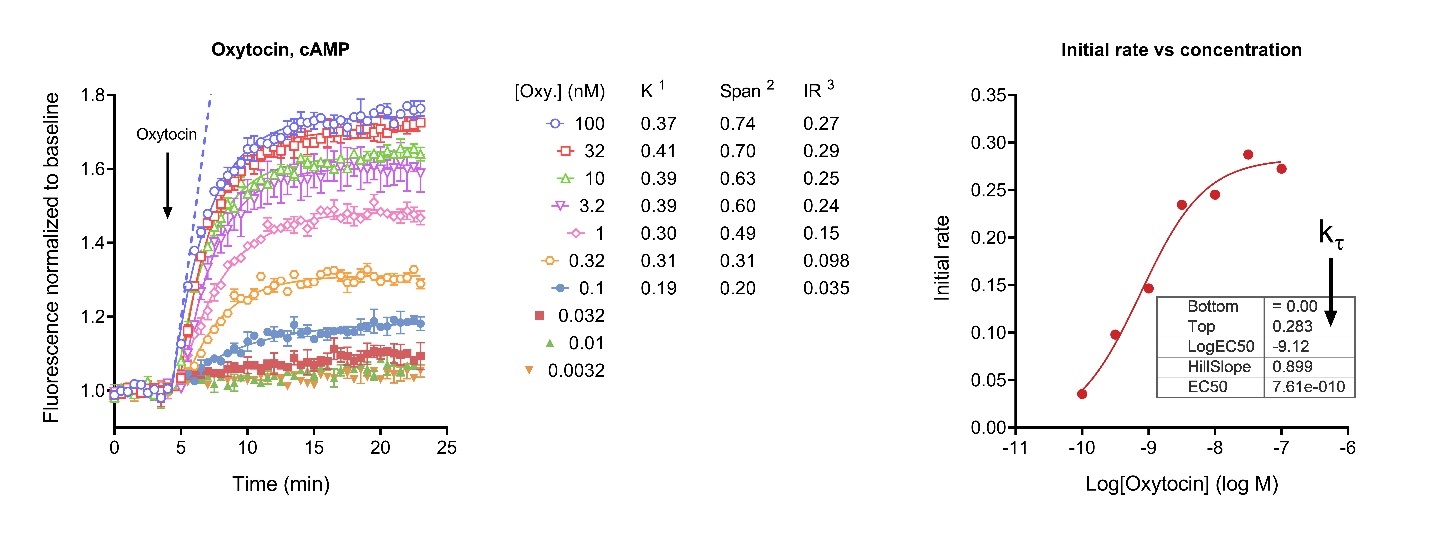
The data analysis is demonstrated using data for cAMP generated by the V2 vasopressin receptor (Figure 9). cAMP generation was stimulated by oxytocin at multiple concentrations and cAMP detected using the Red Up cADDis sensor. The curve fitting protocol is described in detail in the supplementary file Association exponential analysis. In brief, data for each concentration of oxytocin are analyzed using the “Plateau followed by one phase association” equation. The value of X0, the signal start time, is floated in the analysis, i.e. it is a fitted rather than a fixed value. This is recommended, in order to accommodate imprecision in the precise ligand addition time, and to accommodate any delay between ligand addition and signal initiation. The initial value for X0 is entered manually. The analysis is then run, and the fitted values are then inspected (see supplementary file Association exponential analysis, page 16). For the data in Figure 9, this indicated the fit was reasonable for the higher concentrations (R2 > 0.9 for 0.1 – 100 nM). The fit was poor for the lowest concentrations (R2 = 0.48 - 0.74 for 0.0032 to 0.032 nM) because there was minimal signal generated.
paragraph
Order 267
word/document.xml:/w:document[1]/w:body[1]/w:p[260]
The next step is the calculation of the initial rate. This is done using using Eq. 6.
paragraph
Order 269
Style Equation
word/document.xml:/w:document[1]/w:body[1]/w:p[262]
Initial rate = k × SteadyState
paragraph
Order 271
word/document.xml:/w:document[1]/w:body[1]/w:p[264]
What we are doing here is multiplying the rate constant by the ligand-specific signal increment at the plateau. Note the SteadyState term is the plateau Y value minus the background – it isn’t the plateau Y value. In terms of the Prism equation format, this equation is: Initial rate = K × Span. The values of K and Span are the fitted values from the curve fits. (Span is calculated from the fit parameters Y0 and Plateau, as Plateau – Y0). For example, in Figure 9 at 100 nM oxytocin, the K value is 0.37 min-1 and the Span value is 0.74. The initial rate is now calculated by multiplying K by Span, per Eq. 6. For 100 nM this gives the initial rate value of 0.27 normalized fluorescence units per min (NFU per min). This initial rate is illustrated by the dashed blue in in Figure 9. Initial rate values for the other concentrations are given in Figure 9.
paragraph
Order 276
word/document.xml:/w:document[1]/w:body[1]/w:p[269]
The final step is the determination of k, which is the initial rate at a maximally-effective concentration of ligand. This is done by analyzing the concentration-response for the initial rate, detailed in the supplementary file Association exponential analysis. The initial rate values are entered into a data table (y values). The corresponding ligand concentration is entered as the logarithm of the concentration (x values). The data are then fit to a standard sigmoid curve logistic equation by nonlinear regression (“log(agonist) vs. response -- Variable slope (four parameters)” (74)) (Figure 9). The “Bottom” parameter, the lower plateau, is fixed to zero, since by definition the initial rate is zero in the absence of ligand. From this fit the k value can be determined - it is simply the value of “Top”, the y value at the upper, right-hand plateau of the curve. This gives a k value of 0.283 normalized fluorescence units.min-1 (Figure 9).
heading
Order 279
Level 4
Style Heading4
word/document.xml:/w:document[1]/w:body[1]/w:p[272]
H4. Example 2: Arrestin Recruitment
paragraph
Order 281
word/document.xml:/w:document[1]/w:body[1]/w:p[274]
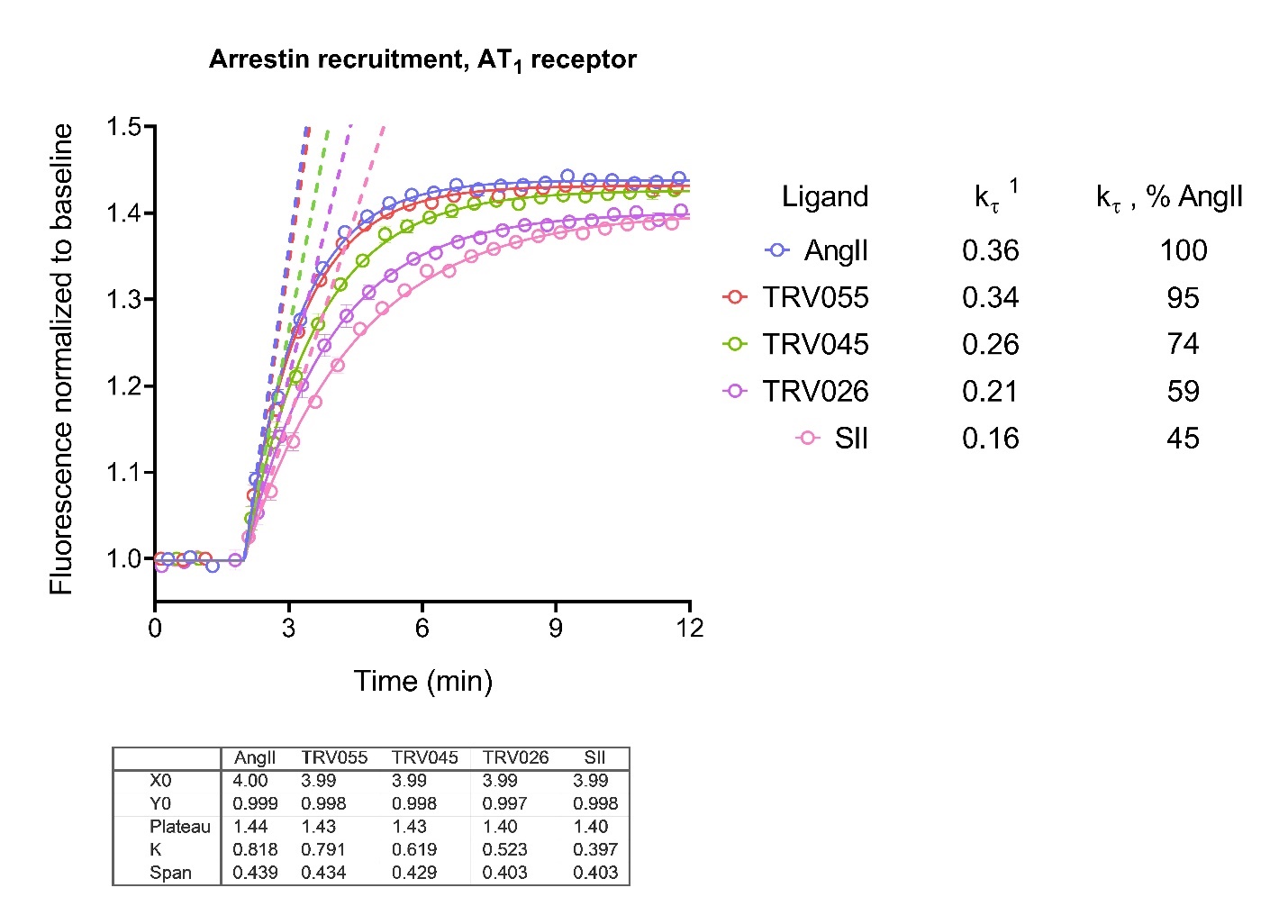
A second example of the analysis is arrestin recruitment via the AT1 receptor. The arrestin sensor (see Arrestin Sensor) was used with five AT1 receptor ligands to quantify kinetics of arrestin recruitment by full and partial agonists (Figure 10), as described in ref (29). Here ligands were tested at a single maximally-stimulating concentration (32 μM). This enables efficient assessment of ligand efficacy, i.e. maximal effect (though at the expense of measuring ligand potency). In this example of a downward sensor, data were were first normalized to be upward, to represent the stimulation of arrestin recruitment, using the equation from Data Normalization:
paragraph
Order 283
Style Equation
word/document.xml:/w:document[1]/w:body[1]/w:p[276]
paragraph
Order 286
word/document.xml:/w:document[1]/w:body[1]/w:p[278]
The upward time course data were then fit to the association exponential equation (Eq. 9), using Prism as described above (Example 1: cAMP Signaling). This yielded the fitted parameter values for the rate constant K and the steady-state response above background (SteadyState, or Span in Prism), values given in Figure 10). From these parameters the initial rate was calculated, by multiplying K by Span (Figure 10). The dashed lines in Figure 10 indicate the initial rate. From these values k is determined. In this case, k is simply equal to the initial rate because k is the initial rate at a maximally-stimulating concentration of ligand, the concentration used in this experiment. The resulting k values, given in Figure 10, ranged from 0.36 NFU per min for AngII to 0.16 NFU per min for SII. The value of SII indicates the ligand is a partial agonist; the SII-occupied receptor elicited arrestin recruitment at an initial rate only 45% of that produced by AngII. Interestingly, this partial agonism is not evident if an endpoint approach is used to quantify the data - by the time the signal has fully formed, at 10 min after ligand application (at the plateau), SII is almost as effective as AngII (Figure 10). This fact is relevant to the quantification of biased agonism (Simplifying Biased Agonism Assessment Using Signaling Kinetics).
heading
Order 291
Level 3
Style Heading3
word/document.xml:/w:document[1]/w:body[1]/w:p[283]
H3. Rise-and-Fall to Baseline Curve Fitting, Initial Rate Calculation and k Determination
paragraph
Order 293
word/document.xml:/w:document[1]/w:body[1]/w:p[285]
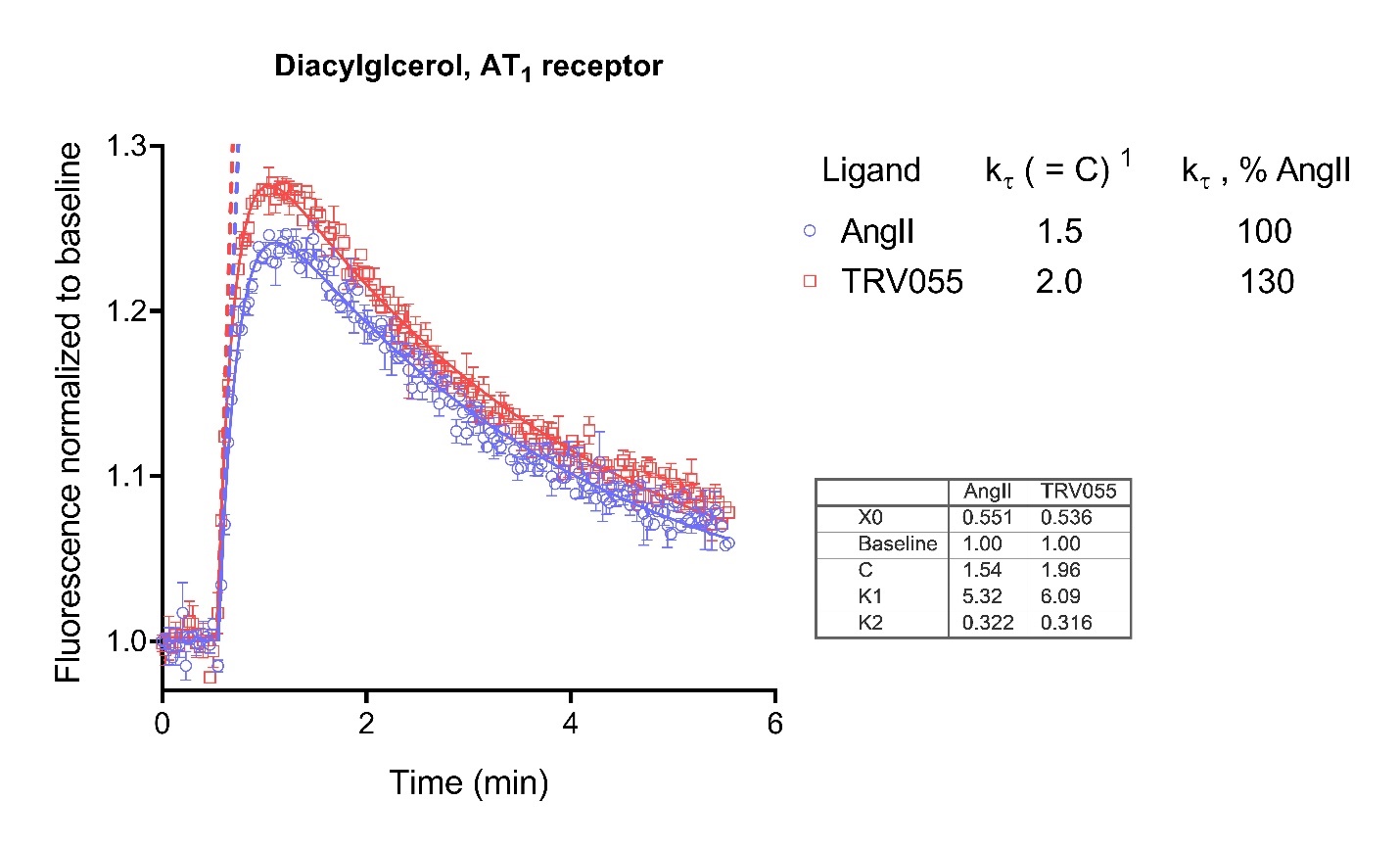
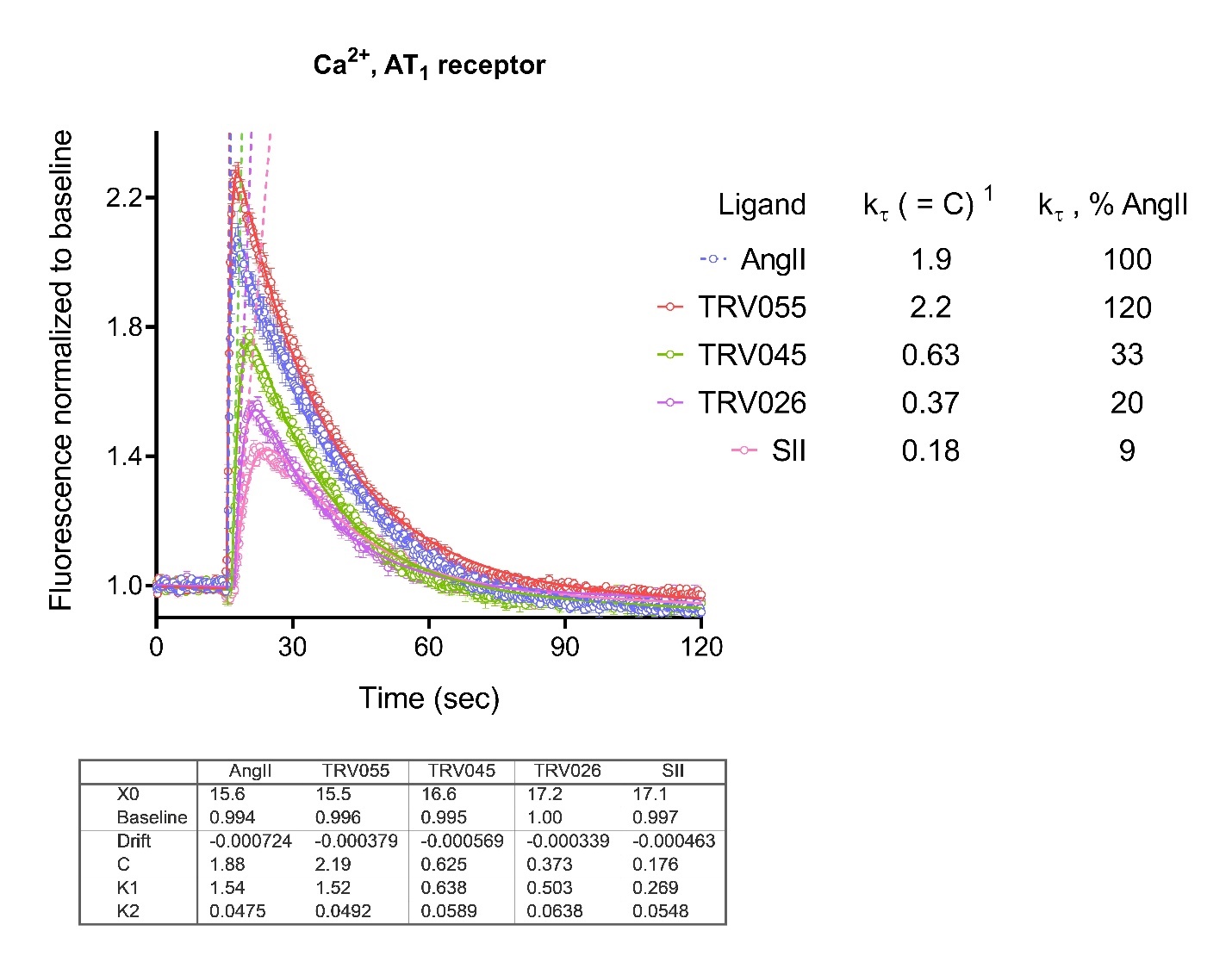
The rise-and-fall to baseline curve (Figure 8C) describes the time course for numerous biosensor responses. It is the familiar curve shape in Ca2+ mobilization assays. These data can be fit to determine the initial rate of signaling. The same general process is used as described above for the association exponential curve (Association Exponential Curve Fitting, Initial Rate Calculation and k Determination). The time course data are fit to an equation, in this case Eq. 3, and the fitted parameter values used to calculate the initial rate and k. Two examples are shown here, DAG production and Ca2+ mobilization (both via the AT1 receptor). The latter employs an equation that accommodates a technical issue in biosensor experiments, baseline drift.
heading
Order 295
Level 4
Style Heading4
word/document.xml:/w:document[1]/w:body[1]/w:p[287]
H4. Example 1: DAG Production via the AT1 Receptor
paragraph
Order 297
word/document.xml:/w:document[1]/w:body[1]/w:p[289]
In this experiment, rather than a concentration-response being run, a single, maximally-stimulating concentration of ligand was used, to quantify ligand efficacy. In Figure 11, this is shown for the endogenous ligand AngII and for a synthetic ligand TRV055 (data from ref (29)). DAG was detected using the Red DAG sensor. Visual inspection indicates the response rises steeply, then peaks, followed by a decline back down to the baseline level before addition of ligand. The data were fit to Eq. 3. This equation is not a built-in equation in Prism and so needs loading in as a user-entered equation. The simplest way to load the equation is to load it from a file that already contains it, and such a file is provided in the supplementary file Rise-and-fall equations. The equation is loaded in as described in the supplementary file Loading equations into Prism from a file.
paragraph
Order 298
word/document.xml:/w:document[1]/w:body[1]/w:p[290]
The equation used is named “[Pharmechanics] Baseline then rise-and-fall to baseline time course” and is formatted as follows (Eq. 10):
paragraph
Order 300
Style Equation
word/document.xml:/w:document[1]/w:body[1]/w:p[292]
Y=ifX<X0,Baseline, Baseline+Ck1-k2e-k2X-X0-e-k1X-X0
paragraph
Order 301
Style Equation
word/document.xml:/w:document[1]/w:body[1]/w:p[293]
paragraph
Order 303
word/document.xml:/w:document[1]/w:body[1]/w:p[295]
Note this equation is extended to include the run-in period before the start of the signal (at X0), using an IF statement, as described for Eq. 9 above. The AT1 DAG data were fit to this equation (Figure 11). The fitting protocol is described in detail in the supplementary file Rise-and-fall to baseline exponential equation. The value of X0, the signal start time, was floated in the analysis, and its initial value was entered manually. The fit to the equation was reasonable (R2 = 0.98 for both AngII and TRV055, Figure 11).
paragraph
Order 304
word/document.xml:/w:document[1]/w:body[1]/w:p[296]
The value of the initial rate is then determined. This is particularly easy for the rise-and-fall to baseline equation - the initial rate is simply equal to the fitted parameter C. These initial rate values are indicated in Figure 11. Now the k value can be determined. Since a maximally-stimulating concentration of ligand was used in this experiment, k is equal to the initial rate at this concentration. In other words, k is equal to the value of C (indicated in Figure 11). Now we can determine the relative efficacy of the two ligands AngII and TRV055 using the k value, by dividing the value by that for AngII. The resulting efficacy values are 100% for AngII (by definition) and 130% for TRV055 (Figure 11). This result indicates TRV055 had a higher efficacy than AngII in terms of the initial rate for Ca2+ mobilization, indicating TRV055 was a superagonist.
heading
Order 310
Level 4
Style Heading4
word/document.xml:/w:document[1]/w:body[1]/w:p[302]
H4. Example 2: Ca2+ Mobilization via the AT1 Receptor
paragraph
Order 312
word/document.xml:/w:document[1]/w:body[1]/w:p[304]
In this example, there was a slight drift of the baseline response over time. This is a common technical issue in biosensor experiments. It can arise from photobleaching or slight environmental changes over time. Fortunately, the analysis can be slightly modified to incorporate baseline drift.
paragraph
Order 313
word/document.xml:/w:document[1]/w:body[1]/w:p[305]
The example is Ca2+ mobilization via the AT1 receptor (29). In the experiment, five ligands were tested at a maximally-stimulating concentration, with Ca2+ detected using the Red GECO sensor. The ligands were AngII, TRV055, TRV045, TRV026 and SII. The time course data are shown in Figure 12. Close visual inspection indicates baseline drift - the response at late time points is slightly lower than the response before the addition of ligand. This can be handled by slight modification of the equation used to analyze the data. Eq. 10 is modified to incorporate a baseline drift term, giving Eq. 11:
paragraph
Order 315
Style Equation
word/document.xml:/w:document[1]/w:body[1]/w:p[307]
paragraph
Order 316
Style Equation
word/document.xml:/w:document[1]/w:body[1]/w:p[308]
Y=ifX<X0,Baseline+Drift×X, YS+Drift×X-X0)+Ck1-k2e-k2(X-X0)-e-k1(X-X0)
paragraph
Order 317
Style Equation
word/document.xml:/w:document[1]/w:body[1]/w:p[309]
paragraph
Order 319
word/document.xml:/w:document[1]/w:body[1]/w:p[311]
“Drift” is the slope of the change of Baseline over time. Note Baseline is the Y value when X is zero, i.e. is the Y intercept. The equation is a user-defined equation that can be loaded from the file Rise-and-fall equations. The equation is loaded as described in the supplementary file Loading equations into Prism from a file.
paragraph
Order 320
word/document.xml:/w:document[1]/w:body[1]/w:p[312]
The AT1 Ca2+ mobilization data were fit to this equation (termed “[Pharmechanics] Baseline then rise-and-fall to baseline time course with drift” in Prism) (29). The fitting protocol is described in detail in the supplementary file Rise-and-fall to baseline exponential equation with baseline drift. The value of X0, the signal start time, was floated in the analysis, and its initial value was entered manually. The fit to the equation was reasonable (R2 > 0.97 for all five ligands). The k value is equal to C, since C is the initial rate and a maximally-stimulating concentration of ligand was applied. These values are given in Figure 12. The k values can be normalized to AngII to obtain a measure of relative efficacy (Figure 12). This showed TRV055 was slightly more efficacious than AngII (120%) and that the other ligands were partial agonists, with activity ranging from 9 - 33% (Figure 12). These data are used in the assessment of biased agonism for the AT1 receptor, as described in Simplifying Biased Agonism Assessment Using Signaling Kinetics below.
heading
Order 328
Level 3
Style Heading3
word/document.xml:/w:document[1]/w:body[1]/w:p[320]
H3. Rise-and-Fall to Steady-State Curve Fitting
paragraph
Order 330
word/document.xml:/w:document[1]/w:body[1]/w:p[322]
Often in rise-and-fall type responses the signal falls to a plateau that is above the baseline signal (as opposed to falling back to baseline) (Figure 8D) (37). This type of response can be analyzed with a modified form of the rise-and-fall equation (Eq. 4). The initial rate of the rise phase and k can be determined by applying a formula to the fitted parameter values.
paragraph
Order 331
word/document.xml:/w:document[1]/w:body[1]/w:p[323]
An example of this waveform is shown in Figure 13, the cAMP response to isoproterenol via the 2 adrenoceptor endogenously expressed in HEK293 cells. A maximally-stimulating concentration of the agonist isoproterenol was used (20 M). The data were fit to Eq. 4 using Prism. This equation is not built into the program so needs loading in as a user-defined equation. This can be done simply from the Rise-and-fall equations file, as described in the supplementary file Loading equations into Prism from a file. The equation is named “[Pharmechanics] Baseline then rise-and-fall to steady state time course” and is formatted as follows (Eq. 12):
paragraph
Order 333
Style Equation
word/document.xml:/w:document[1]/w:body[1]/w:p[325]
Y=ifX<X0,Baseline, Baseline+SteadyState×1-De-k1X-X0+D-1e-k2X-X0
paragraph
Order 334
Style Equation
word/document.xml:/w:document[1]/w:body[1]/w:p[326]
paragraph
Order 336
word/document.xml:/w:document[1]/w:body[1]/w:p[328]
Note this equation is extended to include the run-in period before the start of the signal (at X0) as described for Eq. 9 above (Association Exponential Curve Fitting, Initial Rate Calculation and k Determination). The cAMP data were fit to this equation. A step-by-step guide is provided in the supplementary file Rise-and-fall to steady state analysis. The value of X0, the signal start time, was floated in the analysis, and its initial value was entered manually. The fit to the equation was good (R2 = 0.997).
paragraph
Order 341
word/document.xml:/w:document[1]/w:body[1]/w:p[333]
Now the initial rate value is determined. This requires application of a formula to the fitted parameter values. The formula is Eq. 8:
paragraph
Order 343
Style Equation
word/document.xml:/w:document[1]/w:body[1]/w:p[335]
Initial rate=SteadyState × Dk1-D-1k2
paragraph
Order 346
word/document.xml:/w:document[1]/w:body[1]/w:p[337]
Note SteadyState is the ligand-specific steady-state response (ligand-stimulated increment above baseline) and D is the fitting constant. Applying this formula to the data in Figure 13 gave an initial rate value of 0.36 NFU.min-1. k is equal to this initial rate, since a maximally-stimulating concentration of ligand was used.
heading
Order 347
Level 2
Style Heading2
word/document.xml:/w:document[1]/w:body[1]/w:p[338]
H2. Simplifying Biased Agonism Assessment Using Signaling Kinetics
paragraph
Order 348
word/document.xml:/w:document[1]/w:body[1]/w:p[339]
GPCRs activate multiple signaling pathways and regulatory events. In GPCR drug discovery, it is desirable to activate pathways that mediate a desired therapeutic outcome, and to avoid or block stimulating pathways that lead to side effects and/or attenuate therapeutic efficacy. This pathway-selective activation by a ligand is described as biased agonism (reviewed in refs. (31-35)). Broadly-speaking, GPCRs couple to two different signaling/regulatory limbs, G-proteins and arrestins (35). G-proteins activate signaling cascades that elicit the biological effect of the GPCR ligand. Arrestins usually block G-protein signaling, terminating the signal, but can also mediate signaling, often acting as scaffolding proteins that bring signaling partners together (75). Therapeutically, there are examples where it is potentially desirable to selectively activate one of these pathways over the other. For example, for the AT1 receptor, ligands that selectively promote arrestin recruitment without activating G-protein can elicit increased cardiac performance compared with traditional antagonists that do not recruit arrestin (76).
heading
Order 350
Level 3
Style Heading3
word/document.xml:/w:document[1]/w:body[1]/w:p[341]
H3. k Bias Ratio Calculation
paragraph
Order 352
word/document.xml:/w:document[1]/w:body[1]/w:p[343]
Signaling bias is often quantified using ratios of efficacy for the different signaling pathways being compared. More specifically, the strength of signal transduction by the ligand-bound receptor down one pathway is divided by the strength transduction down the second pathway in the comparison (reviewed in ref. (31)). This approach is directly amenable to the initial rate measurement of signal transduction; k is a direct measure of the strength of signal transduction by the ligand-bound receptor. Bias can simply be quantified as the ratio of the k values.
paragraph
Order 353
word/document.xml:/w:document[1]/w:body[1]/w:p[344]
This bias calculation is a simple, two-step process (29) and is exemplified here using the angiotensin AT1 receptor data (Figure 14), comparing arrestin recruitment with Ca2+ mobilization (Figures 10 and 12). The first step is to tabulate the k values for the pathways being compared (Figure 14). Next, the k values are normalized to the k value of a reference ligand. In this case, AngII was used as the reference ligand. The initial rate is expressed as a percentage of that for the reference (k %) and this is done for the multiple pathways being compared (Figure 14, Step 2). For the AT1 receptor, this yields the k % values for arrestin and Ca2+ in Figure 14 (ranging from 45 - 100% for arrestin and 9-120% for calcium).
paragraph
Order 354
word/document.xml:/w:document[1]/w:body[1]/w:p[345]
The next step is to compare the pathways by calculating the kinetic bias ratio (29). This is done by dividing the k % value for one pathway by the k % value for the other (Figure 14, Step 3). For the AT1 receptor, this gives the k % ratios in Figure 14. The highest arrestin : Ca2+ ratio in this set was 5.0, for SII. This result indicates SII is arrestin-biased by 5.0-fold, relative to AngII. The lowest value was 0.8 for TRV055. This value, being close to 1, indicates TRV055 is unbiased for the two pathways, relative to AngII. These bias estimates obtained using the k method are in good agreement with established methods for quantifying bias (77).
paragraph
Order 355
word/document.xml:/w:document[1]/w:body[1]/w:p[346]
It is important to note the k method quantifies bias in terms of efficacy but not affinity. More specifically, k defines the efficacy of the ligand-bound receptor to couple with an effector to generate a signal, but does not define the affinity of the ligand for the receptor-effector complex. Bias can be manifest at the level of affinity as well as efficacy; a ligand can bind with different affinity to the receptor in complex with different effectors (31).
heading
Order 357
Level 3
Style Heading3
word/document.xml:/w:document[1]/w:body[1]/w:p[348]
H3. Comparison with Existing Methods
paragraph
Order 359
word/document.xml:/w:document[1]/w:body[1]/w:p[350]
Measuring biased agonism is not trivial. Major advances have been made in applying receptor theory to the data analysis and in training and educating investigators in the calculations. Numerous methods are now available, reviewed in ref. (31). However, challenges remain in quantifying biased agonism. There are three issues that the kinetic analysis presented here can help address. First, the bias estimate can be dependent on the time point at which it is measured (27,30). This problem emerges from the time-dependence of signaling; a ligand can be a partial agonist at one time point and a full agonist at a later time point, resulting in bias at the former time point and no bias at the latter. This is demonstrated by the AT1 arrestin data in Figure 10 - at the early time points on the rise phase SII and TRV045 are partial agonist but later at the plateau the compounds are near-full agonists (relative to AngII). The initial rate approach solves this problem because the rate is the same at all time points. The second issue is the abstract scales that are used to quantify efficacy and biased agonism. The lack of intuitive meaning to these parameters makes it challenging to translate them to in vivo efficacy and to determine how large the bias effect is. The kinetic approach reduces this uncertainty because it is more intuitive - the initial rate is a biologically meaningful parameter and the bias ratio is simply the rate of one pathway relative to another (normalized to a reference ligand). Third, the data analysis methods and procedures involved in quantifying bias can be complex, often involving advanced curve fitting (such as simultaneous fits to multiple data sets) and multiple nested calculations (27,30,31). The kinetic method is simpler; once the initial rate is obtained, bias is simply the ratio of the initial rates for the pathways.
heading
Order 363
Level 2
Style Heading2
word/document.xml:/w:document[1]/w:body[1]/w:p[354]
paragraph
Order 365
word/document.xml:/w:document[1]/w:body[1]/w:p[356]
The timing of GPCR signaling is important in uncovering new mechanisms of signaling and regulation, revealing new spatiotemporal pharmacologic modalities potentially useful for new therapeutic development. Employing this kinetic dimension to drug discovery and receptor research requires straightforward methods to measure the time course of signaling, and tractable data analysis methods to reduce the time course data to meaningful drug parameters. This chapter describes how this can be done using genetically-encoded fluorescent biosensors. The continuous-read modality coupled with the exceptionally efficient workflow of the assay enables high-quality time course data recording. The data are ideally suited for analysis using an enzyme-based kinetic framework. This analysis has been reduced to practice so that any investigator familiar with basic curve-fitting analysis can employ it, as described in the step-by-step analysis guides. The drug parameter obtained, the initial rate of signaling by ligand-bound receptor, is intuitive and familiar, enabling a simplified and parsimonious calculation of biased agonism. These methods enable investigators to explore the kinetic dimension of GPCR signaling in their receptor research and drug discovery projects.
heading
Order 369
Level 2
Style Heading2
word/document.xml:/w:document[1]/w:body[1]/w:p[360]
paragraph
Order 370
word/document.xml:/w:document[1]/w:body[1]/w:p[361]
We are grateful to Anne Marie Quinn, Paul Tewson and Rose Quinn for reviewing and providing material for this chapter. Research reported in this chapter was funded by The National Institutes of Health under the following SBIR awards: R44DA050357, R44GM125390, R44NS082222 and National Science Foundation SBIR IIP-1430878.
heading
Order 371
Level 2
Style Heading2
word/document.xml:/w:document[1]/w:body[1]/w:p[362]
reference
Order 373
Style Reference
word/document.xml:/w:document[1]/w:body[1]/w:p[364]
1 Fredriksson, R., Lagerstrom, M. C., Lundin, L. G. & Schioth, H. B. The G-protein-coupled receptors in the human genome form five main families. Phylogenetic analysis, paralogon groups, and fingerprints. Mol Pharmacol 63, 1256-1272, doi:10.1124/mol.63.6.1256 (2003).
reference
Order 374
Style Reference
word/document.xml:/w:document[1]/w:body[1]/w:p[365]
2 Sriram, K. & Insel, P. A. GPCRs as targets for approved drugs: How many targets and how many drugs? Mol Pharmacol, doi:10.1124/mol.117.111062 (2018).
reference
Order 375
Style Reference
word/document.xml:/w:document[1]/w:body[1]/w:p[366]
3 Rask-Andersen, M., Masuram, S. & Schioth, H. B. The druggable genome: Evaluation of drug targets in clinical trials suggests major shifts in molecular class and indication. Annu Rev Pharmacol Toxicol 54, 9-26, doi:10.1146/annurev-pharmtox-011613-135943 (2014).
reference
Order 376
Style Reference
word/document.xml:/w:document[1]/w:body[1]/w:p[367]
4 Salomon, Y., Londos, C. & Rodbell, M. A highly sensitive adenylate cyclase assay. Anal Biochem 58, 541-548, doi:10.1016/0003-2697(74)90222-x (1974).
reference
Order 377
Style Reference
word/document.xml:/w:document[1]/w:body[1]/w:p[368]
5 Berridge, M. J., Dawson, R. M., Downes, C. P., Heslop, J. P. & Irvine, R. F. Changes in the levels of inositol phosphates after agonist-dependent hydrolysis of membrane phosphoinositides. Biochem J 212, 473-482, doi:10.1042/bj2120473 (1983).
reference
Order 378
Style Reference
word/document.xml:/w:document[1]/w:body[1]/w:p[369]
6 Wang, T., Li, Z., Cvijic, M. E., Zhang, L. & Sum, C. S. in Assay Guidance Manual (eds G. S. Sittampalam et al.) https://www.ncbi.nlm.nih.gov/books/NBK464633/ (2004).
reference
Order 379
Style Reference
word/document.xml:/w:document[1]/w:body[1]/w:p[370]
7 Lohse, M. J. et al. Optical techniques to analyze real-time activation and signaling of G-protein-coupled receptors. Trends Pharmacol Sci 29, 159-165, doi:10.1016/j.tips.2007.12.002 (2008).
reference
Order 380
Style Reference
word/document.xml:/w:document[1]/w:body[1]/w:p[371]
8 Marullo, S. & Bouvier, M. Resonance energy transfer approaches in molecular pharmacology and beyond. Trends Pharmacol Sci 28, 362-365, doi:10.1016/j.tips.2007.06.007 (2007).
reference
Order 381
Style Reference
word/document.xml:/w:document[1]/w:body[1]/w:p[372]
9 Tsvetanova, N. G., Irannejad, R. & von Zastrow, M. G protein-coupled receptor (GPCR) signaling via heterotrimeric G proteins from endosomes. J Biol Chem 290, 6689-6696, doi:10.1074/jbc.R114.617951 (2015).
reference
Order 382
Style Reference
word/document.xml:/w:document[1]/w:body[1]/w:p[373]
10 Ferrandon, S. et al. Sustained cyclic AMP production by parathyroid hormone receptor endocytosis. Nat Chem Biol 5, 734-742, doi:10.1038/nchembio.206 (2009).
reference
Order 383
Style Reference
word/document.xml:/w:document[1]/w:body[1]/w:p[374]
11 Namkung, Y. et al. Functional selectivity profiling of the angiotensin II type 1 receptor using pathway-wide BRET signaling sensors. Sci Signal 11, doi:10.1126/scisignal.aat1631 (2018).
reference
Order 384
Style Reference
word/document.xml:/w:document[1]/w:body[1]/w:p[375]
12 Olsen, R. H. J. et al. TRUPATH, an open-source biosensor platform for interrogating the GPCR transducerome. Nat Chem Biol, doi:10.1038/s41589-020-0535-8 (2020).
reference
Order 385
Style Reference
word/document.xml:/w:document[1]/w:body[1]/w:p[376]
13 Greenwald, E. C., Mehta, S. & Zhang, J. Genetically Encoded Fluorescent Biosensors Illuminate the Spatiotemporal Regulation of Signaling Networks. Chem Rev 118, 11707-11794, doi:10.1021/acs.chemrev.8b00333 (2018).
reference
Order 386
Style Reference
word/document.xml:/w:document[1]/w:body[1]/w:p[377]
14 Moore, C. A., Milano, S. K. & Benovic, J. L. Regulation of receptor trafficking by GRKs and arrestins. Annu Rev Physiol 69, 451-482, doi:10.1146/annurev.physiol.69.022405.154712 (2007).
reference
Order 387
Style Reference
word/document.xml:/w:document[1]/w:body[1]/w:p[378]
15 Kakiuchi, S. & Rall, T. W. The influence of chemical agents on the accumulation of adenosine 3',5'-Phosphate in slices of rabbit cerebellum. Mol Pharmacol 4, 367-378 (1968).
reference
Order 388
Style Reference
word/document.xml:/w:document[1]/w:body[1]/w:p[379]
16 Shear, M., Insel, P. A., Melmon, K. L. & Coffino, P. Agonist-specific refractoriness induced by isoproterenol. Studies with mutant cells. J Biol Chem 251, 7572-7576 (1976).
reference
Order 389
Style Reference
word/document.xml:/w:document[1]/w:body[1]/w:p[380]
17 Exton, J. H., Robison, G. A., Sutherland, E. W. & Park, C. R. Studies on the role of adenosine 3',5'-monophosphate in the hepatic actions of glucagon and catecholamines. J Biol Chem 246, 6166-6177 (1971).
reference
Order 390
Style Reference
word/document.xml:/w:document[1]/w:body[1]/w:p[381]
18 Krupnick, J. G. & Benovic, J. L. The role of receptor kinases and arrestins in G protein-coupled receptor regulation. Annu Rev Pharmacol Toxicol 38, 289-319, doi:10.1146/annurev.pharmtox.38.1.289 (1998).
reference
Order 391
Style Reference
word/document.xml:/w:document[1]/w:body[1]/w:p[382]
19 Thomsen, A. R. B. et al. GPCR-G Protein-beta-Arrestin Super-Complex Mediates Sustained G Protein Signaling. Cell 166, 907-919, doi:10.1016/j.cell.2016.07.004 (2016).
reference
Order 392
Style Reference
word/document.xml:/w:document[1]/w:body[1]/w:p[383]
20 Calebiro, D. et al. Persistent cAMP-signals triggered by internalized G-protein-coupled receptors. PLoS Biol 7, e1000172, doi:10.1371/journal.pbio.1000172 (2009).
reference
Order 393
Style Reference
word/document.xml:/w:document[1]/w:body[1]/w:p[384]
21 Mullershausen, F. et al. Persistent signaling induced by FTY720-phosphate is mediated by internalized S1P1 receptors. Nat Chem Biol 5, 428-434, doi:10.1038/nchembio.173 (2009).
reference
Order 394
Style Reference
word/document.xml:/w:document[1]/w:body[1]/w:p[385]
22 Stoeber, M. et al. A Genetically Encoded Biosensor Reveals Location Bias of Opioid Drug Action. Neuron 98, 963-976 e965, doi:10.1016/j.neuron.2018.04.021 (2018).
reference
Order 395
Style Reference
word/document.xml:/w:document[1]/w:body[1]/w:p[386]
23 Jensen, D. D. et al. Neurokinin 1 receptor signaling in endosomes mediates sustained nociception and is a viable therapeutic target for prolonged pain relief. Sci Transl Med 9, doi:10.1126/scitranslmed.aal3447 (2017).
reference
Order 396
Style Reference
word/document.xml:/w:document[1]/w:body[1]/w:p[387]
24 Vilardaga, J. P., Jean-Alphonse, F. G. & Gardella, T. J. Endosomal generation of cAMP in GPCR signaling. Nat Chem Biol 10, 700-706, doi:10.1038/nchembio.1611 (2014).
reference
Order 397
Style Reference
word/document.xml:/w:document[1]/w:body[1]/w:p[388]
25 Lobingier, B. T. & von Zastrow, M. When trafficking and signaling mix: How subcellular location shapes G protein-coupled receptor activation of heterotrimeric G proteins. Traffic 20, 130-136, doi:10.1111/tra.12634 (2019).
reference
Order 398
Style Reference
word/document.xml:/w:document[1]/w:body[1]/w:p[389]
26 Hothersall, J. D., Brown, A. J., Dale, I. & Rawlins, P. Can residence time offer a useful strategy to target agonist drugs for sustained GPCR responses? Drug Discov Today 21, 90-96, doi:10.1016/j.drudis.2015.07.015 (2016).
reference
Order 399
Style Reference
word/document.xml:/w:document[1]/w:body[1]/w:p[390]
27 Klein Herenbrink, C. et al. The role of kinetic context in apparent biased agonism at GPCRs. Nat Commun 7, 10842, doi:10.1038/ncomms10842 (2016).
reference
Order 400
Style Reference
word/document.xml:/w:document[1]/w:body[1]/w:p[391]
28 Zhu, X., Finlay, D. B., Glass, M. & Duffull, S. B. Model-free and kinetic modelling approaches for characterising non-equilibrium pharmacological pathway activity: Internalisation of cannabinoid CB1 receptors. Br J Pharmacol 176, 2593-2607, doi:10.1111/bph.14684 (2019).
reference
Order 401
Style Reference
word/document.xml:/w:document[1]/w:body[1]/w:p[392]
29 Hoare, S. R. J., Tewson, P. H., Quinn, A. M. & Hughes, T. E. A kinetic method for measuring agonist efficacy and ligand bias using high resolution biosensors and a kinetic data analysis framework. Sci Rep 10, 1766, doi:10.1038/s41598-020-58421-9 (2020).
reference
Order 402
Style Reference
word/document.xml:/w:document[1]/w:body[1]/w:p[393]
30 Thompson, G. L. et al. Systematic analysis of factors influencing observations of biased agonism at the mu-opioid receptor. Biochem Pharmacol 113, 70-87, doi:10.1016/j.bcp.2016.05.014 (2016).
reference
Order 403
Style Reference
word/document.xml:/w:document[1]/w:body[1]/w:p[394]
31 Kenakin, T. Biased Receptor Signaling in Drug Discovery. Pharmacol Rev 71, 267-315, doi:10.1124/pr.118.016790 (2019).
reference
Order 404
Style Reference
word/document.xml:/w:document[1]/w:body[1]/w:p[395]
32 Gesty-Palmer, D. & Luttrell, L. M. Refining efficacy: exploiting functional selectivity for drug discovery. Adv Pharmacol 62, 79-107, doi:10.1016/B978-0-12-385952-5.00009-9 (2011).
reference
Order 405
Style Reference
word/document.xml:/w:document[1]/w:body[1]/w:p[396]
33 Kenakin, T. & Christopoulos, A. Signalling bias in new drug discovery: detection, quantification and therapeutic impact. Nat Rev Drug Discov 12, 205-216, doi:10.1038/nrd3954 (2013).
reference
Order 406
Style Reference
word/document.xml:/w:document[1]/w:body[1]/w:p[397]
34 Violin, J. D., Crombie, A. L., Soergel, D. G. & Lark, M. W. Biased ligands at G-protein-coupled receptors: promise and progress. Trends Pharmacol Sci 35, 308-316, doi:10.1016/j.tips.2014.04.007 (2014).
reference
Order 407
Style Reference
word/document.xml:/w:document[1]/w:body[1]/w:p[398]
35 Gurevich, V. V. & Gurevich, E. V. Biased GPCR signaling: Possible mechanisms and inherent limitations. Pharmacol Ther, 107540, doi:10.1016/j.pharmthera.2020.107540 (2020).
reference
Order 408
Style Reference
word/document.xml:/w:document[1]/w:body[1]/w:p[399]
36 Hoare, S. R. J., Pierre, N., Moya, A. G. & Larson, B. Kinetic operational models of agonism for G-protein-coupled receptors. J Theor Biol 446, 168-204, doi:10.1016/j.jtbi.2018.02.014 (2018).
reference
Order 409
Style Reference
word/document.xml:/w:document[1]/w:body[1]/w:p[400]
37 Hoare, S. R. J., Tewson, P. H., Quinn, A. M., Hughes, T. E. & Bridge, L. J. Analyzing kinetic signaling data for G‑protein‑coupled receptors. Scientific Reports 10, 12263, doi:10.1038/s41598-020-67844-3 (2020).
reference
Order 410
Style Reference
word/document.xml:/w:document[1]/w:body[1]/w:p[401]
38 Newman, R. H., Fosbrink, M. D. & Zhang, J. Genetically encodable fluorescent biosensors for tracking signaling dynamics in living cells. Chem Rev 111, 3614-3666, doi:10.1021/cr100002u (2011).
reference
Order 411
Style Reference
word/document.xml:/w:document[1]/w:body[1]/w:p[402]
39 Lakowicz, J. R. Principles of Fluorescence Spectroscopy. (Springer Science & Business Media, 2013).
reference
Order 412
Style Reference
word/document.xml:/w:document[1]/w:body[1]/w:p[403]
40 Shrestha, D., Jenei, A., Nagy, P., Vereb, G. & Szöllősi, J. Understanding FRET as a research tool for cellular studies. Int. J. Mol. Sci. 16, 6718-6756, doi:10.3390/ijms16046718 (2015).
reference
Order 413
Style Reference
word/document.xml:/w:document[1]/w:body[1]/w:p[404]
41 Miyawaki, A. et al. Fluorescent indicators for Ca2+ based on green fluorescent proteins and calmodulin. Nature 388, 882-887, doi:10.1038/42264 (1997).
reference
Order 414
Style Reference
word/document.xml:/w:document[1]/w:body[1]/w:p[405]
42 Lam, A. J. et al. Improving FRET dynamic range with bright green and red fluorescent proteins. Nat. Methods 9, 1005-1012, doi:10.1038/nmeth.2171 (2012).
reference
Order 415
Style Reference
word/document.xml:/w:document[1]/w:body[1]/w:p[406]
43 Mastop, M. et al. Characterization of a spectrally diverse set of fluorescent proteins as FRET acceptors for mTurquoise2. Sci. Rep. 7, 11999, doi:10.1038/s41598-017-12212-x (2017).
reference
Order 416
Style Reference
word/document.xml:/w:document[1]/w:body[1]/w:p[407]
44 Kuner, T. & Augustine, G. J. A genetically encoded ratiometric indicator for chloride: capturing chloride transients in cultured hippocampal neurons. Neuron 27, 447-459 (2000).
reference
Order 417
Style Reference
word/document.xml:/w:document[1]/w:body[1]/w:p[408]
45 Sakaue-Sawano, A. & Miyawaki, A. Visualizing spatiotemporal dynamics of multicellular cell-cycle progressions with fucci technology. Cold Spring Harb. Protoc. 2014, doi:10.1101/pdb.prot080408 (2014).
reference
Order 418
Style Reference
word/document.xml:/w:document[1]/w:body[1]/w:p[409]
46 Harlen, K. M., Roush, E. C., Clayton, J. E., Martinka, S. & Hughes, T. E. Live-Cell Assays for Cell Stress Responses Reveal New Patterns of Cell Signaling Caused by Mutations in Rhodopsin, α-Synuclein and TDP-43. Front. Cell. Neurosci. 13, 535, doi:10.3389/fncel.2019.00535 (2019).
reference
Order 419
Style Reference
word/document.xml:/w:document[1]/w:body[1]/w:p[410]
47 Lambert, T. J. FPbase: a community-editable fluorescent protein database. Nat. Methods 16, 277-278, doi:10.1038/s41592-019-0352-8 (2019).
reference
Order 420
Style Reference
word/document.xml:/w:document[1]/w:body[1]/w:p[411]
48 Ding, Y. et al. Ratiometric biosensors based on dimerization-dependent fluorescent protein exchange. Nature Publishing Group 12, 195-198- 193 p following 198, doi:10.1038/nmeth.3261 (2015).
reference
Order 421
Style Reference
word/document.xml:/w:document[1]/w:body[1]/w:p[412]
49 Siegel, M. S. & Isacoff, E. Y. A Genetically Encoded Optical Probe of Membrane Voltage. Neuron 19, 735-741 (1997).
reference
Order 422
Style Reference
word/document.xml:/w:document[1]/w:body[1]/w:p[413]
50 Storace, D. et al. Toward Better Genetically Encoded Sensors of Membrane Potential. Trends Neurosci. 39, 277-289, doi:10.1016/j.tins.2016.02.005 (2016).
reference
Order 423
Style Reference
word/document.xml:/w:document[1]/w:body[1]/w:p[414]
51 Baird, G. S., Zacharias, D. A. & Tsien, R. Y. Circular permutation and receptor insertion within green fluorescent proteins. Proc. Natl. Acad. Sci. U. S. A. 96, 11241-11246 (1999).
reference
Order 424
Style Reference
word/document.xml:/w:document[1]/w:body[1]/w:p[415]
52 Akerboom, J. et al. Optimization of a GCaMP calcium indicator for neural activity imaging. J. Neurosci. 32, 13819-13840 (2012).
reference
Order 425
Style Reference
word/document.xml:/w:document[1]/w:body[1]/w:p[416]
53 Barnett, L. M., Hughes, T. E. & Drobizhev, M. Deciphering the molecular mechanism responsible for GCaMP6m's Ca2+-dependent change in fluorescence. PLoS One 12, e0170934, doi:10.1371/journal.pone.0170934 (2017).
reference
Order 426
Style Reference
word/document.xml:/w:document[1]/w:body[1]/w:p[417]
54 Ahrens, M. B., Orger, M. B., Robson, D. N., Li, J. M. & Keller, P. J. Whole-brain functional imaging at cellular resolution using light-sheet microscopy. Nat. Methods 10, 413-420, doi:10.1038/nmeth.2434 (2013).
reference
Order 427
Style Reference
word/document.xml:/w:document[1]/w:body[1]/w:p[418]
55 Sofroniew, N. J., Flickinger, D., King, J. & Svoboda, K. A large field of view two-photon mesoscope with subcellular resolution for in vivo imaging. bioRxiv, doi:10.1101/055947 (2016).
reference
Order 428
Style Reference
word/document.xml:/w:document[1]/w:body[1]/w:p[419]
56 Molina, R. S. et al. Understanding the Fluorescence Change in Red Genetically Encoded Calcium Ion Indicators. Biophys. J. 116, 1873-1886, doi:10.1016/j.bpj.2019.04.007 (2019).
reference
Order 429
Style Reference
word/document.xml:/w:document[1]/w:body[1]/w:p[420]
57 Shaner, N. C. et al. A bright monomeric green fluorescent protein derived from Branchiostoma lanceolatum. Nat. Methods 10, 407-409, doi:10.1038/nmeth.2413 (2013).
reference
Order 430
Style Reference
word/document.xml:/w:document[1]/w:body[1]/w:p[421]
58 Woehler, A., Wlodarczyk, J. & Neher, E. Signal/Noise Analysis of FRET-Based Sensors. Biophys. J. 99, 2344-2354 (2010).
reference
Order 431
Style Reference
word/document.xml:/w:document[1]/w:body[1]/w:p[422]
59 Arkin, M. R. et al. in Assay Guidance Manual (eds G. Sitta Sittampalam et al.) (Eli Lilly & Company and the National Center for Advancing Translational Sciences, 2012).
reference
Order 432
Style Reference
word/document.xml:/w:document[1]/w:body[1]/w:p[423]
60 Willoughby, D. & Cooper, D. M. F. Live-cell imaging of cAMP dynamics. Nat. Methods 5, 29-36, doi:10.1038/nmeth1135 (2008).
reference
Order 433
Style Reference
word/document.xml:/w:document[1]/w:body[1]/w:p[424]
61 Tewson, P. H., Martinka, S., Shaner, N. C., Hughes, T. E. & Quinn, A. M. New DAG and cAMP Sensors Optimized for Live-Cell Assays in Automated Laboratories. J Biomol Screen 21, 298-305, doi:10.1177/1087057115618608 (2016).
reference
Order 434
Style Reference
word/document.xml:/w:document[1]/w:body[1]/w:p[425]
62 Tewson, P. et al. Assay for Detecting Galphai-Mediated Decreases in cAMP in Living Cells. SLAS Discov 23, 898-906, doi:10.1177/2472555218786238 (2018).
reference
Order 435
Style Reference
word/document.xml:/w:document[1]/w:body[1]/w:p[426]
63 Tewson, P. et al. Simultaneous detection of Ca2+ and diacylglycerol signaling in living cells. PLoS One 7, e42791, doi:10.1371/journal.pone.0042791 (2012).
reference
Order 436
Style Reference
word/document.xml:/w:document[1]/w:body[1]/w:p[427]
64 Zhao, Y. et al. An expanded palette of genetically encoded Ca(2)(+) indicators. Science 333, 1888-1891, doi:10.1126/science.1208592 (2011).
reference
Order 437
Style Reference
word/document.xml:/w:document[1]/w:body[1]/w:p[428]
65 Luttrell, L. M. & Gesty-Palmer, D. Beyond desensitization: physiological relevance of arrestin-dependent signaling. Pharmacol Rev 62, 305-330, doi:10.1124/pr.109.002436 (2010).
reference
Order 438
Style Reference
word/document.xml:/w:document[1]/w:body[1]/w:p[429]
66 Wang, T. et al. in Assay Guidance Manual (eds S. Markossian et al.) (2004).
reference
Order 439
Style Reference
word/document.xml:/w:document[1]/w:body[1]/w:p[430]
67 Gillis, A. et al. Low intrinsic efficacy for G protein activation can explain the improved side effect profiles of new opioid agonists. Sci Signal 13, doi:10.1126/scisignal.aaz3140 (2020).
reference
Order 440
Style Reference
word/document.xml:/w:document[1]/w:body[1]/w:p[431]
68 Kenakin, T. Quantifying biological activity in chemical terms: a pharmacology primer to describe drug effect. ACS Chem Biol 4, 249-260, doi:10.1021/cb800299s (2009).
reference
Order 441
Style Reference
word/document.xml:/w:document[1]/w:body[1]/w:p[432]
69 Xin, W., Tran, T. M., Richter, W., Clark, R. B. & Rich, T. C. Roles of GRK and PDE4 activities in the regulation of beta2 adrenergic signaling. J Gen Physiol 131, 349-364, doi:10.1085/jgp.200709881 (2008).
reference
Order 442
Style Reference
word/document.xml:/w:document[1]/w:body[1]/w:p[433]
70 Violin, J. D. et al. beta2-adrenergic receptor signaling and desensitization elucidated by quantitative modeling of real time cAMP dynamics. J Biol Chem 283, 2949-2961, doi:10.1074/jbc.M707009200 (2008).
reference
Order 443
Style Reference
word/document.xml:/w:document[1]/w:body[1]/w:p[434]
71 Rich, T. C. et al. Cellular mechanisms underlying prostaglandin-induced transient cAMP signals near the plasma membrane of HEK-293 cells. Am J Physiol Cell Physiol 292, C319-331, doi:10.1152/ajpcell.00121.2006 (2007).
reference
Order 444
Style Reference
word/document.xml:/w:document[1]/w:body[1]/w:p[435]
72 Chang, Y. Y. Cyclic 3',5'-adenosine monophosphate phosphodiesterase produced by the slime mold Dictyostelium discoideum. Science 161, 57-59 (1968).
reference
Order 445
Style Reference
word/document.xml:/w:document[1]/w:body[1]/w:p[436]
73 Motulsky, H. J. How to: Plateau followed by one phase association. https://www.graphpad.com/guides/prism/latest/curve-fitting/reg_exponential_plateau_then_association.htm (2019).
reference
Order 446
Style Reference
word/document.xml:/w:document[1]/w:body[1]/w:p[437]
74 Motulsky, H. J. Equation: log(agonist) vs. response -- Variable slope. https://www.graphpad.com/guides/prism/latest/curve-fitting/reg_dr_stim_variable.htm (2019).
reference
Order 447
Style Reference
word/document.xml:/w:document[1]/w:body[1]/w:p[438]
75 Peterson, Y. K. & Luttrell, L. M. The Diverse Roles of Arrestin Scaffolds in G Protein-Coupled Receptor Signaling. Pharmacol Rev 69, 256-297, doi:10.1124/pr.116.013367 (2017).
reference
Order 448
Style Reference
word/document.xml:/w:document[1]/w:body[1]/w:p[439]
76 Violin, J. D. et al. Selectively engaging beta-arrestins at the angiotensin II type 1 receptor reduces blood pressure and increases cardiac performance. J Pharmacol Exp Ther 335, 572-579, doi:10.1124/jpet.110.173005 (2010).
reference
Order 449
Style Reference
word/document.xml:/w:document[1]/w:body[1]/w:p[440]
77 Rajagopal, S. et al. Quantifying ligand bias at seven-transmembrane receptors. Mol Pharmacol 80, 367-377, doi:10.1124/mol.111.072801 (2011).
heading
Order 454
Level 2
Style FiguresTablesBoxesSectionHeading
word/document.xml:/w:document[1]/w:body[1]/w:p[445]
H2. [figs-and-tables] Figures, Tables and Boxes Appendix (do not delete)
paragraph
Order 455
Style Comment
word/document.xml:/w:document[1]/w:body[1]/w:p[446]
Place numbered figures, tables and boxes (referred to from the main text) below.
paragraph
Order 456
Style Comment
word/document.xml:/w:document[1]/w:body[1]/w:p[447]
“In-line” figures (e.g. equations) and tables should be placed within the main text in their desired final location.
paragraph
Order 457
Style Comment
word/document.xml:/w:document[1]/w:body[1]/w:p[448]
Boxes can have a single level of sections; the titles for these sections should be marked up in “Box subhead” style.
paragraph
Order 459
Style Figuregraphic
word/document.xml:/w:document[1]/w:body[1]/w:p[450]
figure
Order 461
Style Figurenumberandcaption
word/document.xml:/w:document[1]/w:body[1]/w:p[452]
Figure. Figure 1. Assay overview of genetically-encoded fluorescent biosensors for measuring GPCR signaling. DNA for the biosensor is delivered into cells (left) and cells incubated for 24 hours to express the sensor. Medium is replaced with assay buffer and GPCR ligands added to the cells (center). The change in fluorescence resulting from activation of signaling is then measured in an automated plate reader (right).
paragraph
Order 463
Style Figuregraphic
word/document.xml:/w:document[1]/w:body[1]/w:p[454]
figure
Order 466
Style Figurenumberandcaption
word/document.xml:/w:document[1]/w:body[1]/w:p[457]
Figure. Figure 2. Biosensor architecture for cADDis cAMP sensor. The sensor comprises two components - a detector that binds the signaling molecule, and a fluorescent protein that reports when the signaling molecule binds the detector. In this case, the detector is EPAC2, a component of the cAMP signaling cascade. A green fluorescent protein (mNeon Green) is positioned between the signaling and catalytic domains of EPAC2. When cAMP binds, there is a global conformational rearrangement of the two domains and this results in a change in the conformation of the fluorescent protein. This changes the optical properties, in this case a change of the fluorescence intensity, i.e. the amount of light emitted. Thus, the amount of cAMP can be detected by the change of fluorescence intensity, which can be measured in a plate reader or fluorescence imaging system.
paragraph
Order 467
Style Figuregraphic
word/document.xml:/w:document[1]/w:body[1]/w:p[458]
figure
Order 469
Style Figurenumberandcaption
word/document.xml:/w:document[1]/w:body[1]/w:p[460]
Figure. Figure 3. Workflow for GPCR biosensor assay employing sensors in the BacMam expression system. See also videos at https://youtu.be/S-oHwesM37U and https://youtu.be/lTcOdi9wL9E
paragraph
Order 471
Style Figuregraphic
word/document.xml:/w:document[1]/w:body[1]/w:p[462]
figure
Order 472
Style Figurenumberandcaption
word/document.xml:/w:document[1]/w:body[1]/w:p[463]
Figure. Figure 4 Biosensor data handling. Biosensor data are typically normalized to baseline, shown here for the cAMP biosensor, Red Up cADDis, detecting V2 vasopressin-mediated cAMP production by 100 nM vasopressin in HEK293 cells. A) Time course of raw instrument data from a single well (fluorescence intensity from the BioTek Synergy Mx reader). First, the baseline response was read every 30 sec for 4 minutes. Then the ligand (vasopressin) was added and the plate read at 30 sec intervals for another 19 min. The data are then normalized to baseline as described in Data Normalization - the fluorescence intensity is divided by the baseline (average of the baseline fluorescence intensity values). This gives the normalized data in panel B.
paragraph
Order 475
Style Figuregraphic
word/document.xml:/w:document[1]/w:body[1]/w:p[466]
figure
Order 476
Style Figurenumberandcaption
word/document.xml:/w:document[1]/w:body[1]/w:p[467]
Figure. Figure 5. Gi signaling kinetics detected using a biosensor: Inhibition of cAMP by the nociceptin/orphanin FQ NOP receptor. The experiment consists of two phases. First, cAMP production is stimulated by forskolin, which directly activates adenylyl cyclase. This phase proceeds until the cAMP has plateaued, i.e. steady-state has been reached. Then the GPCR ligand is added and the decline of cAMP recorded. cAMP was measured using the Green Down cADDis biosensor (Table 1) in HEK293 cells transduced with the NOP receptor. Data were normalized to baseline as described in Data Normalization. (This involved taking the inverse of the baseline-normalized fluorescence values to convert this downward sensor response to an upward cAMP response.) Fluorescence intensity was measured every 30 seconds. The baseline period before addition of forkolin was 4 min and the NOP ligand NOFQ was added at 65 min.
paragraph
Order 478
Style Figuregraphic
word/document.xml:/w:document[1]/w:body[1]/w:p[469]
figure
Order 480
Style Figurenumberandcaption
word/document.xml:/w:document[1]/w:body[1]/w:p[471]
Figure. Figure 6. Biosensors for the Gq signaling pathway. GPCRs signal through Gq to mobilize Ca2+ into the cytoplasm from the endoplasmic reticulum (A). In this cascade, Gq activates the enzyme PLC, which converts PIP2 to DAG and IP3. IP3 then binds and opens Ca2+ channels in the ER membrane, releasing Ca2+ into the cytoplasm. Biosensors have been developed for multiple signaling molecules in this pathway, including PIP2, DAG and Ca2+ (13,38). Representative data are shown for these three biosensors in panels B-D. Note the level of PIP2 decreases over time as it is being broken down by PLC. B, PIP2 breakdown by carbachol (30 μM) via muscarinic receptors in HEK293 cells. C,D DAG generation and Ca2+ mobilization via AT1 angiotensin receptor in HEK293 cells stimulated by angiotensin (32 μM).
paragraph
Order 481
Style Figuregraphic
word/document.xml:/w:document[1]/w:body[1]/w:p[472]
figure
Order 483
Style Figurenumberandcaption
word/document.xml:/w:document[1]/w:body[1]/w:p[474]
Figure. Figure 7. Arrestin biosensor. Arrestin-3 was engineered to incorporate a fluorescent protein (mNeonGreen) in a manner that interaction with receptor causes a decrease in fluorescence intensity (this being a downward sensor) (29). The graph shows the arrestin sensor response on interacting with the AT1 receptor in HEK293 cells, stimulated by 32 μM AngII. The data have been normalized to baseline and converted to upward data, reflecting the increase of arrestin interaction with the receptor, as described in Data Normalization.
paragraph
Order 484
Style Figuregraphic
word/document.xml:/w:document[1]/w:body[1]/w:p[475]
figure
Order 486
Style Figurenumberandcaption
word/document.xml:/w:document[1]/w:body[1]/w:p[477]
Figure. Figure 8. Time course profile shapes typically observed for GPCRs. For a comprehensive survey, see ref. (37). (a) Straight line. (b) Association exponential curve. (c) Rise-and-fall to baseline curve. (d) Rise-and-fall to steady-state curve. Data for (a) were simulated using Eq. 1 (Slope, 6.6 response units.min-1), (b) with Eq. 2 (SteadyState, 200 response units; k, 0.30 min-1), (c) with Eq. 3 (C, 120 response units.min-1; k1, 0.25 min-1; k2, 0.20 min-1) and (d) with Eq. 4 (SteadyState, 75 response units; D, 25 (note is unitless); k1, 0.25 min-1; k2, 0.20 min-1). The Baseline parameter in each equation was set to zero.
paragraph
Order 487
Style Figuregraphic
word/document.xml:/w:document[1]/w:body[1]/w:p[478]
figure
Order 488
Style Figurenumberandcaption
word/document.xml:/w:document[1]/w:body[1]/w:p[479]
Figure. Figure 9. Initial rate analysis of oxytocin-stimulated cAMP accumulation via the V2 vasopressin receptor, an example of association exponential time course analysis. Time course data on the left were fit to the “Plateau followed by one phase association” equation in Prism (73) (Eq. 9). The analysis gave the fitted values shown for K (the rate constant) and Span (the ligand-specific increment at the plateau). The initial rate (IR) was calculated by multiplying K by Span. The dashed blue line is the initial rate for 100 nM oxytocin. On the right, the initial rate is plotted against the logarithm of the concentration of oxytocin. The data were fit to the sigmoid curve equation “log(agonist) vs. response -- Variable slope (four parameters)” (74) with “Bottom” fixed to zero. The fit parameters are shown in the table. k is equal to “Top.” Detailed description of the curve fitting is in the supplementary file Association exponential analysis. 1, units are min-1; 2, units are normalized fluorescence units; 3, units of normalized fluorescence units.min-1. Data are from ref (37).
paragraph
Order 489
Style Figuregraphic
word/document.xml:/w:document[1]/w:body[1]/w:p[480]
figure
Order 491
Style Figurenumberandcaption
word/document.xml:/w:document[1]/w:body[1]/w:p[482]
Figure. Figure 10. Initial rate analysis of arrestin recruitment to the AT1 angiotensin receptor, an example of association exponential time course analysis. The five ligands were tested at a single concentration that was maximally-stimulating (32 μM). Time course data were fit to the “Plateau followed by one phase association” equation in Prism (73) (Eq. 9). The analysis gave the fitted values shown for K (the rate constant) and Span (the steady-state response above baseline). The initial rate (IR) was calculated by multiplying K by Span. The dashed lines indicate the initial rate. In this case, the initial rate is equal to k because a maximally-stimulating concentration of ligand was used. 1, units of normalized fluorescence units.min-1. Data are from ref (29).
paragraph
Order 493
Style Figuregraphic
word/document.xml:/w:document[1]/w:body[1]/w:p[484]
figure
Order 494
Style Figurenumberandcaption
word/document.xml:/w:document[1]/w:body[1]/w:p[485]
Figure. Figure 11. Initial rate analysis of diacylglycerol production by the AT1 angiotensin receptor, an example of rise-and-fall to baseline time course analysis. Two ligands, AngII and TRV055, were tested at a single concentration that was maximally-stimulating (32 μM). Time course data were fit to Eq. 10 using Prism. This user-defined equation (called “[Pharmechanics] Baseline then rise-and-fall to baseline course”) was loaded as described in the supplementary file Loading equations into Prism from a file. The fit parameters are shown in the table. The initial rate value is equal to the parameter C. The initial rate is indicated by the dashed lines. In this case, the initial rate is equal to k because a maximally-stimulating concentration of ligand was used. Detailed description of the curve fitting is in the supplementary file Rise-and-fall to baseline exponential equation. 1, units of normalized fluorescence units.min-1. Data are from ref (29).
paragraph
Order 495
Style Figuregraphic
word/document.xml:/w:document[1]/w:body[1]/w:p[486]
figure
Order 497
Style Figurenumberandcaption
word/document.xml:/w:document[1]/w:body[1]/w:p[488]
Figure. Figure 12. Initial rate analysis with baseline drift of Ca2+ mobilization by the AT1 angiotensin receptor, an example of rise-and-fall to baseline time course with baseline drift analysis. The five ligands were tested at a single concentration that was maximally-stimulating (32 μM). Time course data were fit to Eq. 11 using Prism. This user-defined equation (called “[Pharmechanics] Baseline then rise-and-fall to zero time course with drift”) was loaded as described in the in supplementary file Loading equations into Prism from a file. The fit parameters are shown in the table. The initial rate value is equal to the parameter C. The dashed lines indicate the initial rate. In this case, the initial rate is equal to k because a maximally-stimulating concentration of ligand was used. Detailed description of the curve fitting is in the supplementary file Rise-and-fall to baseline exponential equation with baseline drift. 1, units of normalized fluorescence units.sec-1. Data are from ref (29).
paragraph
Order 499
Style Figuregraphic
word/document.xml:/w:document[1]/w:body[1]/w:p[490]
figure
Order 500
Style Figurenumberandcaption
word/document.xml:/w:document[1]/w:body[1]/w:p[491]
Figure. Figure 13. Initial rate analysis for a rise-and-fall to steady-state time course, cAMP accumulation stimulated by the 2 adrenoceptor. The receptor was stimulated with a maximally-stimulating concentration of isoproterenol (20 M). cAMP was detected with Green Down cADDis using the Hamamatsu FDSS reader at 2 second read frequency. The downward sensor data was normalized to baseline and converted to upward data as described in Data Normalization. Time course data were fit to Eq. 12 in Prism. This user-defined equation (called “[Pharmechanics] Baseline then rise-and-fall to steady state time course”) was loaded as described in the supplementary file Loading equations into Prism from a file. The fit parameters are shown in the table. The initial rate value was calculated from the fitted parameter values using the formula shown. The initial rate is indicated by the dashed line. In this case, the initial rate is equal to k because a maximally-stimulating concentration of ligand was used. Detailed description of the curve fitting is in the supplementary file Rise-and-fall to steady-state analysis. NFU is normalized fluorescence units.
paragraph
Order 502
Style Figuregraphic
word/document.xml:/w:document[1]/w:body[1]/w:p[493]
figure
Order 504
Style Figurenumberandcaption
word/document.xml:/w:document[1]/w:body[1]/w:p[495]
Figure. Figure 14. k bias ratio calculation steps, exemplified using AT1 arrestin and Ca2+ mobilization data (from Figures 10 and 12).
table
Order 508
word/document.xml:/w:document[1]/w:body[1]/w:tbl[5]
Table caption. Table 1. Fluorescent biosensors for GPCR signaling employed in this chapter
Table footprint: 12 rows, 48 cells
Attached table caption from preceding Word paragraph
table
Order 513
word/document.xml:/w:document[1]/w:body[1]/w:tbl[6]
Table caption. Table 2. Steps for measuring the initial rate and k by curve fitting
Step | Procedures |
Prepare data for analysis | Express as fluorescence normalized to baseline If downward sensor is used, convert to upward data |
Enter and graph data | Enter data into curve-fitting software Enter as the signal (y) versus time (x) Ensure graph is large enough for symbols to be discernable |
Curve fitting the time course data | Fit data to relevant time course equation (Eq. 1-4) This provides estimates of the equation parameter values (rate constants, plateau’s etc) |
Calculation of initial rate | Use fitted parameter values to calculate initial rate (Eq. 5-8) Take care to use the correct parameters. The equations in software can be formatted differently than the general equations. |
Determination of k: Multiple concentrations method | Enter the initial rate (y) versus the ligand concentration (x) into the curve fitting program Fit to sigmoid dose response equation Constrain the bottom to be zero k is the fitted value of the top of the curve |
Determination of k: Single concentration method | If a maximally-stimulating concentration of ligand is used, k is simply the initial rate at that concentration. |
Table footprint: 7 rows, 14 cells
Attached table caption from preceding Word paragraph
Precedes a paragraph block
paragraph
Order 519
Style Boxnumberandcaption
word/document.xml:/w:document[1]/w:body[1]/w:p[508]
Box 1. Optimizing amount of sensor by titration.
Immediately after a table block
paragraph
Order 520
Style Boxcontent
word/document.xml:/w:document[1]/w:body[1]/w:p[509]
A titration series is used to determine the optimal amount of sensor.
paragraph
Order 521
Style Boxcontent
word/document.xml:/w:document[1]/w:body[1]/w:p[510]
Step 1. Set up the titration plate as illustrated below. Make up transduction mix as described in Cell Culture and Viral Transduction. Be sure to include control wells (untransduced cells, Row A) in order to calculate the signal-to-background ratio. In columns 9-12, add positive control receptor (supplied with kit). Include indicated volume of sensor and 0.6 μl 500 mM sodium butyrate and make up to 50 μl with cell culture medium.
paragraph
Order 522
Style Boxcontent
word/document.xml:/w:document[1]/w:body[1]/w:p[511]
paragraph
Order 524
Style Boxcontent
word/document.xml:/w:document[1]/w:body[1]/w:p[513]
Step 2. After 24 hours, measure baseline fluorescence intensity then add ligand and measure fluorescence as described in Assay for Signal Transduction.
paragraph
Order 525
Style Boxcontent
word/document.xml:/w:document[1]/w:body[1]/w:p[514]
Step 3. Select optimal sensor volume based on signal-to-background, response to ligand and cell health (sample data below). Signal-to-background ratio should be at least 5, and is the average fluorescence from wells with biosensor, compared with fluorescence from untransduced cells.
paragraph
Order 526
Style Boxcontent
word/document.xml:/w:document[1]/w:body[1]/w:p[515]