Use this section to confirm heading fidelity, spot spacing artifacts, inspect first-class table content, and
understand how nearby paragraphs and tables were sequenced during parsing. Matched in-text citations now jump to
their reference entries, while unresolved citations route to open citation issues.
paragraph
Order 2
Style Comment
word/document.xml:/w:document[1]/w:body[1]/w:p[1]
Note: for “Document Type”, choose only one of the following: appendix, chapter, dedication, foreword, front-matter-part, glossary, preface, ref-list, or section.
paragraph
Order 5
Style Comment
word/document.xml:/w:document[1]/w:body[1]/w:p[3]
Blank or “Yes” is the default value, indicating these features will apply to the document.
paragraph
Order 8
Style Comment
word/document.xml:/w:document[1]/w:body[1]/w:p[5]
Use one row for each author. List authors in order of appearance in the document. Add rows to add more authors. For institutional author, enter the name of the institution in the Given Name(s) column.
paragraph
Order 11
Style Comment
word/document.xml:/w:document[1]/w:body[1]/w:p[7]
Use one row for each affiliation. Link affiliations by label to the respective author. Add rows to add more affiliations.
heading
Order 21
Level 1
Style Heading1
word/document.xml:/w:document[1]/w:body[1]/w:p[17]
H1. Analyzing Kinetic Binding Data
paragraph
Order 22
Style AbstractHeader
word/document.xml:/w:document[1]/w:body[1]/w:p[18]
paragraph
Order 23
Style Abstract
word/document.xml:/w:document[1]/w:body[1]/w:p[19]
Biological and therapeutic agents exert their actions by interacting with specific molecular targets. This process of ligand binding takes time, for the ligand to associate with the target, forming the target-ligand complex, and for the complex to break down. These processes are quantified by the association and dissociation rate constants. Knowledge of these rates can be important in the optimization of new therapeutics and in understanding the biological behavior of target proteins. Experimentally the rates are determined by measuring the time course of test compound binding to the target, directly or indirectly. This chapter describes how to analyze these time course data to determine the binding kinetic rate constant values. Data are analyzed by curve fitting using familiar nonlinear regression data analysis programs (exemplified here with Prism from GraphPad Software). The concepts are introduced using simple, direct target-ligand binding assays. Recently, indirect competition binding methods have become popular for evaluating binding kinetics of the large numbers of compounds encountered in drug discovery. Data analysis for this “Competition kinetics” approach is presented using a step-by-step guide, together with instruction on troubleshooting, limits of sensitivity and experimental artifacts. More complex scenarios are then introduced, including multistep binding interactions and the use of functional assays to quantify ligand binding kinetics. By describing how to quantify ligand binding kinetics and interpret the data, this chapter enables investigators to evaluate the role of the temporal dimension of binding activity to their targets of interest.
heading
Order 27
Level 2
Style Heading2
word/document.xml:/w:document[1]/w:body[1]/w:p[23]
paragraph
Order 28
word/document.xml:/w:document[1]/w:body[1]/w:p[24]
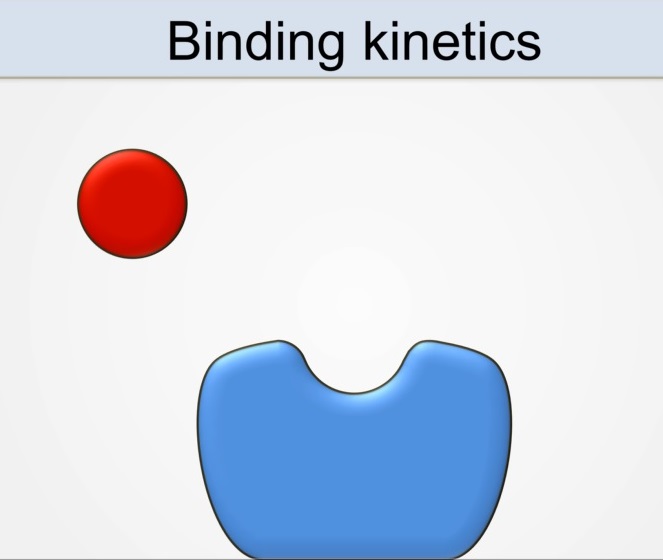
Therapeutic molecules exert their action by interacting with specific molecular targets. The first step in this binding process is the association of the drug ligand molecule with the target. Once bound, the ligand can then dissociate from the target (assuming the ligand binds reversibly and not covalently). These processes take time. This temporal dimension is referred to as binding kinetics or binding dynamics (1,2). The time it takes for a ligand to associate with the target is governed by the association rate, which is the rate of ligand recognition by the target. The time it takes the ligand to dissociate is determined by the dissociation rate, which quantifies the stability of the target-ligand complex. These principles are shown using animations of the binding process in the following video.
paragraph
Order 29
Style Figuregraphic
word/document.xml:/w:document[1]/w:body[1]/w:p[25]
paragraph
Order 30
Style VideoInformation
word/document.xml:/w:document[1]/w:body[1]/w:p[26]
file: Binding_kinetics_animation.mp4;mimetype: video mime-subtype: mp4
figure
Order 31
Style Figurenumberandcaption
word/document.xml:/w:document[1]/w:body[1]/w:p[27]
Figure. Video 1. Binding kinetics animation.
paragraph
Order 32
word/document.xml:/w:document[1]/w:body[1]/w:p[28]
The binding rates are fundamental properties of the drug-target interaction. They can impact the therapeutic action and side effect profile of the ligand, as described in numerous recent reviews (1-16). They also impact quantification of other drug parameters, such as affinity, resulting in erroneous estimates of activity if the rates are not considered appropriately (17-19). Useful introductory webinars are available here and here.
paragraph
Order 33
word/document.xml:/w:document[1]/w:body[1]/w:p[29]
The purpose of this chapter is to describe how to measure the kinetics of target-ligand interaction, specifically how to analyze binding kinetic data to measure the binding rate constants. Step-by-step analysis guides are provided, for the popular curve fitting program Prism (GraphPad Software, Inc). It is assumed the investigator has in hand an assay for measuring ligand binding. (Binding assay methods, briefly summarized in Basic Principles of Ligand Binding Kinetics and Table 1, are extensively reviewed in refs (15,16,20-22).) The chapter is organized as follows.
list
Order 35
Style ListParagraph
word/document.xml:/w:document[1]/w:body[1]/w:p[31]
- Basic principles of ligand binding kinetics.
list
Order 36
Style ListParagraph
word/document.xml:/w:document[1]/w:body[1]/w:p[32]
- Kinetic analysis methods for direct target-ligand binding assays. Applicable to targets where technology is available to directly measure target-ligand interaction.
list
Order 37
Style ListParagraph
word/document.xml:/w:document[1]/w:body[1]/w:p[33]
- Competition kinetics: Quantifying kinetics by competition against a tracer ligand. Often it isn’t feasible to measure ligand binding directly. Instead, competition binding approaches are employed where test ligand binding is assessed by inhibition of labeled “Tracer” ligand binding. This competition method can be used to quantify binding kinetics.
list
Order 38
Style ListParagraph
word/document.xml:/w:document[1]/w:body[1]/w:p[34]
- Compound washout method. An indirect method popular for kinase enzymes is the compound washout method, in which target and compound are pre-incubated, then compound washed out, and compound dissociation recorded by its ability to slow association of a tracer ligand.
list
Order 39
Style ListParagraph
word/document.xml:/w:document[1]/w:body[1]/w:p[35]
- Complex binding mechanisms. Sometimes the ligand binding mechanism is complex, for example involving multiple conformational states of the target. These more complex binding mechanisms and methods to measure their kinetics are introduced here.
list
Order 40
Style ListParagraph
word/document.xml:/w:document[1]/w:body[1]/w:p[36]
- Binding kinetics from functional assays. For some targets, only a functional assay is available (e.g. enzyme catalysis or receptor signaling) and in this section methods to measure ligand binding kinetics in these assays are introduced.
list
Order 41
Style ListParagraph
word/document.xml:/w:document[1]/w:body[1]/w:p[37]
- Appendix. Theoretical description of target-ligand binding and the equations used to analyze the data.
heading
Order 42
Level 2
Style Heading2
word/document.xml:/w:document[1]/w:body[1]/w:p[38]
H2. Basic Principles of Ligand Binding Kinetics
paragraph
Order 43
word/document.xml:/w:document[1]/w:body[1]/w:p[39]
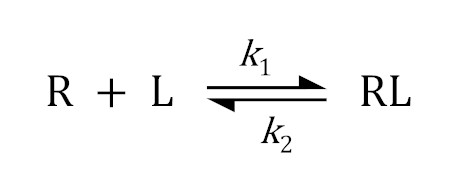
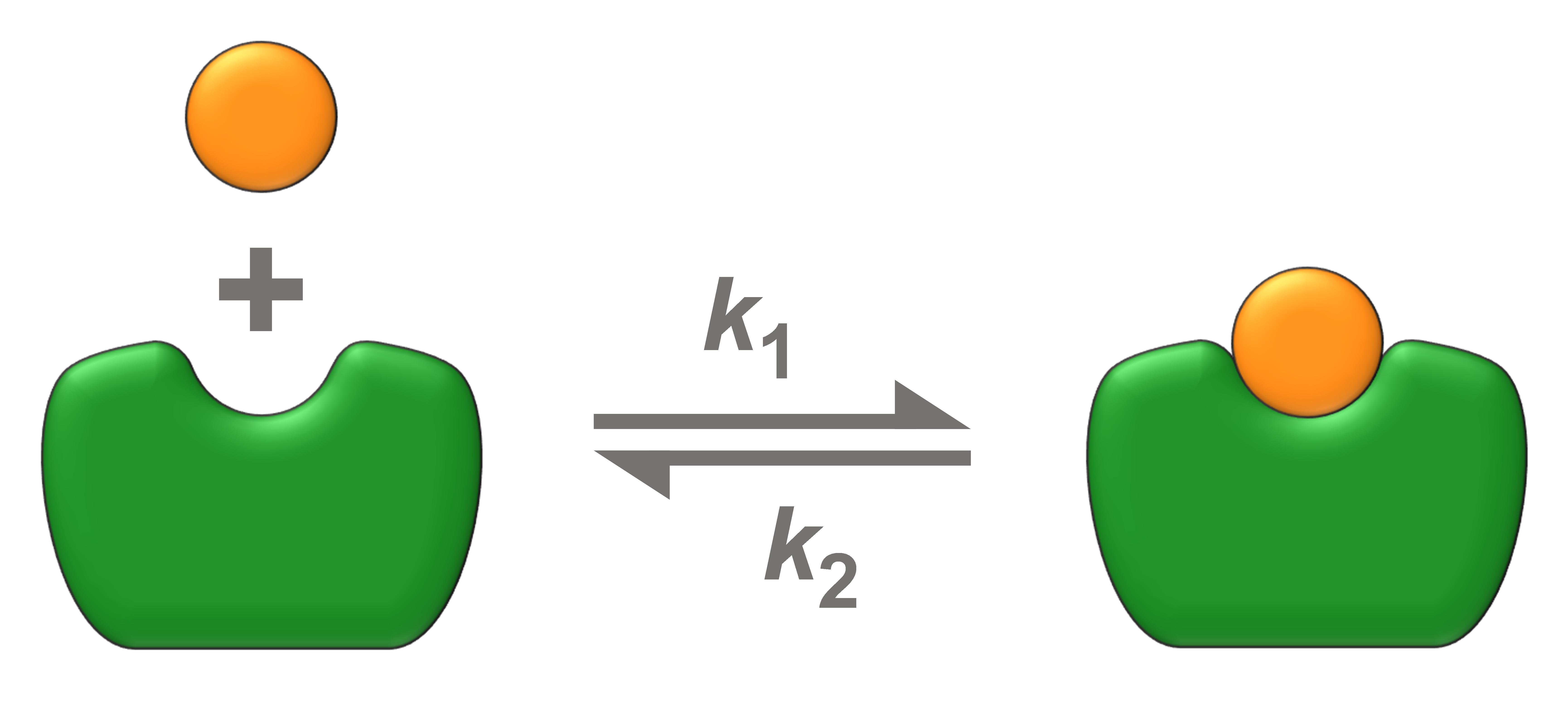
Most drugs bind their target by the classic bimolecular interaction. A single ligand molecule binds to a single site on the target, in a single step, as illustrated in Figure 1. The association step is governed by a rate constant called the association rate constant, denoted by the parameter k1. The binding is reversible and the rate of breakdown of the complex is governed by a rate constant termed the dissociation rate constant, denoted by k2. The process is shown in the video Binding kinetics animation (video 1). The interaction can be written schematically as:
paragraph
Order 44
Style Equation
word/document.xml:/w:document[1]/w:body[1]/w:p[40]
paragraph
Order 45
word/document.xml:/w:document[1]/w:body[1]/w:p[41]
where R is the target, L the ligand, and RL the target-ligand complex.
paragraph
Order 47
word/document.xml:/w:document[1]/w:body[1]/w:p[43]
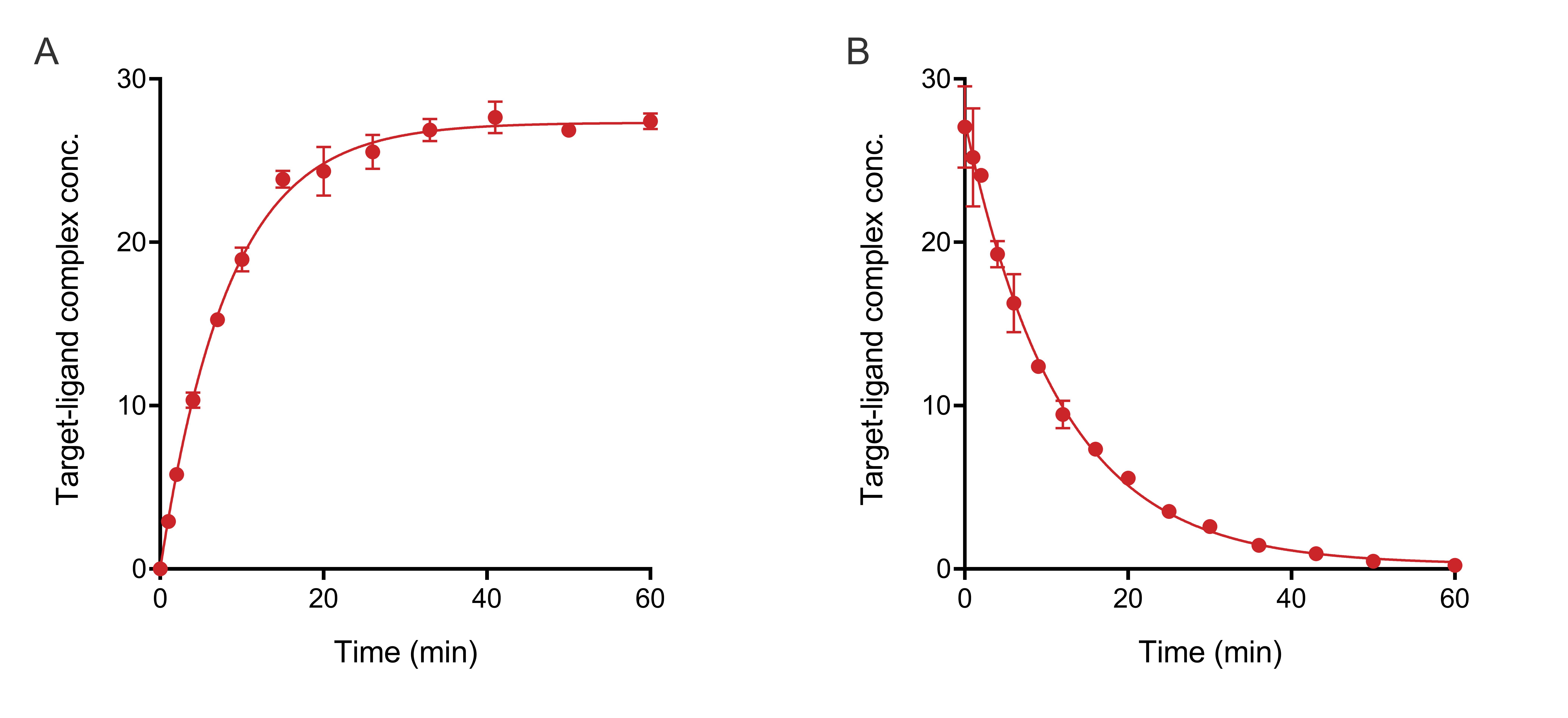
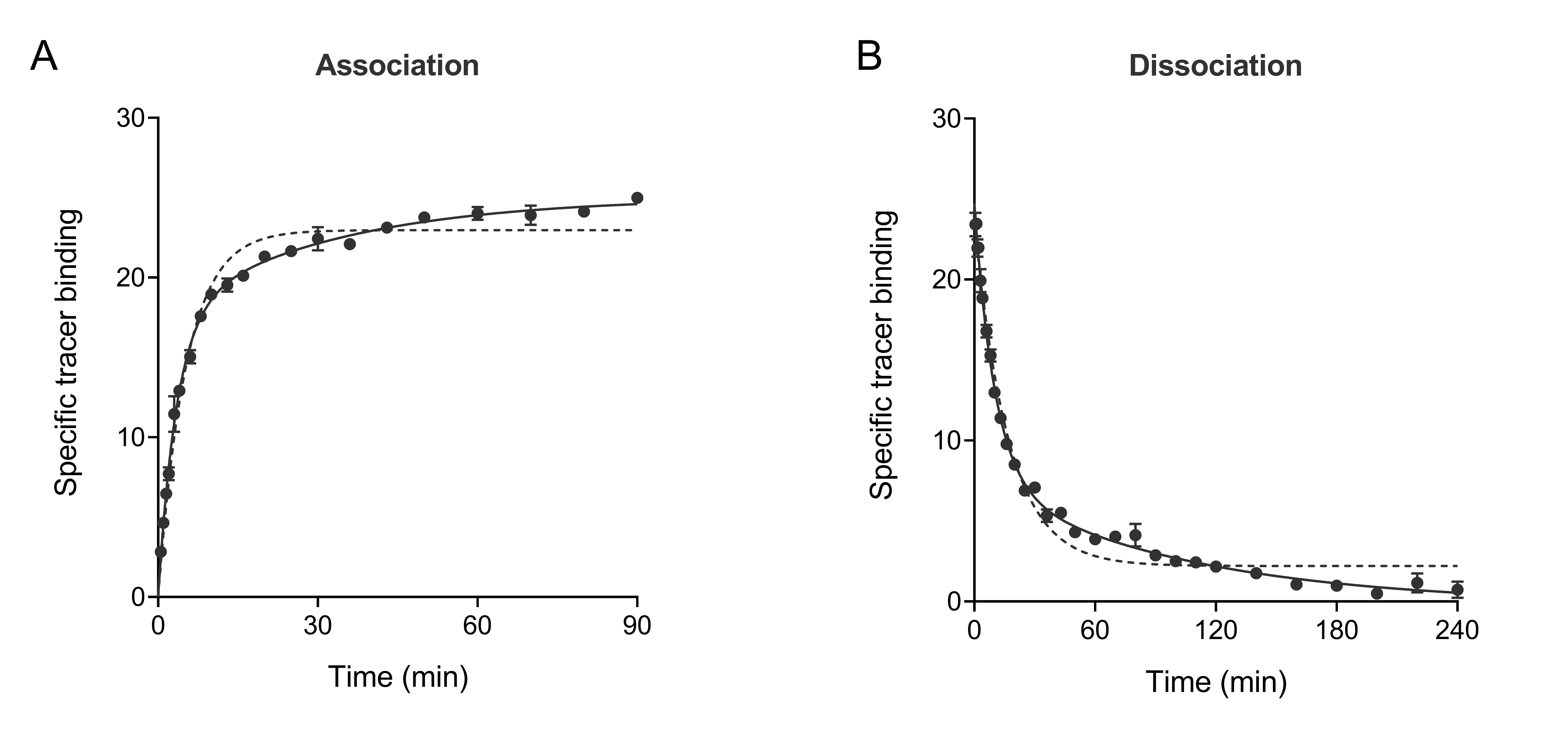
The appearance of this mechanism in binding data is shown in Figure 2, where the time courses of association and dissociation are presented, and also in the video Binding kinetics animation (video 1). The y axis is the concentration of target-ligand complexes. In the association time course data, following mixture of target and ligand, the amount of the target-ligand complex rises rapidly at the beginning (Figure 2A). The increase then slows down and then the level of binding approaches a plateau. This plateau represents the equilibrium level of binding (also referred to as binding at steady state). This curve shape is called an association exponential curve. Dissociation of the target-ligand population over time is shown in Figure 2B. Decline of the population is rapid at first, then slows, then approaches zero at which point all the complexes have broken down. The dissociation curve follows the classic exponential decay curve, familiar in radioactive decay.
paragraph
Order 49
word/document.xml:/w:document[1]/w:body[1]/w:p[45]
Unfortunately, the rate terms used to quantify kinetics are not intuitive for the uninitiated investigator. The units of the association rate constant are molar-1t-1 and of the dissociation rate constant t-1 (where t is time, in minutes or seconds). The larger the rate constant value, the more rapid the binding event (association or dissociation). In an attempt to make the dissociation data easier to interpret, dissociation is often quantified as the residence time (RT), which is the reciprocal of k2, i.e. 1 / k2. Alternatively, sometimes dissociation is quantified as the half-time, which is 0.693 / k2. These parameters give an estimate of the stability of the target-ligand complex, and so are more intuitive. However, the RT concept can give the misleading impression that every individual target-ligand complex in the population breaks down at this time. This is not the case. Dissociation is a random process (formally, a stochastic process) where an individual complex among the population can break down more rapidly or more slowly than the RT. The RT is an average of the population, formally the time at which the 63rd percentile of the population of targets breaks down. Detailed reviews on the mechanics of the association and dissociation process are available (20,23-26).
paragraph
Order 50
word/document.xml:/w:document[1]/w:body[1]/w:p[46]
The rate constants are related to the binding affinity, i.e. the concentration of ligand required to occupy 50% of the targetss at equilibrium. The equilibrium constant (Kd), a measure of affinity, is related to the rate constants as follows:
paragraph
Order 51
Style Equation
word/document.xml:/w:document[1]/w:body[1]/w:p[47]
paragraph
Order 52
word/document.xml:/w:document[1]/w:body[1]/w:p[48]
This relationship allows an alternative method for measuring affinity, rather than the standard method of titrating the ligand concentration and incubating until equilibrium is reached. Instead, the affinity is determined by measuring the association and dissociation rates (as described below) and affinity then calculated using the equation. This method is used routinely in surface plasmon resonance (SPR) binding assays (27).
heading
Order 55
Level 2
Style Heading2
word/document.xml:/w:document[1]/w:body[1]/w:p[51]
H2. Kinetic Analysis Methods for Direct Target-Ligand Binding Assays
paragraph
Order 56
word/document.xml:/w:document[1]/w:body[1]/w:p[52]
The goal is to measure the association rate constant k1 and dissociation rate constant k2. Here we measure the rate constants when an assay is available to directly quantify interaction of the ligand of interest with the target. A very broad array of assay technologies is available for measuring ligand binding and for the purposes of this chapter it is assumed the investigator has selected an appropriate binding assay for their target of interest. The methods and their suitability for kinetics are summarized in Table 1. The reader is referred to recent comprehensive reviews on binding assays ideally suited for kinetic measurements (15,16,20,21). The ideal assay permits serial reading of the binding reaction vessel, the “Real-time” continuous read modality, that enables multiple time point measurements in the same assay plate. Less ideal are end-point assays requiring a separate plate for each time point. Fluorescence or bioluminescence resonance energy transfer technologies are particularly useful for the continuous read modality (7,15,28,29).
paragraph
Order 57
word/document.xml:/w:document[1]/w:body[1]/w:p[53]
The type of data analyzed is specific binding, i.e. the ligand binding signal that is specific to the target. This involves subtracting nonspecific binding (to other components in the assay and assay surfaces) from the total ligand binding signal. It is best practice to do this for each time point of the time course, in case there is a slight drift of the nonspecific binding signal over time. Ideally nonspecific binding will remain constant over time. If there is a major drift of nonspecific binding this can indicate technical issues with the assay that need to be resolved, e.g. photobleaching of fluorescent ligands.
heading
Order 59
Level 3
Style Heading3
word/document.xml:/w:document[1]/w:body[1]/w:p[55]
H3. Association Rate Constant from a Direct Target-Ligand Binding Assay
paragraph
Order 60
word/document.xml:/w:document[1]/w:body[1]/w:p[56]
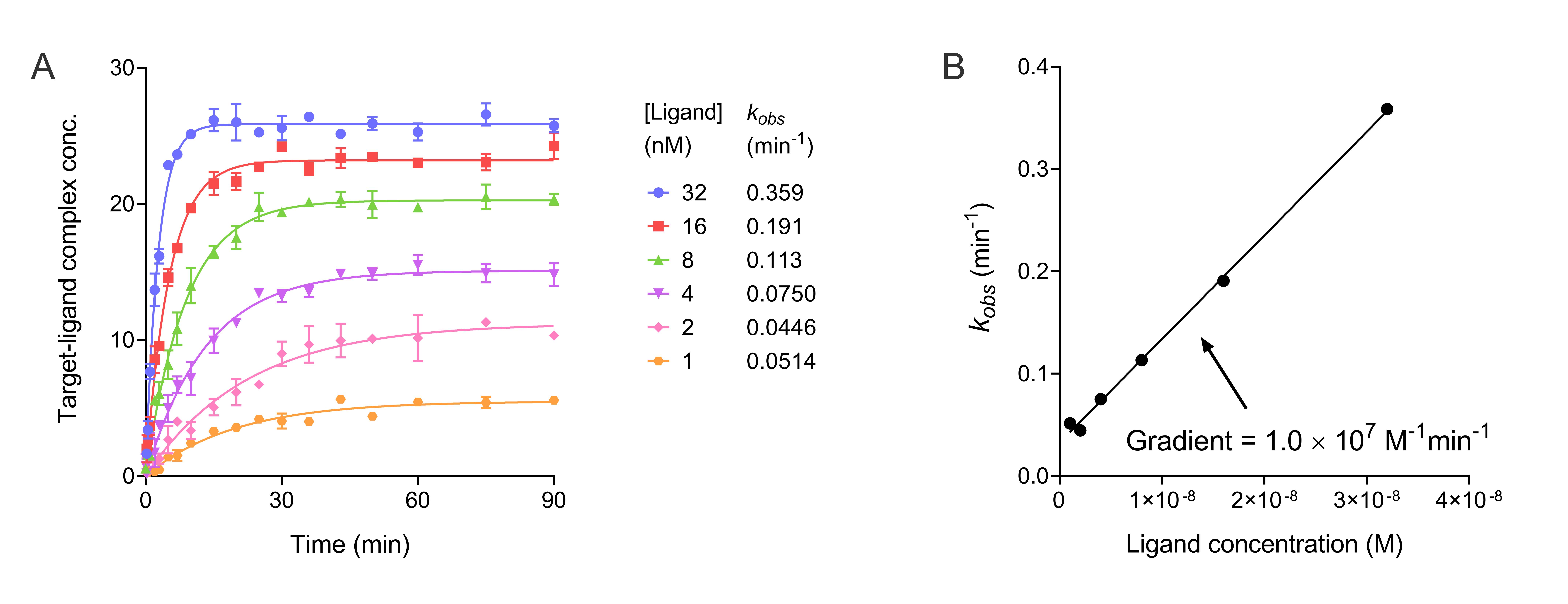
The association rate constant is measured using a target-ligand association assay. Ligand and target are combined and then binding of the target-ligand complex is measured at various time points (Figure 3). The resulting association curve conforms to an exponential association curve, as described above. Multiple concentrations of tracer are tested in the experiment and the data are analyzed in a two-step process. First, the time course data are fit to an exponential equation. This yields a parameter called the observed association rate, a separate value for each ligand concentration. Second, the observed association rate is plotted against the ligand concentration. The data are then fit by linear regression. k1 is then determined, as the gradient of the line.
paragraph
Order 62
word/document.xml:/w:document[1]/w:body[1]/w:p[58]
The assay setup considerations are detailed in Box 1. Enough time points should be collected to properly define the curve, particularly the rise phase and plateau. Some iteration will likely be required to identify the optimal range of time points to satisfy these criteria. The concentration of tracer should span at least a 10-fold range with concentrations above and below the Kd. Precise ligand serial dilution is required, i.e. there should be minimal loss of ligand to surfaces on serial dilution. This is particularly important for high-affinity ligands where the concentration in the experiment is in the low nM or pM range. The concentration of ligand bound at the plateau of the time course should ideally be less than 10% of the total ligand concentration, as described in (22) (“Zone A”) although < 20% is acceptable. It is possible to analyze data when a substantial fraction of the ligand is bound by the target but this requires a different analysis (see, for example, Eq. 11 in ref. (40)). The tracer and target must be stable over the duration of the experiment.
paragraph
Order 63
word/document.xml:/w:document[1]/w:body[1]/w:p[59]
Representative data for the association experiment are shown in Figure 3, for six concentrations of ligand. Note that as the concentration of ligand increases, the rate of association increases. This is evident visually by the steepness of the initial part of the time course increasing as the ligand concentration increases (Figure 3A). This is because association is driven by mass action; the more ligand, the faster the target becomes occupied. Now we proceed with the data analysis. The first step is to fit the time course data to the appropriate exponential equation. The equation used is the association exponential equation, which emerges from the underlying theory of target-ligand binding kinetics described in the Appendix. This equation is Eq. 1:
paragraph
Order 65
Style Equation
word/document.xml:/w:document[1]/w:body[1]/w:p[61]
RL=RLtinf×1-e-kobst Eq. 1
paragraph
Order 66
word/document.xml:/w:document[1]/w:body[1]/w:p[62]
where [RL] is the concentration of target-ligand complex (the y axis value), t the time (the x axis value), and [RL]t(inf)the concentration of target-ligand complex at the plateau, i.e. at infinite time. kobs is a parameter termed the observed rate constant. It is the observed rate of association of ligand with target at the concentration of ligand tested. It is important to stress that kobs is not the same as the association rate constant, k1. kobs is related to k1, as described below.
paragraph
Order 67
word/document.xml:/w:document[1]/w:body[1]/w:p[63]
The time course data can be analyzed using commercially-available software, including Prism from GraphPad Software, Inc., XLfit from ID Business Solutions Ltd., and SigmaPlot from Systat Software, Inc. Eq. 1 is built into these programs. Here we show how to analyze these data using Prism (Version 8 is used but the equations are available in all previous versions). A step-by-step guide is shown in the supplementary file “Association data analysis.” The procedure employs nonlinear regression to fit the time course data to the exponential association equation (Eq. 1). Data for each concentration of ligand is fit to the equation, yielding a kobs value for each concentration (Figure 3A). The built-in equation in Prism is called, “One-phase association.”(41) Note this equation is formatted slightly differently from Eq. 1. (Y0 in the Prism equation is binding at t = 0 (constrained to be zero), Span is equivalent to [RL]t(inf), and K is equivalent to kobs (41)).
paragraph
Order 68
word/document.xml:/w:document[1]/w:body[1]/w:p[64]
The second step is the determination of k1. This is done by plotting the kobs values versus the concentration of ligand (Figure 3B). The data are then fit by linear regression to determine the slope and intercept of the line (as detailed in the supplementary file “Association data analysis”). The k1 value is the gradient of the line. Applying this analysis to the data in Figure 3 gives a k1 value of 1.0 107 M-1min-1. This analysis assumes the experiment works ideally. Box 2 details troubleshooting tips when the data do not conform to the ideal.
paragraph
Order 69
word/document.xml:/w:document[1]/w:body[1]/w:p[65]
The underlying theory of this second step is the equation defining the observed association rate. This equation, derived in the Appendix, is:
paragraph
Order 71
Style Equation
word/document.xml:/w:document[1]/w:body[1]/w:p[67]
paragraph
Order 73
word/document.xml:/w:document[1]/w:body[1]/w:p[69]
This is a straight line equation of the form y=mx+c, where the gradient m is equal to k1. This equation also indicates something interesting. The dissociation rate constant k2 can in principle, also be estimated from this analysis – visual inspection of the equations indicates it is the y intercept of the straight line equation. However, this approach is not advised for measuring k2 – it is better to measure this parameter directly using a dissociation experiment, as described next.
heading
Order 77
Level 3
Style Heading3
word/document.xml:/w:document[1]/w:body[1]/w:p[73]
H3. Dissociation Rate Constant from a Direct Target-Ligand Binding Assay
paragraph
Order 78
word/document.xml:/w:document[1]/w:body[1]/w:p[74]
Measuring dissociation of ligand from a target requires a two-step assay. First, the target-ligand complex needs to form. Ligand and target are incubated together for a sufficient time, usually until equilibrium has been approached (the plateau of the association curve). In the next phase, the dissociation of ligand from the target is measured. This is initiated by an experimental intervention that stops association of the ligand with the target. With association blocked, the only process that takes place is dissociation. This results in a decrease of the target-ligand complex concentration over time (Figure 2B). In this way, the rate of dissociation can be quantified. This is usually done for a single concentration of ligand, at a concentration suitable to obtain sufficient signal, typically 3-fold the Kd concentration.
paragraph
Order 79
word/document.xml:/w:document[1]/w:body[1]/w:p[75]
The intervention that initiates the dissociation phase is of two types: 1) If the ligand is labeled, an excess of unlabeled ligand is added. The excess prevents association by out-competing the labeled ligand for binding to the target. The concentration of unlabeled ligand used is 100-300-fold the IC50 for the ligand in a competition binding assay versus the labeled ligand. 2) Washout of the labeled ligand. With one exception, this method is not recommended because it is challenging to determine that the labeled ligand has been completely washed out, especially in cell membrane-based binding assays employing hydrophobic ligands. The exception is SPR assays, in which washing of the surface is a continuous default process in the assay modality (27). In SPR assays, dissociation is initiated by the washout method.
paragraph
Order 80
word/document.xml:/w:document[1]/w:body[1]/w:p[76]
Representative data are shown in Figure 2B. These binding data are specific tracer binding, i.e. data from which nonspecific binding has been subtracted. (It is good practice to measure and subtract nonspecific binding at each time point.) After the dissociation phase is initiated, the target binding signal declines, with the shape of the decline being the exponential decay curve (Figure 2B). After sufficient time, the specific binding signal declines to zero, i.e. all the target-ligand complexes dissociate (see Box 3 for when the signal does not decline to zero). It is desirable to determine the level of binding immediately before the initiation of the dissociation phase, if possible (giving the binding level at t = 0 of the dissociation phase).
paragraph
Order 81
word/document.xml:/w:document[1]/w:body[1]/w:p[77]
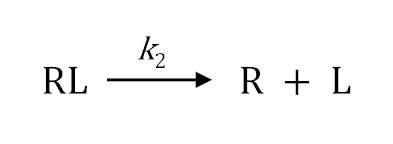
The data analysis is simpler than that for association, requiring only a single step. All that is required is fitting the data to an exponential decay equation by nonlinear regression. The equation is Eq. 2, derived in the Appendix:
paragraph
Order 83
Style Equation
word/document.xml:/w:document[1]/w:body[1]/w:p[79]
paragraph
Order 85
word/document.xml:/w:document[1]/w:body[1]/w:p[81]
where [RL]t0 is the concentration of target-ligand complexes immediately before initiation of the dissociation phase (the t = 0 binding level) and k2 the dissociation rate constant. Analyzing the data in Figure 2 gives a k2 value of 0.086 min-1. This corresponds to a RT of 1 / 0.086 = 12 min. The binding data used in the analysis is target-specific binding, as described above. This analysis can be done in commercially available software; Eq. 2 or an analogous equation is built into these programs. A step-by-step guide using Prism is provided in the supplementary file “Dissociation data analysis.” The built-in equation in Prism is called, “One-phase decay.” (43) Note this equation is formatted slightly differently from Eq. 2. It includes a baseline term called “Plateau” which is binding at infinite time (which is assumed to be zero in Eq. 2). The rate term is called “K,” which is equivalent to k2. Troubleshooting the analysis is presented in Box 3.
heading
Order 88
Level 2
Style Heading2
word/document.xml:/w:document[1]/w:body[1]/w:p[84]
H2. Competition Kinetics: Quantifying Kinetics by Competition Against a Tracer Ligand
heading
Order 90
Level 3
Style Heading3
word/document.xml:/w:document[1]/w:body[1]/w:p[86]
paragraph
Order 91
word/document.xml:/w:document[1]/w:body[1]/w:p[87]
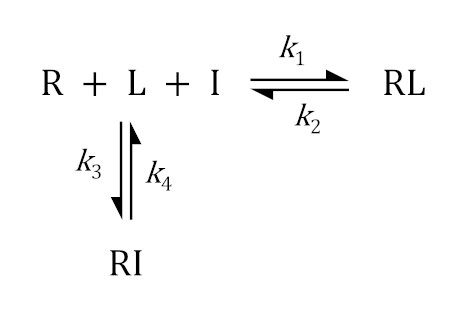
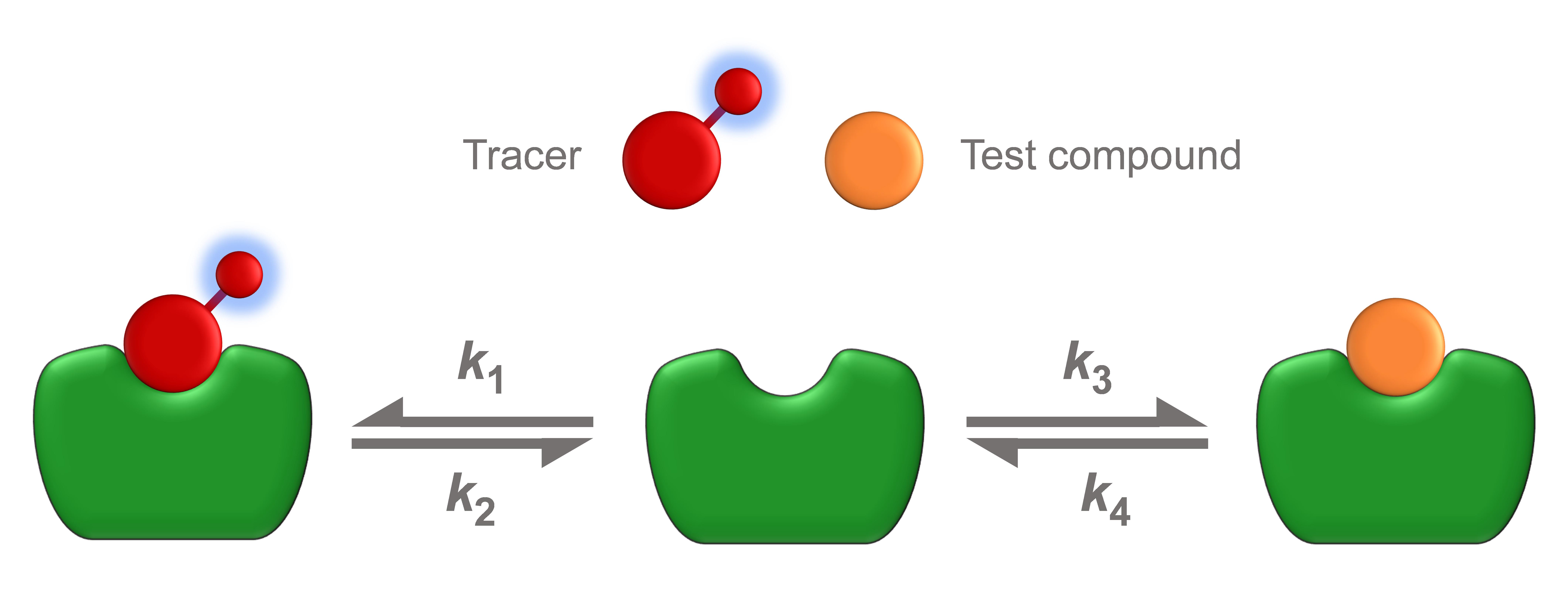
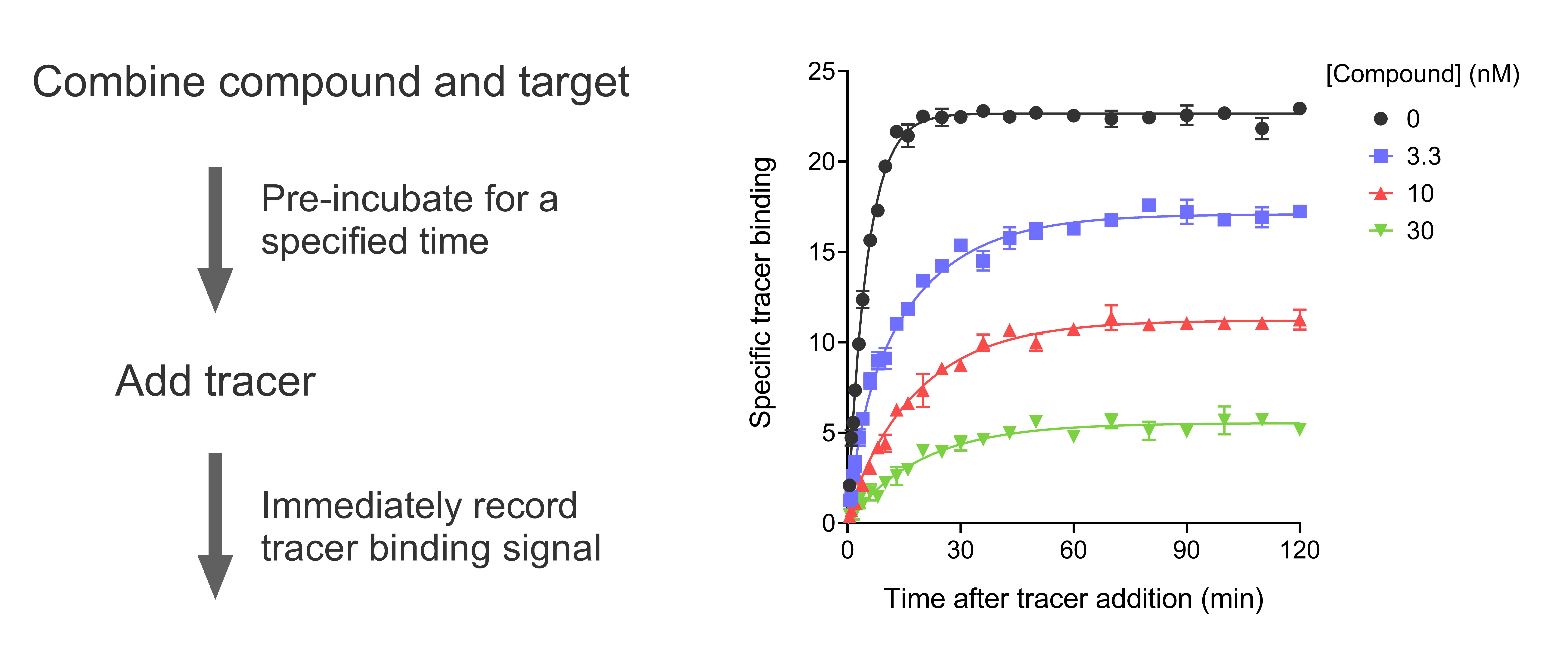
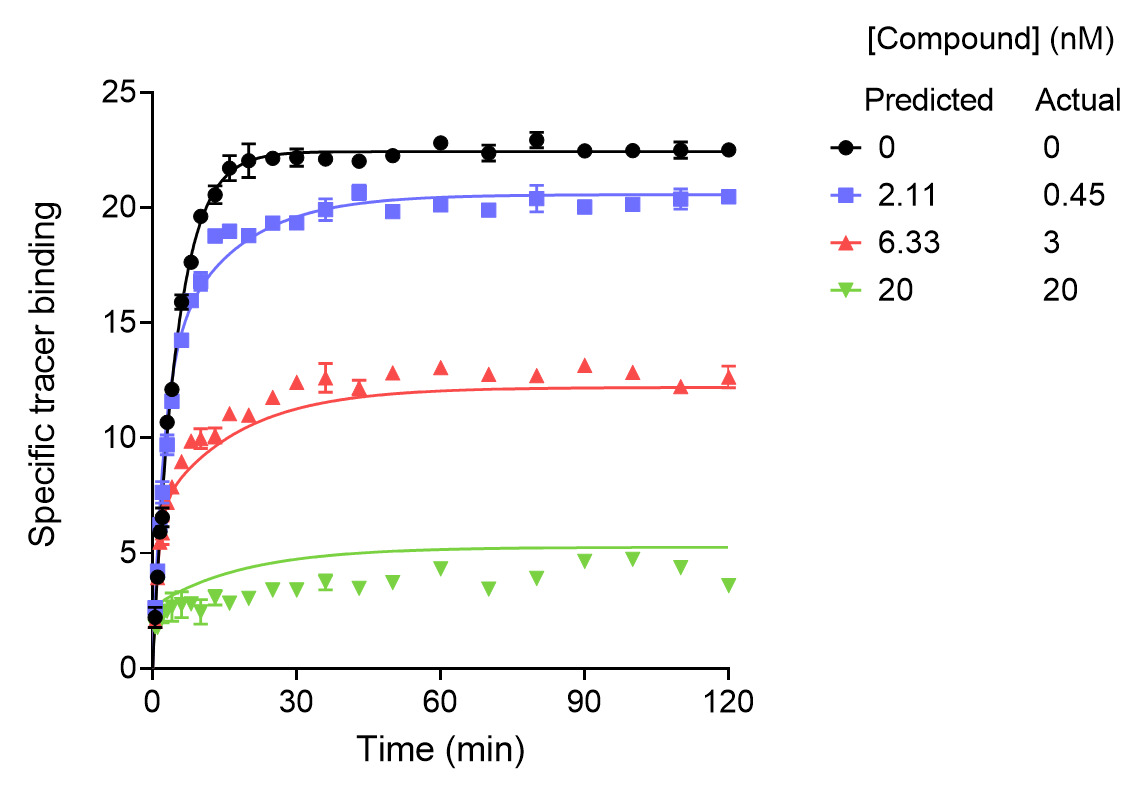
The sections above assume a direct method for measuring ligand binding to the target. However, this is usually not the case and instead a competition assay is used, particularly in lead optimization campaigns when large numbers of compounds are being tested. Competition assays are the familiar method for measuring ligand binding of unlabeled compounds (22). An unlabeled test ligand is incubated at various concentrations in competition with a tracer ligand for binding to the target. The test ligand inhibits tracer ligand binding and from this inhibition the binding of the test ligand can be determined. This method is used to measure affinity (Ki) (22) and is familiar to most investigators. Fortunately, the same approach can be used to measure the kinetics of the unlabeled test compound (association and dissociation rate constants) (Figure 4). This method is called “kinetics of competitive binding” or “competition kinetics” and the original papers describing it are refs. (18,19). The competition assay is run in kinetic mode; multiple concentrations of compound are tested at multiple time points (Figs. 5 and 6). The data are then fit to an equation by nonlinear regression, in a program like Prism. The analysis provides estimates of the association and dissociation rate constants of the test ligand. Two recent papers have provided a detailed description and evaluation of this method and its sensitivity limits (45,46). For examples of the method's application see refs. (7,45,49,50)
paragraph
Order 92
word/document.xml:/w:document[1]/w:body[1]/w:p[88]
The binding mechanism is shown in Figure 4. Unlabeled test ligand competitively inhibits tracer ligand binding to the target. Both ligands bind reversibly in a simple one-step bimolecular interaction. The rate constants are termed, by convention, k1 and k2 for the tracer association and dissociation rate constant, respectively, with the corresponding terms being k3 and k4 for the unlabeled test ligand.
heading
Order 96
Level 3
Style Heading3
word/document.xml:/w:document[1]/w:body[1]/w:p[92]
paragraph
Order 97
word/document.xml:/w:document[1]/w:body[1]/w:p[93]
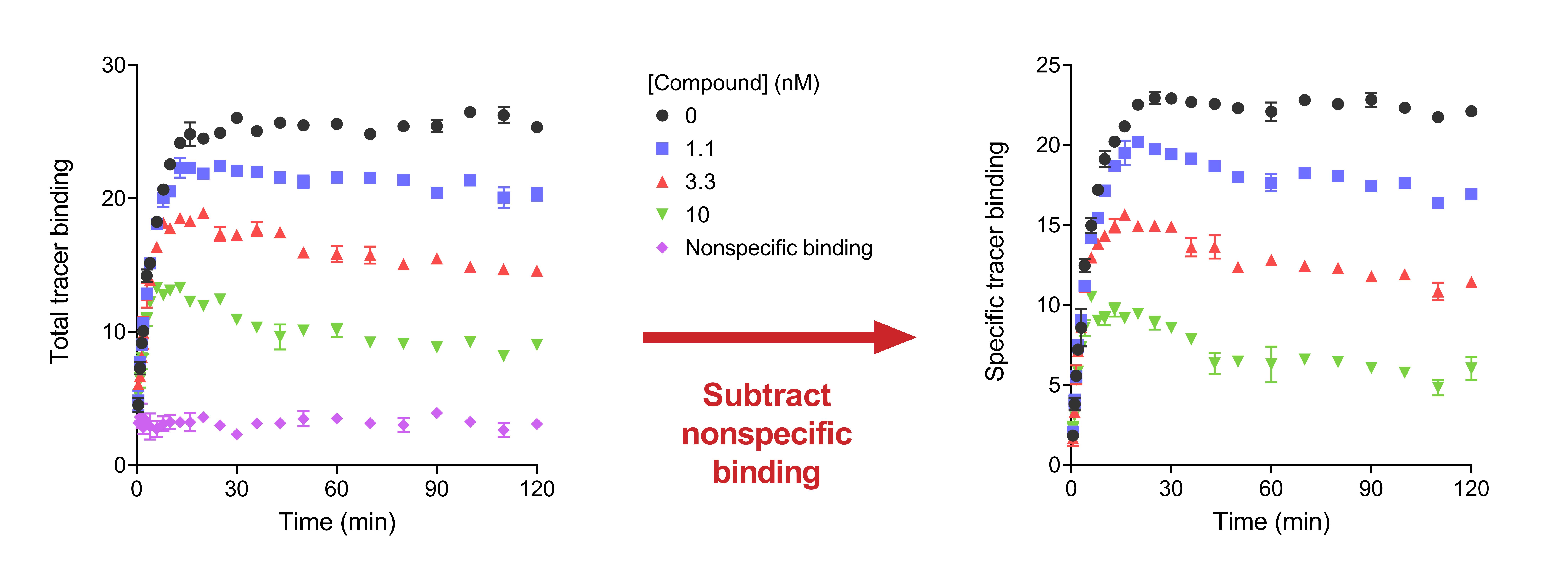
The typical assay consists of five conditions (Box 4). Three concentrations of test compound are competed against the tracer ligand. There are two controls - tracer binding in the absence of test ligand, and nonspecific binding (measured at all time points) (Figure 5). The compound concentration range should span at least 25-75% inhibition of tracer binding at equilibrium. Consequently, a preliminary experiment needs to be done, an equilibrium binding assay to determine the IC50 of the test ligand. With the IC50 in hand, the ligand concentrations for the kinetic assay can be calculated. For three concentrations, the following calculation is used
paragraph
Order 98
word/document.xml:/w:document[1]/w:body[1]/w:p[94]
25% inhibition – use 0.33-fold the IC50 concentration
paragraph
Order 99
word/document.xml:/w:document[1]/w:body[1]/w:p[95]
paragraph
Order 100
word/document.xml:/w:document[1]/w:body[1]/w:p[96]
paragraph
Order 101
word/document.xml:/w:document[1]/w:body[1]/w:p[97]
So if the IC50 is 10 nM, the concentrations will be 3.3, 10 and 30 nM.
paragraph
Order 102
word/document.xml:/w:document[1]/w:body[1]/w:p[98]
The compound serial dilution needs to be precise. The kinetic analysis is particularly unforgiving of imprecise dilution, i.e. the concentration in the assay being different from that predicted by the serial dilution calculation. Use of low-binding plasticware is recommended, and serial dilution in the ideal solvent for the ligand is required (e.g. DMSO for small molecules).
paragraph
Order 103
word/document.xml:/w:document[1]/w:body[1]/w:p[99]
The concentration of tracer now needs to be selected. As a rule of thumb, a concentration 3-fold the Kd concentration is ideal. The tracer concentration selection is affected by three considerations. First, sufficient signal is required for sufficient robustness of detection of the binding signal. Second, the speed of the association needs to be controlled. Speed of association is dependent on ligand concentration, as described in Association Rate Constant from a Direct Target-Ligand Binding Assay and shown in Figure 3. If the concentration is too high, the association will be too rapid for there to be sufficient data points on the early part of the curve, necessary to robustly quantify the kinetics. If the concentration is too low, the association will take too long to measure. Ideally the concentration should allow at least four time points before the half-time of tracer association and at least 12 after, within the constraints of the workflow and instrumentation. Third, “Zone A” needs to be satisfied – the ligand concentration needs to be high enough that at most 20% of the tracer ligand is bound at the end of the experiment (i.e. at the plateau). This criterion also applies to the unlabeled ligand (see Box 5, “Troubleshooting the competition kinetics assay”).
paragraph
Order 104
word/document.xml:/w:document[1]/w:body[1]/w:p[100]
Next, the duration of the time course needs to be selected. At least four time points should be included before the half-time of the control association curve (absence of unlabeled compound). Then at least 12 time points after the half-time should be included. The last time point recommended in exploratory experiments is two hours. This will give sufficient time to quantify RTs of up to an hour. Longer RTs require longer time courses to quantify accurately (45,46). As a rough rule of thumb, the time course duration should be at least double the RT of the unlabeled compound. In Box 4, time points are presented that provide a guide for pilot experiments. A large number of time points is recommended to accurately quantify the rates. For this reason, continuous-read assay modalities such as fluorescent ligand binding are ideal (7,15,28,29).
heading
Order 107
Level 3
Style Heading3
word/document.xml:/w:document[1]/w:body[1]/w:p[103]
paragraph
Order 108
word/document.xml:/w:document[1]/w:body[1]/w:p[104]
The goal of the data analysis is determination of k3 and k4, the association and dissociation rate constant of the unlabeled test compound. The analysis proceeds in a series of steps:
list
Order 110
Style ListParagraph
word/document.xml:/w:document[1]/w:body[1]/w:p[106]
- Subtraction of nonspecific binding.
list
Order 111
Style ListParagraph
word/document.xml:/w:document[1]/w:body[1]/w:p[107]
- Fitting the control curve to determine k1.
list
Order 112
Style ListParagraph
word/document.xml:/w:document[1]/w:body[1]/w:p[108]
- Fitting the test compound curves to determine k3 and k4.
paragraph
Order 114
word/document.xml:/w:document[1]/w:body[1]/w:p[110]
The first step is the subtraction of nonspecific binding from the total binding signal and this is shown in Figure 5. Nonspecific binding at a given time point is subtracted from the total binding value at that time point, giving the target-specific binding value.
paragraph
Order 119
word/document.xml:/w:document[1]/w:body[1]/w:p[115]
The resulting specific binding data are now analyzed by nonlinear regression. For the analysis to work, certain parameter values need to be determined first. Specifically, k1 and k2 (the association and dissociation rate constants of the tracer, respectively). k2 is determined in a dissociation experiment which is run separately, and is usually determined in the characterization of the tracer (see Dissociation Rate Constant from a Direct Target-Ligand Binding Assay). k1 is handled differently. The k1 value is determined within the experiment, from the control (tracer binding without unlabeled compound). This is done as follows. The control curve data are fitted to the following equation (Eq. 3):
paragraph
Order 121
Style Equation
word/document.xml:/w:document[1]/w:body[1]/w:p[117]
RL=Bmax[L]k1Lk1+k2×1-e-Lk1+k2t Eq. 3
paragraph
Order 123
word/document.xml:/w:document[1]/w:body[1]/w:p[119]
This equation is built into Prism, named “Association kinetics - One conc. of hot.” (47) A step-by-step guide on how to use it is provided in the supplementary file “Competition kinetics analysis”. k1 and Bmax are fitted in the analysis and [L] and k2 are entered as constants (note the Prism equation uses slightly different terminology - k1 is termed Kon, k2 is Koff, and [L] is Hotnm (47)). Bmax is the total concentration of targets in the units used on the y axis (e.g. cpm or dpm for a radioligand binding assay). [L] is the concentration of tracer ligand, in molar concentration for Eq. 3 and entered as nM concentration for the Prism equation.
paragraph
Order 124
word/document.xml:/w:document[1]/w:body[1]/w:p[120]
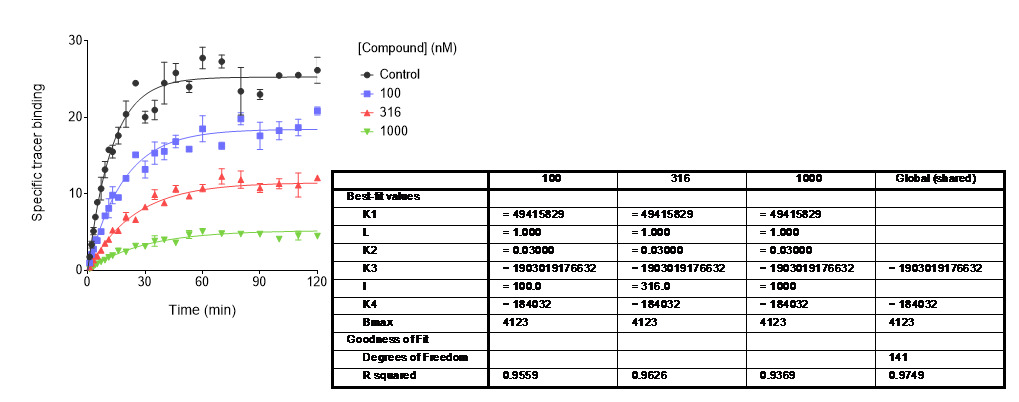
Now we are ready to analyze the test compound curves to determine k3 and k4. This has been streamlined in Prism so that the user operates the analysis in the same was as other more familiar curve-fitting procedures (like dose-response analysis). The equation is complex (Eq. 4 shown at the end of this section) but has been pre-loaded into Prism (48) so the user simply selects it as the equation option and runs the analysis. There is one additional dimension to the data analysis. All the compound curves are analyzed simultaneously. This is done in Prism by labeling the column header in the data table with the compound concentration (48). Other programs that can handle this three-dimensional nonlinear regression are SigmaPlot and XLfit.
paragraph
Order 125
word/document.xml:/w:document[1]/w:body[1]/w:p[121]
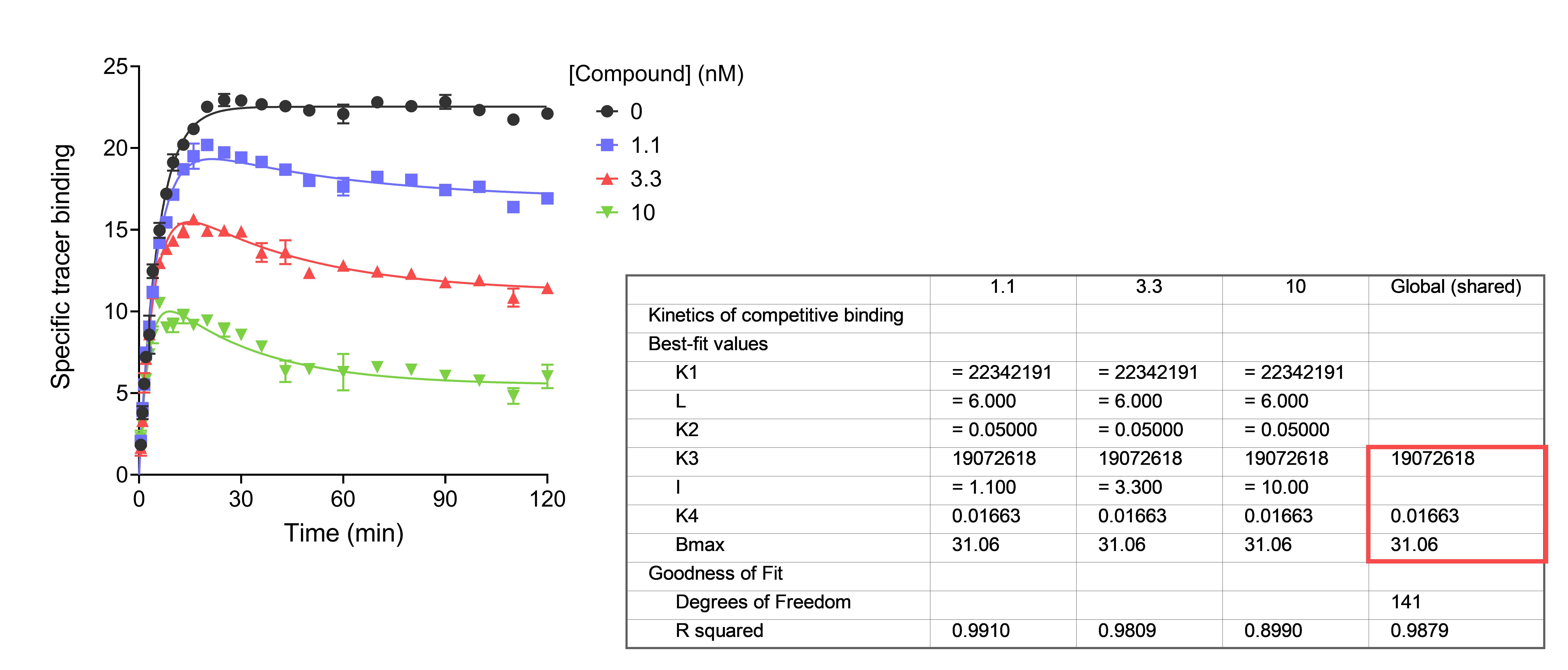
A step-by-step guide to the fitting procedure is shown in the supplementary file, “Competition kinetics analysis.” The output is the fitted value of k3 and k4, the association and dissociation rate constants of the unlabeled compound, and Bmax, the total number of ligand binding sites. A representative graph showing the curve fits and fitted values is shown in Figure 6. The fitted value of k3 is 1.9 107 M-1min-1 and of k4 is 0.017 min-1. The RT (1 / k4) is then 59 min.
paragraph
Order 126
word/document.xml:/w:document[1]/w:body[1]/w:p[122]
The equation for the analysis is Eq. 4 (18,19):
paragraph
Order 128
Style Equation
word/document.xml:/w:document[1]/w:body[1]/w:p[124]
RL=BmaxLk1KF-KSk4KF-KSKFKS+k4-KFKFe-KFt-k4-KSKSe-KSt Eq. 4
paragraph
Order 130
word/document.xml:/w:document[1]/w:body[1]/w:p[126]
paragraph
Order 131
Style Equation
word/document.xml:/w:document[1]/w:body[1]/w:p[127]
KF=0.5KA+KB+KA-KB2+4LIk1k3
paragraph
Order 132
Style Equation
word/document.xml:/w:document[1]/w:body[1]/w:p[128]
KS=0.5KA+KB-KA-KB2+4LIk1k3
paragraph
Order 133
Style Equation
word/document.xml:/w:document[1]/w:body[1]/w:p[129]
paragraph
Order 134
Style Equation
word/document.xml:/w:document[1]/w:body[1]/w:p[130]
paragraph
Order 136
word/document.xml:/w:document[1]/w:body[1]/w:p[132]
The fitted parameters are k3, k4 and Bmax. The parameters fixed at constant values in the analysis are [L], [I], k1 and k2. [I] is the inhibitor concentration in molar concentration for Eq. 4 and entered as nM concentration in Prism. The parameters KF, KS, KA and KB are combinations of the other parameters, introduced to simplify writing of the equation into curve-fitting programs.
heading
Order 141
Level 3
Style Heading3
word/document.xml:/w:document[1]/w:body[1]/w:p[137]
H3. Shape of the Curves Can Diagnose the Residence Time of the Test Compound
paragraph
Order 142
word/document.xml:/w:document[1]/w:body[1]/w:p[138]

An interesting observation is immediately obvious on inspecting the data in Figure 6 – the curves are of an unusual shape. There is an overshoot of the tracer binding curve in the presence of compound, before the curve returns to a plateau value. This phenomenon arises when the RT of the test compound is longer than that of the tracer (18,19,45,46). More generally, the shape of the curve can diagnose the RT of the test compound, relative to the RT of the tracer. This is shown in Figure 7. Competition kinetics data are shown for compounds with a range of RTs, from 300 min to 3 min. The tracer RT is 67 min. It can be seen that when the compound RT is longer than the tracer RT, the overshoot phenomenon occurs (Figure 7A, 300 min and 7B, 100 min). The longer the RT, the more pronounced the overshoot (compare Figure 7A and B). When the compound RT is slightly shorter than the tracer RT (30 min, Figure 7C), a biphasic curve is evident – there is an initial rapid burst of binding followed by a shallower phase as the curve approaches the plateau. When the compound RT is short relative to the tracer (10 min and 3 min) the curve resembles a monophasic curve, similar in shape but different in dimensions to the control curve (Figure 7D,E).
heading
Order 146
Level 3
Style Heading3
word/document.xml:/w:document[1]/w:body[1]/w:p[142]
H3. Limits of Sensitivity
paragraph
Order 147
word/document.xml:/w:document[1]/w:body[1]/w:p[143]
Like any other assay, there are limits to the sensitivity of the competition kinetics approach, specifically for quantifying the RT. This has been emphasized in two recent studies (45,46). If the RT is too short or too long, the analysis is unable to provide a realistic estimate of k4. (Typically a short RT value in this context is less than 1 min and a long value > 3 hr.) Under these conditions, a false fit can result – the program is able to fit a curve, but the parameters are physically meaningless. Consequently, it is important for investigators not to take the fitted values at face value but rather to consider them within the limits of sensitivity of the analysis. Fortunately, intuition is a good guide in most cases. For example, if dissociation of a test compound is rapid, a high-frequency of reads and an early first read time is necessary; in other words, detecting rapid dissociation requires rapid sampling of the binding reaction (45,46). Reciprocally, detecting slow dissociation requires the duration of the assay to be long (45,46).
paragraph
Order 148
word/document.xml:/w:document[1]/w:body[1]/w:p[144]
The limits of sensitivity were recently evaluated by simulation – Monte Carlo analysis was used to simulate virtual experiments under a variety of conditions. The reader is referred to refs (45,46) for a comprehensive evaluation. In this chapter, two examples are presented to show what the data look like when the limits of sensitivity are breached. The examples were constructed using the easy-to-follow methods described in the supplementary information of ref. (45), which investigators can use to evaluate their own systems. Here a best-case assay technology scenario is assumed, where there are no major limitations on sampling frequency, initial read time, or signal stability (for example, a resonance energy transfer continuous read assay with autoinjectors and a stable signal; see refs. (45,46) for the impact of these technical limitations).
paragraph
Order 149
word/document.xml:/w:document[1]/w:body[1]/w:p[145]
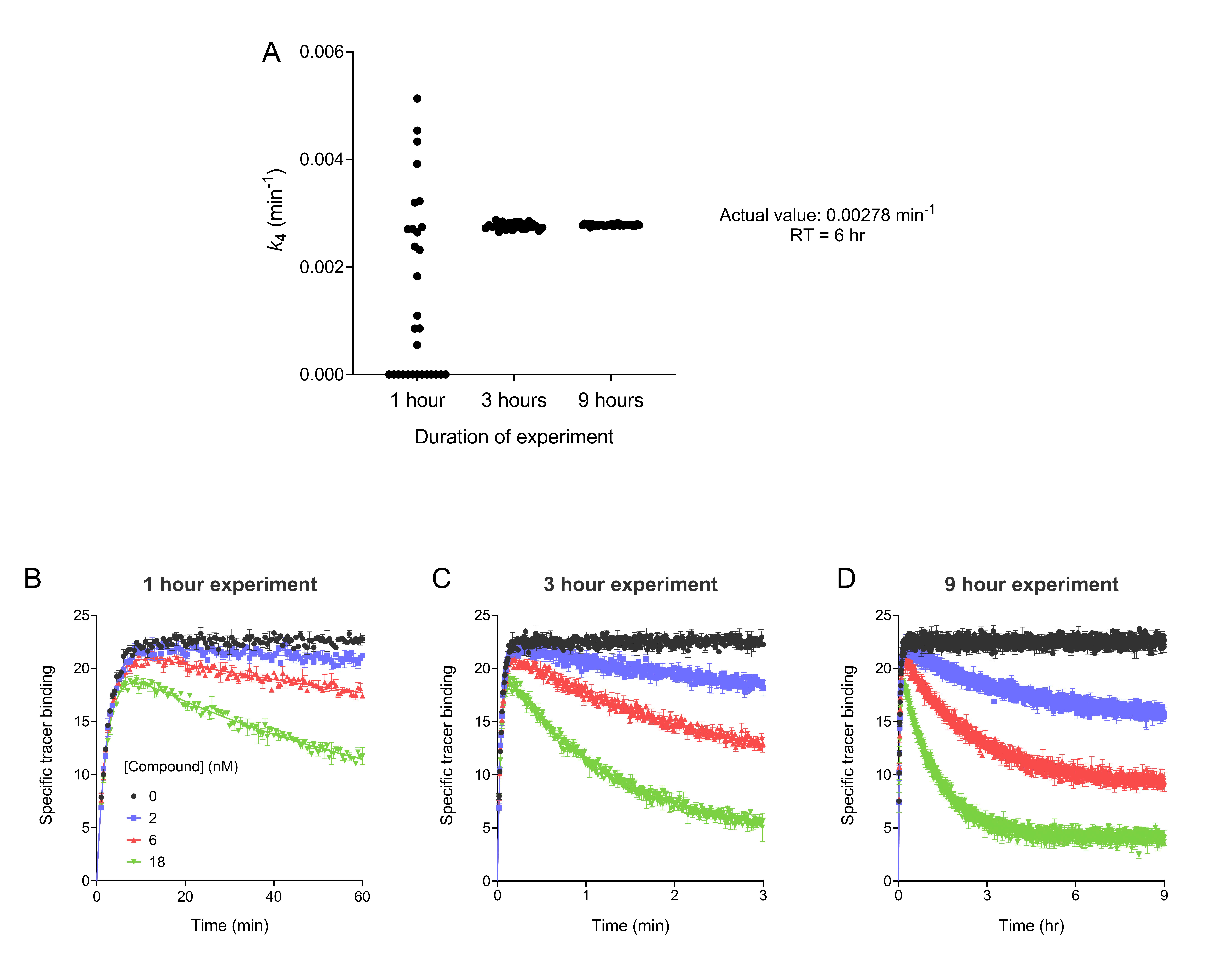
Figure 8 shows a limit of sensitivity issue for long RT compounds. This simulation shows the effect of the assay run time (total observation time) on estimating the dissociation rate of a compound with a long RT (6 hr). If the run time is too short, the dissociation rate of the compound is poorly estimated (more precisely, the fitted k4 value is highly variable between experimental runs). This is shown by the large range of fitted k4 values in Figure 8A for a run time of 1 hr. Increasing the run time to 3 hr dramatically reduces the variability and increasing to 9 hr produces a further, slight improvement (Figure 8A). The reason for the variability is obvious when the curves are examined (compare Fig 8 panel B with panels C and D). At 1 hr, the curve shape is poorly defined – the binding is still coming down from the peak and most of the curve is missing. It takes until 3 hr for binding to come down to the plateau, and up to 9 hr for the curve to be fully defined. For a more detailed description, see Figure <?escape?>2 of ref. (46). Improvements in estimating long RT values can also be obtained by using tracers with longer RTs (46).
paragraph
Order 153
word/document.xml:/w:document[1]/w:body[1]/w:p[149]

Figure 9 shows a limit of sensitivity problem for short RT compounds. The simulation shows the effect of read frequency (the time interval between measurements of binding) on estimating the dissociation rate of a compound with a short RT (10 sec). If read frequency is too long (1 min), the dissociation rate is poorly estimated by the analysis, evident by the large spread of k4 values in Figure 9A. This can be overcome by increasing the read frequency. Increasing to 10 seconds substantially reduces the variability, and increasing to 1 sec provides highly reproducible estimates of k4 (Figure 9A). This makes intuitive sense – detecting events on the order of seconds is unlikely to be reliable with measurements separated by minutes. Simulations have also shown the first time point to be critical – if there is a delay between adding the target to the well and the first measurement, k4 can be poorly estimated for rapidly-dissociating compounds (45). For this reason, autoinjectors on the reader are advised for quantifying short RTs.
heading
Order 155
Level 3
Style Heading3
word/document.xml:/w:document[1]/w:body[1]/w:p[151]
H3. Adaptations of the Method
paragraph
Order 156
word/document.xml:/w:document[1]/w:body[1]/w:p[152]
The competition kinetics equation makes several assumptions regarding the binding mechanism and experimental setup that are not always applicable and/or desirable. To accommodate adaptations, new equations have been derived that investigators can use to analyze their data.
heading
Order 158
Level 4
Style Heading4
word/document.xml:/w:document[1]/w:body[1]/w:p[154]
H4. Rapid Dissociation of Unlabeled Compound
paragraph
Order 159
word/document.xml:/w:document[1]/w:body[1]/w:p[155]
Sometimes the dissociation of test compound is too rapid for the method to quantify k4 reliably, within the constraints of the assay design (see “Limits of sensitivity” above). This can result in a false-fit to the data – the curve-fitting algorithm will fit a curve, but the parameter values are physically unrealistic. This is shown in Box 5 (bottom graph and table). When engaged in an SAR campaign, there is no data output from the experiment for these compounds, which can be inconvenient, for example when tabulating activity. To solve this problem, an equation has been derived that returns the value of the equilibrium binding affinity of such rapidly-dissociating compounds (51) (see Appendix, Adaptation for Rapidly-Dissociating Compounds). This is achievable because the compound can be assumed to be at equilibrium with the unbound targets immediately after the target is added and throughout the time course of the experiment.
paragraph
Order 160
word/document.xml:/w:document[1]/w:body[1]/w:p[156]
The experiment is run identically to the competition kinetics assay but a different equation is used to analyze the data (51,52). A step-by-step guide for running the analysis is provided in the supplementary file, “Rapid competitor data analysis.” The first step in the analysis is to determine the k1 value of the tracer, and this is done as described above (Data Analysis). The next step is to analyze the test compound data with the equation (Eq. 5 below). Unfortunately, this equation is not built-in to commercial curve-fitting software so it must be loaded in as a user-defined equation. Fortunately, a simple way of doing this is available in Prism. The user downloads a Prism file containing the equation (Custom equations for binding kinetics) and then with a couple of mouse clicks loads the equation into the library on their computer. This is explained in the supplementary file “Loading equations into Prism from a file.”
paragraph
Order 161
word/document.xml:/w:document[1]/w:body[1]/w:p[157]
The analysis is run in the same way as the competition kinetics analysis, just with a different equation. Data for all concentrations of compound are analyzed simultaneously, giving a global fit that provides an estimate of the equilibrium binding affinity of the unlabeled compound for the target (Ki). The equation is Eq. 5 (51,52):
paragraph
Order 163
Style Equation
word/document.xml:/w:document[1]/w:body[1]/w:p[159]
[RL]t=BmaxLk11-ρIkobs1-e-kobst Eq. 5
paragraph
Order 166
word/document.xml:/w:document[1]/w:body[1]/w:p[162]
paragraph
Order 167
Style Equation
word/document.xml:/w:document[1]/w:body[1]/w:p[163]
paragraph
Order 169
Style Equation
word/document.xml:/w:document[1]/w:body[1]/w:p[165]
paragraph
Order 171
word/document.xml:/w:document[1]/w:body[1]/w:p[167]
(Note ρI and kobs are composite parameters introduced to simplify writing of the equation into curve-fitting programs.) The fitted values are Ki and Bmax and the following parameters are entered as fixed, constant values - L, [I], k1 and k2.
heading
Order 173
Level 4
Style Heading4
word/document.xml:/w:document[1]/w:body[1]/w:p[169]
H4. Pre-incubating With Test Compound
paragraph
Order 174
word/document.xml:/w:document[1]/w:body[1]/w:p[170]
The order of reagent addition is constrained in the original competition kinetics method. The target must be exposed simultaneously to the labeled tracer and unlabeled test ligands, i.e. the target is added last to the assay (18,19). This is not always feasible within the workflow of the experiment. For example, when using plated cells it is difficult to expose the cells to both ligands at the same time – this requires ligands to be mixed together before adding to the assay. Instead, for convenience, usually the test compound is added first, pre-incubated with the cells, then the tracer ligand is added.
paragraph
Order 175
word/document.xml:/w:document[1]/w:body[1]/w:p[171]
An equation has been derived to handle pre-incubation of target with unlabeled compound before application of tracer (Figure 10, Eq. 6, see Pre-incubating with Test Compound) (53,54). The equation is a close analogue of the competition kinetics equation and is used in the same way, yielding fitted values of k3 and k4, the binding rate constants of test compound. To employ it in Prism, investigators are recommended to use the “Competition kinetics analysis” guide in supplementary files and substitute the competition kinetics equation with the “[Pharmechanics] Kinetics of competitive binding: Competitor pre-incubation” equation (this is a custom equation, available from the supplementary file “Custom equations for binding kinetics”, loaded as described in “Loading equations into Prism from a file”). The x axis values are the time points after the pre-incubation, i.e. after the tracer is added. The equation contains one extra variable, the pre-incubation time with compound, termed “PIT” which is in the same units as the x axis values.
heading
Order 178
Level 4
Style Heading4
word/document.xml:/w:document[1]/w:body[1]/w:p[174]
H4. Pre-incubating with Tracer
paragraph
Order 179
word/document.xml:/w:document[1]/w:body[1]/w:p[175]
An alternative way of setting up the assay is to pre-incubate target with tracer to allow target-tracer complexes to form, followed by addition of unlabeled test compound. An equation has been derived to analyze these data (Eq. 7, see Pre-incubating with Tracer) and its application detailed in ref. (53). The equation is available in the supplementary file “Custom equations for binding kinetics”, where it is named “[Pharmechanics] Kinetics of competitive binding: Labeled ligand pre-incubation.”
heading
Order 184
Level 2
Style Heading2
word/document.xml:/w:document[1]/w:body[1]/w:p[180]
H2. Compound Washout Method
heading
Order 186
Level 3
Style Heading3
word/document.xml:/w:document[1]/w:body[1]/w:p[182]
paragraph
Order 187
word/document.xml:/w:document[1]/w:body[1]/w:p[183]

A popular method for measuring unlabeled compound RT is the washout method, frequently employed for kinase enzyme targets. A detailed description of the experimental method is provided in ref. (55) and the procedure is shown in Figure 11. The target and the unlabeled test compound are incubated together to form the target-compound complex, in a pre-incubation step. Next, a wash step is performed to remove the free (unbound) test compound from the assay. At the end of the wash step, there is compound bound to the target and, ideally, no unbound compound. Immediately following the wash step, tracer ligand is added and the tracer binding to the target is recorded (Figure 11). As a control, tracer binding is measured in a sample where vehicle instead of compound is applied in the pre-incubation step.
paragraph
Order 188
word/document.xml:/w:document[1]/w:body[1]/w:p[184]
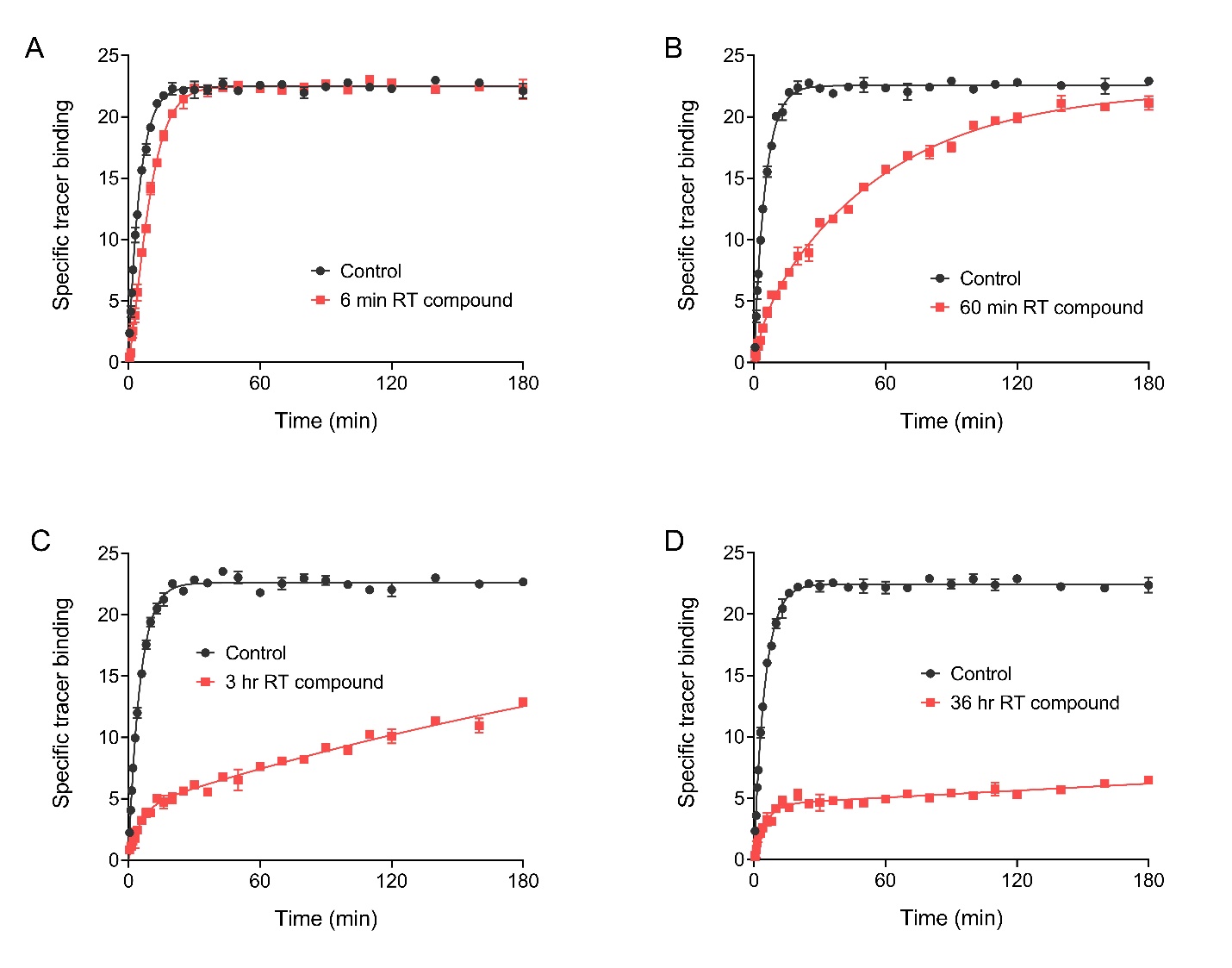
This assay indirectly quantifies test compound dissociation from the target, by its ability to inhibit tracer binding. The test compound first has to dissociate from the target before the tracer can bind and this results in a delay in the association of the tracer (Figs. 11 and 12) (56-58). The extent of the delay is dependent on the dissociation rate of the test compound. If dissociation is slow, it takes a long time for the targets to become free of the compound, slowing association of the tracer (Figure 12B). By contrast, if dissociation is rapid, target becomes available quickly and there is little slowing of tracer association (Figure 12A). In the literature, the data are usually evaluated qualitatively. However, an equation is available to quantitatively analyze the data, to determine the RT value of test compound (56) (Eq. 8, see Washout Kinetics Method Equation). Applying the equation is described in Data Analysis to Quantify the Compound Residence Time below and the supplementary file, “Washout method analysis”. A useful, comprehensive application of the analysis is provided in ref. (58).
heading
Order 193
Level 3
Style Heading3
word/document.xml:/w:document[1]/w:body[1]/w:p[189]
H3. Experimental Considerations
paragraph
Order 194
word/document.xml:/w:document[1]/w:body[1]/w:p[190]
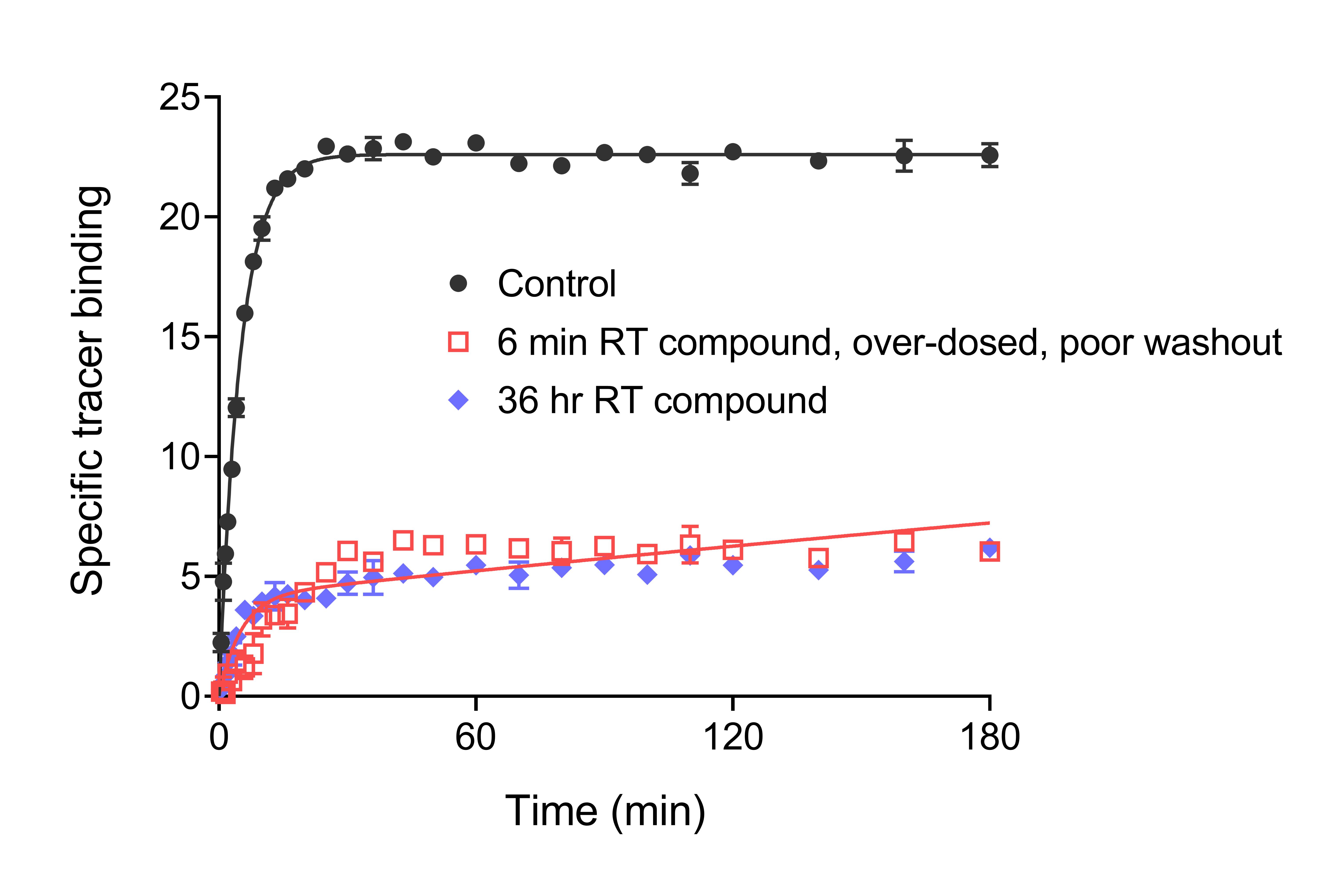
Technically, the experiment must be performed carefully for the method to provide unambiguous results on the dissociation rate of the compound. It is essential that the unbound compound be thoroughly removed during the wash step; any remaining compound sufficient to occupy the target will block tracer binding by simple equilibrium competition. Note some free compound molecules will be in the well during the tracer incubation owing to breakdown of the target-compound complex. This concentration will be too low to significantly occupy the target if Zone A (minimal compound depletion by target) is satisfied. If there is sufficient free compound remaining in the tracer incubation step owing to incomplete washout, it will slow association of the tracer (59). This can give the false appearance of a long RT compound (Figure 13). This requires the washout method to be carefully considered, particularly for drug-like small molecules which tend to be hydrophobic and difficult to remove, especially from cells (59). If possible, a sample of the assay medium after washing should be removed and the presence of any remaining compound evaluated by testing the medium in a binding assay. Another check is the shape of the tracer binding curve – if test compound has been effectively removed, the curve will eventually reach the same level of binding as the control (no compound in pre-incubation), assuming compound dissociation is not too slow. If significant compound remains after the wash step, the curve will plateau below the no-compound control, as a result of equilibrium competition between residual compound and the tracer (Figure 13) (59).
paragraph
Order 195
word/document.xml:/w:document[1]/w:body[1]/w:p[191]
In the pre-incubation step, a concentration of compound sufficient to occupy no more than 80% of the targets is recommended (4-fold the Ki determined in a preliminary competition binding assay). This minimizes the wash burden. If the concentration is too high, residual compound can bind the target in the tracer incubation. For example, if a 100-fold excess over Ki concentration is used, and the wash step removes 99% of the compound, the 1% that remains will be sufficient to block 50% of the targets, resulting in false appearance of a long RT compound (Figure 13).
heading
Order 197
Level 3
Style Heading3
word/document.xml:/w:document[1]/w:body[1]/w:p[193]
H3. Data Analysis to Quantify the Compound Residence Time
paragraph
Order 198
word/document.xml:/w:document[1]/w:body[1]/w:p[194]
Measuring the dissociation rate constant of the test compound (k4) is the goal of the analysis. A step-by-step guide is provided in the supplementary file, “Washout method analysis.” The data type is specific binding, i.e. data from which nonspecific binding has been subtracted (Data Analysis and Figure 5). The analysis makes the same assumptions as the competition kinetics analysis (Competition Kinetics: Quantifying Kinetics by Competition Against a Tracer Ligand) – single-site, single-step, competitive binding mechanism with minimal ligand depletion (<20%).
paragraph
Order 199
word/document.xml:/w:document[1]/w:body[1]/w:p[195]
There are two steps in the analysis. First, the control data are analyzed to obtain k1 for the tracer (control being the sample without compound in the pre-incubation). The data are fit to Eq. 3 as described in Data Analysis, which can be done in Prism using the equation “Association kinetics - One conc. of hot.” (47) Note the analysis requires k2 of the tracer to be known (tracer dissociation rate constant) – this is measured in a separate experiment.
paragraph
Order 200
word/document.xml:/w:document[1]/w:body[1]/w:p[196]
With the k1 value in hand, the compound data can be analyzed to determine k4, as detailed in the supplementary file, “Washout method analysis” employing Eq. 8 (Washout Kinetics Method Equation). The analysis provides fitted values of k4; B0 (the percentage of targets occupied by compound at the end of the pre-incubation phase); and Bmax (the total number of ligand binding sites).
paragraph
Order 201
word/document.xml:/w:document[1]/w:body[1]/w:p[197]
Figure 12 shows representative graphs for compounds with varying RTs (i.e. k4 values), from 6 min to 36 hr. The shape and position of the curve makes intuitive sense. For the shortest RT (6 min), the compound curve is only slightly delayed compared with the control curve; there is minimal delay of tracer binding because the compound dissociates so rapidly, leaving target free to bind tracer (Figure 12A). At later time points, the plateau for the compound curve reaches the same level as the control. This is because, given enough time, all of the compound-target complexes break down, leaving all of the targets free to bind tracer. Note this argument assumes the concentration of free compound in the tracer incubation is too low to significantly occupy the tracer – see below for what happens when this is not the case. For a 60 min RT compound (Fig 12B), there is a marked delay in tracer association, which is predicted because it takes time for the target to become available owing to the slow dissociation of the compound. When the RT is long (3 hr), the curve is markedly biphasic (Fig 12C). There is a small rapid burst of tracer binding at the start, and a slower rise phase. The rapid phase represents tracer binding to the free targets; the experiment is set up so that 80% of targets are bound by compound, leaving 20% unoccupied and so immediately available to bind tracer. The slower rise phase represents tracer binding to targets that become available once the compound has dissociated from the target. (Note the data analysis can give ambiguous results when the top of the curve is not reached over the timeframe of the assay. This issue can be solved by fixing the Bmax value for the compound curve to that of the control). When the RT is very long, relative to the timeframe of the assay (36 hr vs 3 hr), a near-monophasic curve results, in which binding plateaus well below the control (Fig 12D). In this case, the binding signal is effectively tracer binding only to the targets which were free at the end of the pre-incubation. Very few new targets become available because compound dissociation is so slow.
paragraph
Order 202
word/document.xml:/w:document[1]/w:body[1]/w:p[198]
The association rate constant of test compound can be determined if multiple concentrations of test compound are run. An experiment of this type will return fitted values of the percentage of target population bound, B0, for each concentration of test compound, [I]. B0 is plotted against [I] and the data are fit to the following equation:
paragraph
Order 204
Style Equation
word/document.xml:/w:document[1]/w:body[1]/w:p[200]
B0=100×Bmax[I]k3Ik3+k41-e-Ik3+k4tPI
paragraph
Order 205
word/document.xml:/w:document[1]/w:body[1]/w:p[201]
Where tPI is the compound pre-incubation time.
heading
Order 211
Level 3
Style Heading3
word/document.xml:/w:document[1]/w:body[1]/w:p[207]
H3. False-Positive Long Residence Time Resulting from Incomplete Washout
paragraph
Order 212
word/document.xml:/w:document[1]/w:body[1]/w:p[208]
The kinetic washout method assumes the free compound is so well washed out that no new target-compound complexes form in the tracer incubation step. What happens when this is not the case? How do the data appear when the wash is inefficient and there is ample free compound remaining to bind the target in the tracer incubation? Compounds with short RTs can appear to possess long RTs, giving false positives in lead optimization where the goal is a long RT compound.
paragraph
Order 213
word/document.xml:/w:document[1]/w:body[1]/w:p[209]
A worst-case scenario is presented in Figure 13, using simulated data. A compound with a short RT (6 min) is dosed at a very high concentration in the compound pre-incubation step (1,000 nM, which is 100 times the compound Kd of 10 nM). Then the free compound is washed out, but the washout is not complete – it removes only 90% of the free compound. This leaves compound in the well, at 100 nM concentration, when the tracer is added. This concentration, at 10 times the Kd, easily competes against the tracer. This results in strong inhibition of tracer binding (red squares in Figure 13). Alarmingly, the data resemble those for a compound with a much longer RT of 36 hr, run under the proper conditions, i.e. complete washout of free compound (blue diamonds, Figure 13). Analysis of the 6 min RT compound data with the kinetic washout equation gives a fitted RT of 10 hr. These results show that incomplete washout of compound can result in a false positive long RT.
paragraph
Order 214
word/document.xml:/w:document[1]/w:body[1]/w:p[210]
Data in Figure 13 were simulated using Eq. 5 of ref (53), with the following parameter values: [L], 6 nM; Bmax, 30 binding units; k1, 2.5 107 M-1min-1; k2, 0.05 min-1; k3, 1.67 107 M-1min-1; k4, 0.167 min-1; pre-incubation time, 30 min; pre-incubation compound concentration, 1,000 nM; tracer incubation compound concentration, 10 nM. Data were fitted to the kinetic washout equation (Eq. 8). Bmax was constrained to that of the control curve (30 binding units).
heading
Order 218
Level 2
Style Heading2
word/document.xml:/w:document[1]/w:body[1]/w:p[214]
H2. Complex Binding Mechanisms
paragraph
Order 219
word/document.xml:/w:document[1]/w:body[1]/w:p[215]
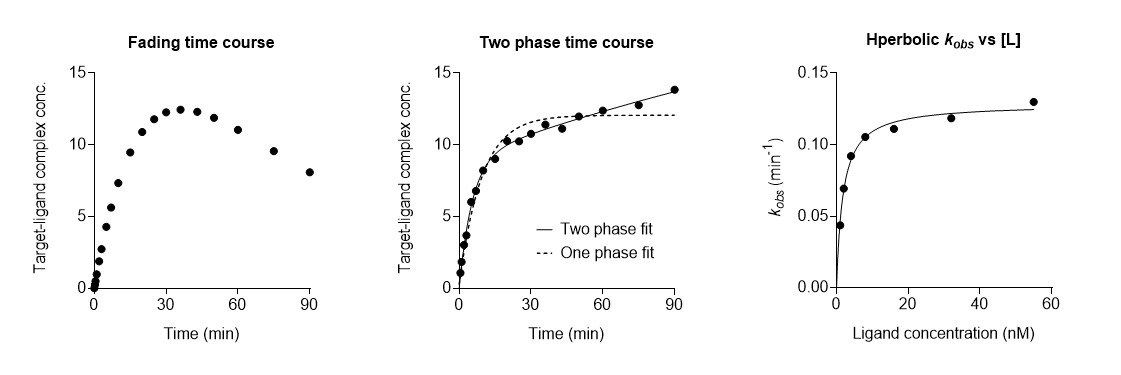
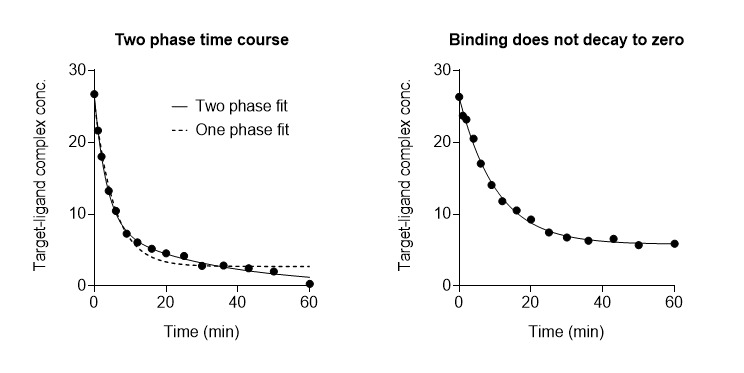
Often in binding kinetic studies the data do not fit well to the equations given in the preceding sections. These equations assume the binding event is of the simplest form, a single-step, single site target-ligand interaction. When the data are not fit well by the equations it can indicate a more complicated binding mechanism. Such mechanisms often include two conformational states of the target, with different binding kinetics, giving rise to multiphasic time course curves (for example, Figure 14). Thanks to the efforts of investigators, equations are available to analyze more complex binding data to obtain estimates of the kinetic parameters. While a detailed description is beyond the scope of this chapter, these mechanisms are introduced below and references are provided.
heading
Order 221
Level 3
Style Heading3
word/document.xml:/w:document[1]/w:body[1]/w:p[217]
H3. Two Conformational States Mechanism
paragraph
Order 222
word/document.xml:/w:document[1]/w:body[1]/w:p[218]
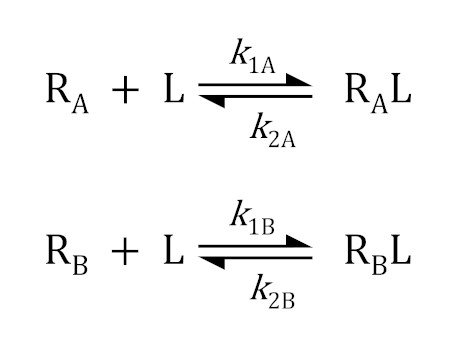
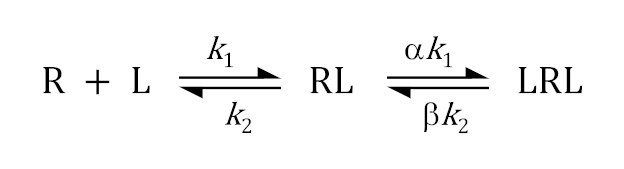
Sometimes there is more than one conformational state of the target in the assay. GPCRs are the classic example. In binding assays, the GPCR exists in two predominant conformations, the G-protein coupled state and the uncoupled state, which bind agonist ligands with different affinity (60,61) and with different binding kinetics (44,62). This mechanism is represented by the following scheme:
paragraph
Order 224
Style Equation
word/document.xml:/w:document[1]/w:body[1]/w:p[220]
paragraph
Order 226
word/document.xml:/w:document[1]/w:body[1]/w:p[222]
where the subscripts A and B denote the two conformational states of the receptor. Note there is no interconversion between the states in this model. This mechanism gives rise to biphasic time course curves for ligand association and dissociation (Figure 14) – there are two components to the curves, one fast and one slow (62). Equations are available in Prism for analyzing these data (“Two phase association” and “Two phase decay”). An example of this mechanism and the data analysis is provided in refs (62,63). The mechanism has been extended to handle the competition kinetic scenario (i.e. with two ligands, an unlabeled test ligand and a labeled tracer), as described in ref (62).
heading
Order 229
Level 3
Style Heading3
word/document.xml:/w:document[1]/w:body[1]/w:p[225]
H3. Two-step “Conformational Induction” Model
paragraph
Order 230
word/document.xml:/w:document[1]/w:body[1]/w:p[226]
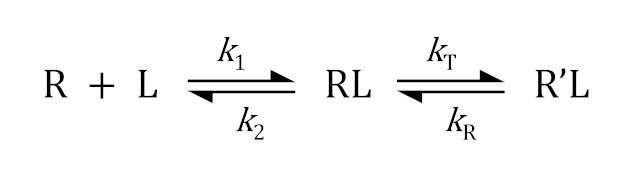
This mechanism is often encountered with enzymes. The ligand first binds the target in a loose complex. The complex then undergoes a conformational change, producing a tightly-bound complex. This is a mechanism of conformational induction – the ligand induces a new conformation of the target after binding to it. This mechanism is discussed in detail in refs (42,64,65). The mechanism scheme is,
paragraph
Order 232
Style Equation
word/document.xml:/w:document[1]/w:body[1]/w:p[228]
paragraph
Order 234
word/document.xml:/w:document[1]/w:body[1]/w:p[230]
RL is the first, loosely-bound complex, and R’L is the second, tightly-bound state. The first step is the same as the single-site binding mechanism described in Basic Principles of Ligand Binding Kinetics. The second step is represented as an isomerization event. Transition to and from the R’L state is governed by isomerization rate constants kT and kR, respectively.
paragraph
Order 235
word/document.xml:/w:document[1]/w:body[1]/w:p[231]
The shape of the curve depends on the technical properties of the assay. If the emitted binding signal for a molecule of RL and a molecule of R’L is the same (e.g. in a radioligand binding assay) then biphasic curves result, similar to the data in Figure 14 (see data in ref. (65)). Sometimes the binding signal can be dependent on the conformation of the target, for example in fluorescence assays where fluorescence intensity or resonance energy transfer can change when the conformation of the target changes. When the binding signal for R’L is lower than for R, a rise-and-fall curve shape results (unpublished results). In some cases, the initial complex RL is not detected at all, for example in filtration radioligand binding assays where the loosely-bound complex dissociates during the filtration wash step. Under this condition, a monophasic association curve results but the plot of the observed rate versus the ligand concentration is a hyperbola rather than a straight line (42,64).
paragraph
Order 236
word/document.xml:/w:document[1]/w:body[1]/w:p[232]
The mechanism has been extended to handle competition between a labeled tracer and an unlabeled test compound, as described in ref (66).
heading
Order 238
Level 3
Style Heading3
word/document.xml:/w:document[1]/w:body[1]/w:p[234]
paragraph
Order 239
word/document.xml:/w:document[1]/w:body[1]/w:p[235]
In this mechanism, the target consists of a dimer of identical subunits, each subunit containing a single binding site for the ligand. Binding of ligand to one of the subunits within the dimer affects the binding kinetics of the ligand for the second subunit within the dimer.
paragraph
Order 241
Style Equation
word/document.xml:/w:document[1]/w:body[1]/w:p[237]
paragraph
Order 243
word/document.xml:/w:document[1]/w:body[1]/w:p[239]
is the cooperativity effect of ligand binding to the first subunit on the association rate constant and is the cooperativity effect on the dissociation rate constant. An equation for this model is derived in ref (67), which also includes a detailed description of the manifestation of the model in the binding data.
heading
Order 245
Level 2
Style Heading2
word/document.xml:/w:document[1]/w:body[1]/w:p[241]
H2. Binding Kinetics from Functional Assays
heading
Order 246
Level 3
Style Heading3
word/document.xml:/w:document[1]/w:body[1]/w:p[242]
paragraph
Order 247
word/document.xml:/w:document[1]/w:body[1]/w:p[243]
In the preceding material we assume a binding assay is available for the target. Often this is not the case and instead all we have available is a functional assay, i.e. an assay of the target’s biological action, e.g. product formation by an enzyme, and signaling by a receptor. This is particularly true for new targets in drug discovery. Fortunately, methods are available to quantify the binding kinetics of inhibitor compounds from functional assays. A detailed description is beyond the scope of this chapter but here the basics of the data analysis are presented together with references for further reading.
heading
Order 249
Level 3
Style Heading3
word/document.xml:/w:document[1]/w:body[1]/w:p[245]
paragraph
Order 250
word/document.xml:/w:document[1]/w:body[1]/w:p[246]
The binding kinetics of enzyme inhibitors and equations for analyzing the data have been extensively investigated and described (31-34). Methods are available for quantifying inhibitor binding kinetics from enzyme activity assays. The formation of product is measured over time in the absence and presence of the inhibitor. This is done under initial rate conditions, i.e. the linear portion of the time course of product formation. The data are then fit to equations to determine the RT. For enzymes, analysis can be complicated by the myriad of mechanisms by which the inhibitor inhibits the enzyme, and so consultation with an expert in enzymology is recommended.
paragraph
Order 251
word/document.xml:/w:document[1]/w:body[1]/w:p[247]
The RT of enzyme inhibitors is often measured using the jump dilution method (32), a variant of the washout method described above. Enzyme and inhibitor are incubated together to form the enzyme inhibitor complex. Then the reaction is diluted into a much larger volume of assay buffer containing the substrate and all the necessary reaction components. The generation of product is then recorded over time. The jump dilution is designed to reduce the free inhibitor concentration sufficiently that it does not appreciably compete with substrate for the enzyme. Consequently, the inhibition that does occur in the substrate incubation is due to the pre-bound complexes from the inhibitor pre-incubation step; the complex needs to break down before the substrate can bind and product be formed. A vehicle control is included in the experiment in order to record enzyme activity without the inhibitor; the enzyme is pre-incubated with vehicle and diluted in the same way as the inhibitor sample. Data are then analyzed using an appropriate equation to determine the RT (for example, Eq. 8.14 of ref. (32)).
heading
Order 253
Level 3
Style Heading3
word/document.xml:/w:document[1]/w:body[1]/w:p[249]
H3. G-protein-coupled Receptors
paragraph
Order 254
word/document.xml:/w:document[1]/w:body[1]/w:p[250]
The activity of GPCRs is measured by recording the signaling pathways these receptors stimulate. Signaling is initiated by binding of an activating ligand (an agonist) to the GPCR. This provides an assay of activity that can be used to quantify the kinetics of inhibitor binding to the GPCR (i.e. antagonist binding).
paragraph
Order 255
word/document.xml:/w:document[1]/w:body[1]/w:p[251]

A straightforward qualitative method for measuring antagonist RT is available employing the washout method (Figure 15) (35,38). This procedure, called recovery of agonist responsiveness, uses the washout procedure described in Compound Washout Method. Cells bearing the receptor are pre-incubated with antagonist long enough for the receptor-antagonist complex to form, then the free antagonist is removed by washing. The cells are then incubated for various times during which the antagonist will dissociate. Following this, agonist is applied and a rapid signaling assay is conducted (e.g. Ca2+ mobilization). The strength of the signal provides a readout of antagonist binding – the more antagonist that is bound, the lower the signaling by the agonist. The amount of signal is plotted against the time after antagonist washout. Over time, the response increases owing to dissociation of the antagonist, freeing the receptor to bind the agonist and so generate a signal. The time it takes the response to recover can be used as an assessment of the RT of the compound for the receptor. This is usually quantified as the half-time. However, the relationship between recovery time and RT is not one-to-one, owing to the pharmacological phenomenon of receptor reserve (which dissociates the degree of receptor occupancy from the degree of functional response). The recovery time is a relative measure of RT, useful for ranking compounds. Technical considerations in this assay include the use of a short duration signaling assay (so that antagonist does not appreciably dissociate during the signaling assay), and effective washout of the antagonist to avoid false positive long RTs (as described in Compound Washout Method).
paragraph
Order 256
word/document.xml:/w:document[1]/w:body[1]/w:p[252]
More sophisticated methods are available for quantifying binding kinetics in GPCR functional assays. These require a familiarity with receptor theory. One method utilizes the phenomenon of insurmountability, a property of slowly-dissociating antagonists in functional assays in which the antagonist reduces the maximal response to the agonist (36,37). Alternatively, if there is no receptor reserve in the functional assay the signaling time course can be directly fitted using an analogue of the competition kinetics equation (39).
heading
Order 258
Level 2
Style Heading2
word/document.xml:/w:document[1]/w:body[1]/w:p[254]
paragraph
Order 259
word/document.xml:/w:document[1]/w:body[1]/w:p[255]
The kinetics of target-ligand interaction provide an additional dimension to the understanding of drug target function and the optimization of novel therapeutics. This chapter enables the newcomer to quantify binding kinetics, specifically how to measure the rate constants for ligand association and dissociation. Analysis is straightforward for direct target-ligand binding assays. More advanced data analysis is required for indirect competition binding assays for quantifying binding kinetics of the large numbers of compounds encountered in modern drug discovery. This analysis, within the range of expertise of most investigators, is taught in easy-to-use step-by-step guides, and aided by guidance on troubleshooting and data interpretation. More complex scenarios are introduced, including complex binding mechanisms and the measurement of binding kinetics in functional assays for enzymes and GPCRs. By describing how to quantify binding kinetics, this chapter will aid investigators in applying and evaluating the role of the temporal dimension of binding activity to their targets of interest.
heading
Order 260
Level 2
Style Heading2
word/document.xml:/w:document[1]/w:body[1]/w:p[256]
H2. Appendix: Equations for Binding Kinetic Data Analysis
paragraph
Order 262
word/document.xml:/w:document[1]/w:body[1]/w:p[258]
The equations used to analyze the data are derived from first principles applied to the binding mechanism diagrams (53). The equations define the concentration of target-ligand complex as a function of time. They are used to fit the time course data to estimate the rate constant values for the binding interaction. In this section, the techniques for deriving the basic binding equations are presented, for the direct target-ligand binding interactions (See Equations for Direct Target-Ligand Binding Kinetics Analysis). Next, the competition kinetics equation is presented, used for measuring unlabeled test compound binding kinetics in competition with a labeled tracer ligand (see Original Competition Kinetics Equation). This equation has been adapted to allow for rapid competitor dissociation (See Adaptation for Rapidly-Dissociating Compounds), and for pre-incubation of target with compound (Pre-incubating with Test Compound). Finally, an equation for analyzing data from the washout kinetics method is described.
heading
Order 264
Level 3
Style Heading3
word/document.xml:/w:document[1]/w:body[1]/w:p[260]
H3. Equations for Direct Target-Ligand Binding Kinetics Analysis
heading
Order 266
Level 4
Style Heading4
word/document.xml:/w:document[1]/w:body[1]/w:p[262]
H4. Association Time Course Equation
paragraph
Order 267
word/document.xml:/w:document[1]/w:body[1]/w:p[263]
The mechanism for the basic target-ligand interaction is:
paragraph
Order 269
Style Equation
word/document.xml:/w:document[1]/w:body[1]/w:p[265]
paragraph
Order 271
word/document.xml:/w:document[1]/w:body[1]/w:p[267]
paragraph
Order 273
word/document.xml:/w:document[1]/w:body[1]/w:p[269]
This mechanism is a single-site, single-step reversible binding interaction between ligand L and target R. The binding kinetics are defined by the association rate constant k1 and dissociation rate constant k2. The equation derivation is for conditions of minimal ligand depletion, meaning the bound concentration is much less than the total concentration of ligand across the time course (< 20%, ideally < 10% (“Zone A”)). (For ligand depletion conditions, use Eq. 11 of ref. (40).)
paragraph
Order 274
word/document.xml:/w:document[1]/w:body[1]/w:p[270]
The goal is an equation that defines the concentration of target-ligand complex ([RL]) as a function of time (t) and the mechanism parameters of interest (k1 and k2). We start by writing equations that describe the rate of formation and the rate of breakdown of the target-ligand complex. From first principles, the rate of formation is the product of the free ligand concentration, free target concentration and the association rate constant:
paragraph
Order 276
Style Equation
word/document.xml:/w:document[1]/w:body[1]/w:p[272]
paragraph
Order 278
word/document.xml:/w:document[1]/w:body[1]/w:p[274]
The rate of breakdown is the product of the target-ligand complex concentration and the dissociation rate constant:
paragraph
Order 279
Style Equation
word/document.xml:/w:document[1]/w:body[1]/w:p[275]
paragraph
Order 281
word/document.xml:/w:document[1]/w:body[1]/w:p[277]
The next step is to write the equation that defines the rate of change of the target-ligand complex concentration over time, after target and ligand are mixed together. This is a differential equation. The rate of change, d[RL]dt is equal to the rate of formation minus the rate of breakdown, giving the equation
paragraph
Order 283
Style Equation
word/document.xml:/w:document[1]/w:body[1]/w:p[279]
paragraph
Order 285
word/document.xml:/w:document[1]/w:body[1]/w:p[281]
This equation contains two time-dependent terms, [RL] (the species we are measuring, the y axis value of the time course) and [R]. Note that [L], the free ligand concentration, is constant over time because it is not depleted by formation of [RL]. The derivation proceeds by removing the second time-dependent term [R]. This is done using a common mathematical maneuver in pharmacology and enzymology, the conservation of mass equation. This simply expresses the target species in the system as a function of a constant, the total concentration of targets, [R]TOT. Specifically,
paragraph
Order 287
Style Equation
word/document.xml:/w:document[1]/w:body[1]/w:p[283]
paragraph
Order 289
word/document.xml:/w:document[1]/w:body[1]/w:p[285]
Note that [R]TOT is constant over time. [R] is now expressed in terms of [R]TOT and [RL] by rearranging the conservation of mass equation:
paragraph
Order 291
Style Equation
word/document.xml:/w:document[1]/w:body[1]/w:p[287]
paragraph
Order 293
word/document.xml:/w:document[1]/w:body[1]/w:p[289]
In the context of a binding assay, it is convenient to express [R]TOT in terms of the total number of binding sites for the ligand, termed Bmax. Bmax is equal to [R]TOT for targets with a single binding site, so we can write,
paragraph
Order 295
Style Equation
word/document.xml:/w:document[1]/w:body[1]/w:p[291]
paragraph
Order 297
word/document.xml:/w:document[1]/w:body[1]/w:p[293]
We now substitute [R] in the differential equation with Bmax – [RL]:
paragraph
Order 299
Style Equation
word/document.xml:/w:document[1]/w:body[1]/w:p[295]
dRLdt= BmaxLk1-RLLk1-RLk2
paragraph
Order 301
word/document.xml:/w:document[1]/w:body[1]/w:p[297]
This equation is now simplified to the following:
paragraph
Order 303
Style Equation
word/document.xml:/w:document[1]/w:body[1]/w:p[299]
paragraph
Order 305
word/document.xml:/w:document[1]/w:body[1]/w:p[301]
The next step is to convert the differential equation to an equation of the form [RL] = f(t) where f(t) is a function of time. This is called the “Analytic form” and is the format used by curve-fitting programs commonly used in ligand binding data analysis. This step requires facility with integral calculus. Fortunately, in this case the integral is well known and the integration can be done directly, giving:
paragraph
Order 307
Style Equation
word/document.xml:/w:document[1]/w:body[1]/w:p[303]
RL= BmaxLk1Lk1+k21-e-Lk1+k2.t
paragraph
Order 309
word/document.xml:/w:document[1]/w:body[1]/w:p[305]
This equation is adapted to analyze the data, as follows. First of all, it can be expressed in a general form. This general form is an equation found in curve fitting programs, and is the association exponential equation (Eq. 1):
paragraph
Order 311
Style Equation
word/document.xml:/w:document[1]/w:body[1]/w:p[307]
RL=[RL]t(inf)×1-e-kobst Eq. 1
paragraph
Order 312
word/document.xml:/w:document[1]/w:body[1]/w:p[308]
paragraph
Order 313
Style Equation
word/document.xml:/w:document[1]/w:body[1]/w:p[309]
paragraph
Order 315
Style Equation
word/document.xml:/w:document[1]/w:body[1]/w:p[311]
paragraph
Order 317
word/document.xml:/w:document[1]/w:body[1]/w:p[313]
Time course data are analyzed with Eq. 1. [RL] is the y value, t the x value, and the fitted values are [RL]t(inf) (the binding level at the plateau) and kobs (the rate constant) (see Association Rate Constant from a Direct Target-Ligand Binding Assay). In Prism, Eq. 1 is named “One-phase association” (41).
paragraph
Order 318
word/document.xml:/w:document[1]/w:body[1]/w:p[314]
The kobs = [L]k1 + k2 equation is now used to determine the k1 value (see Association Rate Constant from a Direct Target-Ligand Binding Assay). kobs is measured for a range of ligand concentrations (Figure 3A) and then kobs is plotted versus the ligand concentration. This plot is a straight line with gradient of k1 (Figure 3B) so the data are analyzed by linear regression. The fitted value of the gradient is equal to k1.
heading
Order 320
Level 4
Style Heading4
word/document.xml:/w:document[1]/w:body[1]/w:p[316]
H4. Dissociation Time Course Equation
paragraph
Order 321
word/document.xml:/w:document[1]/w:body[1]/w:p[317]
In the dissociation assay, the target-ligand complex is formed, and then the decay of the target-ligand complex is measured over time after an experimental intervention that blocks the association interaction (the dissociation phase). Association can be blocked by washing out the unbound ligand, or, when a labeled ligand is being used, addition of a large excess of unlabeled ligand. The mechanism in the dissociation phase of the experiment is simply breakdown of the target-ligand complex:
paragraph
Order 322
Style Equation
word/document.xml:/w:document[1]/w:body[1]/w:p[318]
paragraph
Order 323
word/document.xml:/w:document[1]/w:body[1]/w:p[319]
paragraph
Order 325
word/document.xml:/w:document[1]/w:body[1]/w:p[321]
The equation defining the dissociation time course is derived using the same strategy as described above for the association process. The rate of change of the target-ligand complex over time is simply the rate of decay of the complex:
paragraph
Order 327
Style Equation
word/document.xml:/w:document[1]/w:body[1]/w:p[323]
paragraph
Order 329
word/document.xml:/w:document[1]/w:body[1]/w:p[325]
Note the negative sign, indicating [RL] is declining over time. The next step is to obtain the analytic form, and this is done directly by integration, giving the equation used to analyze the data (Eq. 2):
paragraph
Order 332
Style Equation
word/document.xml:/w:document[1]/w:body[1]/w:p[328]
paragraph
Order 334
word/document.xml:/w:document[1]/w:body[1]/w:p[330]
This equation is used to analyze dissociation time course data (Figure 2B). [RL] is the y value, t is the x value, and k2 and [RL]t0 are the fitted parameters. In Prism, Eq. 2 is named “One-phase decay.” (43)
heading
Order 336
Level 3
Style Heading3
word/document.xml:/w:document[1]/w:body[1]/w:p[332]
H3. Competition Kinetics Equations
paragraph
Order 337
word/document.xml:/w:document[1]/w:body[1]/w:p[333]
In the competition kinetics assay, an unlabeled compound is competed against a labeled tracer ligand for binding to the target. The analysis assumes the two ligands bind the same site on the target and that the binding events are simple single-site, single-step reversible interactions. The equations assume minimal depletion of the free ligand concentration (for both the labeled and unlabeled ligand). The mechanism is illustrated in Figure 4 and shown schematically below:
paragraph
Order 339
Style Equation
word/document.xml:/w:document[1]/w:body[1]/w:p[335]
paragraph
Order 341
word/document.xml:/w:document[1]/w:body[1]/w:p[337]
paragraph
Order 343
word/document.xml:/w:document[1]/w:body[1]/w:p[339]
By convention, k1 and k2 are the association and dissociation rate constants, respectively, of the labeled ligand (L), with k3 and k4 being the corresponding rates for the unlabeled test ligand (I).
heading
Order 345
Level 4
Style Heading4
word/document.xml:/w:document[1]/w:body[1]/w:p[341]
H4. Original Competition Kinetics Equation
paragraph
Order 346
word/document.xml:/w:document[1]/w:body[1]/w:p[342]
In the original, commonly-used method, target is exposed simultaneously to both ligands (i.e. the target is added last to the assay). The data take the form of the time course of labeled ligand binding in the presence of the unlabeled compound (Figure 6). The equation describing these data is a bi-exponential equation and is rather complex to the uninitiated investigator, but it is a straightforward analytical equation where [RL] is a function of time and mechanism parameters. It has been loaded as a built-in equation in Prism (named “Kinetics of competitive binding” (48)) so it isn’t necessary to enter it manually when using this program. The equation, Eq. 4, is:
paragraph
Order 349
Style Equation
word/document.xml:/w:document[1]/w:body[1]/w:p[344]
RL=BmaxLk1KF-KSk4KF-KSKFKS+k4-KFKFe-KFt-k4-KSKSe-KSt Eq. 4
paragraph
Order 352
word/document.xml:/w:document[1]/w:body[1]/w:p[346]
paragraph
Order 353
Style Equation
word/document.xml:/w:document[1]/w:body[1]/w:p[347]
KF=0.5KA+KB+KA-KB2+4LIk1k3
paragraph
Order 354
Style Equation
word/document.xml:/w:document[1]/w:body[1]/w:p[348]
KS=0.5KA+KB-KA-KB2+4LIk1k3
paragraph
Order 355
Style Equation
word/document.xml:/w:document[1]/w:body[1]/w:p[349]
paragraph
Order 356
Style Equation
word/document.xml:/w:document[1]/w:body[1]/w:p[350]
paragraph
Order 358
word/document.xml:/w:document[1]/w:body[1]/w:p[352]
Note that KF, KS, KA and KB are composite parameters introduced to simplify writing of the equation into curve-fitting programs. The original papers describing the equation are refs. (18,19) and a detailed description of the mathematical methods used to derive it is in ref. (53)
heading
Order 360
Level 4
Style Heading4
word/document.xml:/w:document[1]/w:body[1]/w:p[354]
H4. Adaptation for Rapidly-Dissociating Compounds
paragraph
Order 361
word/document.xml:/w:document[1]/w:body[1]/w:p[355]
Occasionally the unlabeled test compound dissociates too rapidly for the analysis method to quantify k4 reliably (Limits of Sensitivity). A false fit results, where the program fits a curve to the data well, but that returns unrealistic estimates of k3 and k4 (see Box 5, bottom graph and data table). Effectively, the compound is immediately and constantly at equilibrium with free targets. The analysis method can be adapted to quantify the binding affinity of such a compound from the time course data. The equation for this analysis is Eq. 5 (51-52):
paragraph
Order 363
Style Equation
word/document.xml:/w:document[1]/w:body[1]/w:p[357]
RL=BmaxLk11-ρIkobs1-e-kobst Eq. 5
paragraph
Order 364
word/document.xml:/w:document[1]/w:body[1]/w:p[358]
paragraph
Order 365
Style Equation
word/document.xml:/w:document[1]/w:body[1]/w:p[359]
paragraph
Order 367
Style Equation
word/document.xml:/w:document[1]/w:body[1]/w:p[361]
paragraph
Order 369
word/document.xml:/w:document[1]/w:body[1]/w:p[363]
Ki is the equilibrium binding affinity of the unlabeled test compound. Note ρI and kobs are composite parameters introduced to simplify writing of the equation into curve-fitting programs.
paragraph
Order 370
word/document.xml:/w:document[1]/w:body[1]/w:p[364]
This equation, named “[Pharmechanics] Kinetics of competitive binding, rapid competitor dissociation”, is available in the supplementary Prism file “Custom equations for binding kinetics”.
heading
Order 372
Level 4
Style Heading4
word/document.xml:/w:document[1]/w:body[1]/w:p[366]
H4. Pre-incubating with Test Compound
paragraph
Order 373
word/document.xml:/w:document[1]/w:body[1]/w:p[367]
The original competition kinetics equation assumes target is exposed simultaneously to test compound and tracer ligand (18,19). An equation is also available that assumes the target is pre-incubated with a test compound before the tracer is added (53,54). The equation is a close analogue of the original equation – it is extended to include a term for binding of compound during the pre-incubation. The equation (Eq. 6) is:
paragraph
Order 376
Style Equation
word/document.xml:/w:document[1]/w:body[1]/w:p[370]
RL=BmaxLk1KF-KSk4KF-KSKFKS+k4-KFKFe-KFt-k4-KSKSe-KSt-BmaxLk1KF-KS×[I]k3KB1-e-KBtPIe-KS.t-e-KF.t Eq. 6
paragraph
Order 378
word/document.xml:/w:document[1]/w:body[1]/w:p[372]
The terms are defined in the section Original Competition Kinetics Equation. tPI is the pre-incubation time with compound and t (the x value) is time after tracer ligand addition. This equation, named “[Pharmechanics] Kinetics of competitive binding: Competitor pre-incubation”, is available in the supplementary Prism file “Custom equations for binding kinetics”.
heading
Order 380
Level 4
Style Heading4
word/document.xml:/w:document[1]/w:body[1]/w:p[374]
H4. Pre-incubating with Tracer
paragraph
Order 381
word/document.xml:/w:document[1]/w:body[1]/w:p[375]
An equation is also available that assumes the tracer is pre-incubated with the target before an unlabeled test compound is added (53). The equation (Eq. 7) is:
paragraph
Order 385
Style Equation
word/document.xml:/w:document[1]/w:body[1]/w:p[378]
RL=BmaxLk1KF-KSk4KF-KSKFKS+k4-KFKFe-KFt-k4-KSKSe-KSt+Bmax[L]k1KF-KS1-e-KAtPIKB-KSKAe-KS.t-KB-KFKAe-KF.t Eq. 7
paragraph
Order 387
word/document.xml:/w:document[1]/w:body[1]/w:p[380]
Here tPI is the pre-incubation time with tracer and t (the x value) is time after compound addition. This equation, named “[Pharmechanics] Kinetics of competitive binding: Labeled ligand pre-incubation.” is available in the supplementary Prism file “Custom equations for binding kinetics”.
heading
Order 389
Level 3
Style Heading3
word/document.xml:/w:document[1]/w:body[1]/w:p[382]
H3. Washout Kinetics Method Equation
paragraph
Order 391
word/document.xml:/w:document[1]/w:body[1]/w:p[383]
An alternative method for measuring unlabeled compound RT is the washout method, popular for certain classes of targets such as protein kinases (55). In this experiment, compound is pre-incubated with target to allow target-compound complexes to form (Figure 11). Next, the free (unbound) compound is washed out, leaving the compound-target complexes in the well. Next, a tracer ligand is added and tracer binding recorded over time. The pre-bound compound delays association of the tracer (Figure 11 graph). This is because the compound first has to dissociate before tracer can bind. An equation, Eq. 8, has been derived for analyzing the tracer time course data (53,56):
paragraph
Order 393
Style Equation
word/document.xml:/w:document[1]/w:body[1]/w:p[385]
RL=BmaxLk1KA1-1-B0×0.01×KAKA-k4e-KAt-B0×0.01×KAKA-k4e-k4t Eq. 8
paragraph
Order 394
word/document.xml:/w:document[1]/w:body[1]/w:p[386]
where B0 is the percentage of the target population bound by test compound at the end of the pre-incubation step.
paragraph
Order 395
word/document.xml:/w:document[1]/w:body[1]/w:p[387]
The association rate constant of unlabeled test compound (k3) can be determined if multiple concentrations of compound are run in the assay. Analysis using Eq. 8 will give a separate B0 for each concentration of compound. The B0 value can then be plotted versus the compound concentration [I], and the data analyzed using the following equation:
paragraph
Order 397
Style Equation
word/document.xml:/w:document[1]/w:body[1]/w:p[389]
B0=100×Bmax[I]k3Ik3+k41-e-Ik3+k4tPI
heading
Order 398
Level 2
Style Heading2
word/document.xml:/w:document[1]/w:body[1]/w:p[390]
reference
Order 400
Style Reference
word/document.xml:/w:document[1]/w:body[1]/w:p[392]
1 Copeland, R. A., Pompliano, D. L. & Meek, T. D. Drug-target residence time and its implications for lead optimization. Nat Rev Drug Discov 5, 730-739, doi:10.1038/nrd2082 (2006).
reference
Order 401
Style Reference
word/document.xml:/w:document[1]/w:body[1]/w:p[393]
2 Swinney, D. C. The role of binding kinetics in therapeutically useful drug action. Curr Opin Drug Discov Devel 12, 31-39 (2009).
reference
Order 402
Style Reference
word/document.xml:/w:document[1]/w:body[1]/w:p[394]
3 Copeland, R. A. The drug-target residence time model: a 10-year retrospective. Nat Rev Drug Discov 15, 87-95, doi:10.1038/nrd.2015.18 (2016).
reference
Order 403
Style Reference
word/document.xml:/w:document[1]/w:body[1]/w:p[395]
4 Dahl, G. & Akerud, T. Pharmacokinetics and the drug-target residence time concept. Drug Discov Today 18, 697-707, doi:10.1016/j.drudis.2013.02.010 (2013).
reference
Order 404
Style Reference
word/document.xml:/w:document[1]/w:body[1]/w:p[396]
5 de Witte, W. E. A., Danhof, M., van der Graaf, P. H. & de Lange, E. C. M. The implications of target saturation for the use of drug-target residence time. Nat Rev Drug Discov 18, 82-84, doi:10.1038/nrd.2018.234 (2018).
reference
Order 405
Style Reference
word/document.xml:/w:document[1]/w:body[1]/w:p[397]
6 Folmer, R. H. A. Drug target residence time: a misleading concept. Drug Discov Today 23, 12-16, doi:10.1016/j.drudis.2017.07.016 (2018).
reference
Order 406
Style Reference
word/document.xml:/w:document[1]/w:body[1]/w:p[398]
7 Georgi, V. et al. Binding Kinetics Survey of the Drugged Kinome. J Am Chem Soc 140, 15774-15782, doi:10.1021/jacs.8b08048 (2018).
reference
Order 407
Style Reference
word/document.xml:/w:document[1]/w:body[1]/w:p[399]
8 Guo, D., Hillger, J. M., AP, I. J. & Heitman, L. H. Drug-target residence time--a case for G protein-coupled receptors. Med Res Rev 34, 856-892, doi:10.1002/med.21307 (2014).
reference
Order 408
Style Reference
word/document.xml:/w:document[1]/w:body[1]/w:p[400]
9 Swinney, D. C. Biochemical mechanisms of New Molecular Entities (NMEs) approved by United States FDA during 2001-2004: mechanisms leading to optimal efficacy and safety. Curr Top Med Chem 6, 461-478 (2006).
reference
Order 409
Style Reference
word/document.xml:/w:document[1]/w:body[1]/w:p[401]
10 Tonge, P. J. Drug-Target Kinetics in Drug Discovery. ACS Chem Neurosci 9, 29-39, doi:10.1021/acschemneuro.7b00185 (2018).
reference
Order 410
Style Reference
word/document.xml:/w:document[1]/w:body[1]/w:p[402]
11 Vauquelin, G. Effects of target binding kinetics on in vivo drug efficacy: koff , kon and rebinding. Br J Pharmacol 173, 2319-2334, doi:10.1111/bph.13504 (2016).
reference
Order 411
Style Reference
word/document.xml:/w:document[1]/w:body[1]/w:p[403]
12 Vauquelin, G. & Charlton, S. J. Long-lasting target binding and rebinding as mechanisms to prolong in vivo drug action. Br J Pharmacol 161, 488-508, doi:10.1111/j.1476-5381.2010.00936.x (2010).
reference
Order 412
Style Reference
word/document.xml:/w:document[1]/w:body[1]/w:p[404]
13 Zhang, R. & Monsma, F. Binding kinetics and mechanism of action: toward the discovery and development of better and best in class drugs. Expert Opin Drug Discov 5, 1023-1029, doi:10.1517/17460441.2010.520700 (2010).
reference
Order 413
Style Reference
word/document.xml:/w:document[1]/w:body[1]/w:p[405]
14 Hothersall, J. D., Brown, A. J., Dale, I. & Rawlins, P. Can residence time offer a useful strategy to target agonist drugs for sustained GPCR responses? Drug Discov Today 21, 90-96, doi:10.1016/j.drudis.2015.07.015 (2016).
reference
Order 414
Style Reference
word/document.xml:/w:document[1]/w:body[1]/w:p[406]
15 Sykes, D. A., Stoddart, L. A., Kilpatrick, L. E. & Hill, S. J. Binding kinetics of ligands acting at GPCRs. Mol Cell Endocrinol 485, 9-19, doi:10.1016/j.mce.2019.01.018 (2019).
reference
Order 415
Style Reference
word/document.xml:/w:document[1]/w:body[1]/w:p[407]
16 Georgi, V. et al. Binding kinetics in drug discovery - A current perspective. Front Biosci (Landmark Ed) 22, 21-47, doi:10.2741/4470 (2017).
reference
Order 416
Style Reference
word/document.xml:/w:document[1]/w:body[1]/w:p[408]
17 Hoare, S. R. J., Fleck, B. A., Williams, J. P. & Grigoriadis, D. E. The importance of target binding kinetics for measuring target binding affinity in drug discovery: a case study from a CRF1 receptor antagonist program. Drug Discov Today 25, 7-14, doi:10.1016/j.drudis.2019.09.011 (2020).
reference
Order 417
Style Reference
word/document.xml:/w:document[1]/w:body[1]/w:p[409]
18 Aranyi, P. Kinetics of the hormone-receptor interaction. Competition experiments with slowly equilibrating ligands. Biochim Biophys Acta 628, 220-227, doi:10.1016/0304-4165(80)90369-4 (1980).
reference
Order 418
Style Reference
word/document.xml:/w:document[1]/w:body[1]/w:p[410]
19 Motulsky, H. J. & Mahan, L. C. The kinetics of competitive radioligand binding predicted by the law of mass action. Mol Pharmacol 25, 1-9 (1984).
reference
Order 419
Style Reference
word/document.xml:/w:document[1]/w:body[1]/w:p[411]
20 Bernetti, M., Masetti, M., Rocchia, W. & Cavalli, A. Kinetics of Drug Binding and Residence Time. Annu Rev Phys Chem 70, 143-171, doi:10.1146/annurev-physchem-042018-052340 (2019).
reference
Order 420
Style Reference
word/document.xml:/w:document[1]/w:body[1]/w:p[412]
21 Vauquelin, G., Huber, H. & Swinney, D. C., Experimental Methods to Determine Binding Kinetics. Thermodynamics and Kinetics of Drug Binding (eds G.M. Keserü & D.C. Swinney) Ch. 9, 169-189 (Wiley-VCH Verlag GmbH & Co. KGaA, 2015).
reference
Order 422
Style Reference
word/document.xml:/w:document[1]/w:body[1]/w:p[414]
22 Auld, D. S. et al. Receptor Binding Assays for HTS and Drug Discovery. In Assay Guidance Manual (eds G. S. Sittampalam et al.) (2004).
reference
Order 423
Style Reference
word/document.xml:/w:document[1]/w:body[1]/w:p[415]
23 Alberty, R. A. & Hammes, G. G. Application of the Theory of Diffusion-controlled Reactions to Enzyme Kinetics. Journal of Physical Chemistry 62, 154-159, doi:10.1021/j150560a005 (1958).
reference
Order 424
Style Reference
word/document.xml:/w:document[1]/w:body[1]/w:p[416]
24 Hill, T. L. Effect of rotation on the diffusion-controlled rate of ligand-protein association. Proc Natl Acad Sci U S A 72, 4918-4922, doi:10.1073/pnas.72.12.4918 (1975).
reference
Order 425
Style Reference
word/document.xml:/w:document[1]/w:body[1]/w:p[417]
25 Pan, A. C., Borhani, D. W., Dror, R. O. & Shaw, D. E. Molecular determinants of drug-receptor binding kinetics. Drug Discov Today 18, 667-673, doi:10.1016/j.drudis.2013.02.007 (2013).
reference
Order 426
Style Reference
word/document.xml:/w:document[1]/w:body[1]/w:p[418]
26 Schiele, F., Ayaz, P. & Mueller-Fahrnow, A., The Use of Structural Information to Understand Binding Kinetics. Thermodynamics and Kinetics of Drug Binding. Vol. 65 (eds G.M. Keserü & D. C. Swinney) Ch. 12, 237-256 (Wiley-VCH Verlag GmbH & Co. KGaA, 2015).
reference
Order 427
Style Reference
word/document.xml:/w:document[1]/w:body[1]/w:p[419]
27 Rich, R. L. & Myszka, D. G. Survey of the 2009 commercial optical biosensor literature. J Mol Recognit 24, 892-914, doi:10.1002/jmr.1138 (2011).
reference
Order 428
Style Reference
word/document.xml:/w:document[1]/w:body[1]/w:p[420]
28 Soave, M., Briddon, S. J., Hill, S. J. & Stoddart, L. A. Fluorescent ligands: Bringing light to emerging GPCR paradigms. Br J Pharmacol, doi:10.1111/bph.14953 (2019).
reference
Order 429
Style Reference
word/document.xml:/w:document[1]/w:body[1]/w:p[421]
29 Zwier, J. M. et al. A fluorescent ligand-binding alternative using Tag-lite(R) technology. J Biomol Screen 15, 1248-1259, doi:10.1177/1087057110384611 (2010).
reference
Order 430
Style Reference
word/document.xml:/w:document[1]/w:body[1]/w:p[422]
30 Freyer, M. W. & Lewis, E. A. Isothermal titration calorimetry: experimental design, data analysis, and probing macromolecule/ligand binding and kinetic interactions. Methods Cell Biol 84, 79-113, doi:10.1016/S0091-679X(07)84004-0 (2008).
reference
Order 431
Style Reference
word/document.xml:/w:document[1]/w:body[1]/w:p[423]
31 Copeland, R. A., Slow binding inhibitors. Evaluation of enzyme inhibitors in drug discovery Ch. 6, 203-244 (Wiley, 2013).
reference
Order 432
Style Reference
word/document.xml:/w:document[1]/w:body[1]/w:p[424]
32 Copeland, R. A., Drug-target residence time. Evaluation of enzyme inhibitors in drug discovery Ch. 8, 287-344 (Wiley, 2013).
reference
Order 433
Style Reference
word/document.xml:/w:document[1]/w:body[1]/w:p[425]
33 Morrison, J. F. & Walsh, C. T. The behavior and significance of slow-binding enzyme inhibitors. Adv Enzymol Relat Areas Mol Biol 61, 201-301, doi:10.1002/9780470123072.ch5 (1988).
reference
Order 434
Style Reference
word/document.xml:/w:document[1]/w:body[1]/w:p[426]
34 Szedlacsek, S. E. & Duggleby, R. G. Kinetics of slow and tight-binding inhibitors. Methods Enzymol 249, 144-180, doi:10.1016/0076-6879(95)49034-5 (1995).
reference
Order 435
Style Reference
word/document.xml:/w:document[1]/w:body[1]/w:p[427]
35 Bosma, R. et al. The Target Residence Time of Antihistamines Determines Their Antagonism of the G Protein-Coupled Histamine H1 Receptor. Front Pharmacol 8, 667, doi:10.3389/fphar.2017.00667 (2017).
reference
Order 436
Style Reference
word/document.xml:/w:document[1]/w:body[1]/w:p[428]
36 Kenakin, T., Jenkinson, S. & Watson, C. Determining the potency and molecular mechanism of action of insurmountable antagonists. J Pharmacol Exp Ther 319, 710-723, doi:10.1124/jpet.106.107375 (2006).
reference
Order 437
Style Reference
word/document.xml:/w:document[1]/w:body[1]/w:p[429]
37 Mould, R., Brown, J., Marshall, F. H. & Langmead, C. J. Binding kinetics differentiates functional antagonism of orexin-2 receptor ligands. Br J Pharmacol 171, 351-363, doi:10.1111/bph.12245 (2014).
reference
Order 438
Style Reference
word/document.xml:/w:document[1]/w:body[1]/w:p[430]
38 Sahlholm, K. et al. The fast-off hypothesis revisited: A functional kinetic study of antipsychotic antagonism of the dopamine D2 receptor. Eur Neuropsychopharmacol 26, 467-476, doi:10.1016/j.euroneuro.2016.01.001 (2016).
reference
Order 439
Style Reference
word/document.xml:/w:document[1]/w:body[1]/w:p[431]
39 Hoare, S. R. J., Pierre, N., Moya, A. G. & Larson, B. Kinetic operational models of agonism for G-protein-coupled receptors. J Theor Biol 446, 168-204, doi:10.1016/j.jtbi.2018.02.014 (2018).
reference
Order 440
Style Reference
word/document.xml:/w:document[1]/w:body[1]/w:p[432]
40 Lehnert, T. & Figge, M. T. Dimensionality of Motion and Binding Valency Govern Receptor-Ligand Kinetics As Revealed by Agent-Based Modeling. Front Immunol 8, 1692, doi:10.3389/fimmu.2017.01692 (2017).
reference
Order 441
Style Reference
word/document.xml:/w:document[1]/w:body[1]/w:p[433]
41 Motulsky, H. J. Equation: One phase association. <http://www.graphpad.com/guides/prism/latest/curve-fitting/reg_exponential_association.htm> (2019).
reference
Order 442
Style Reference
word/document.xml:/w:document[1]/w:body[1]/w:p[434]
42 Strickland, S., Palmer, G. & Massey, V. Determination of dissociation constants and specific rate constants of enzyme-substrate (or protein-ligand) interactions from rapid reaction kinetic data. J Biol Chem 250, 4048-4052 (1975).
reference
Order 443
Style Reference
word/document.xml:/w:document[1]/w:body[1]/w:p[435]
43 Motulsky, H. J. Equation: One phase decay. <http://www.graphpad.com/guides/prism/latest/curve-fitting/reg_exponential_decay_1phase.htm> (2020).
reference
Order 444
Style Reference
word/document.xml:/w:document[1]/w:body[1]/w:p[436]
44 Hoare, S. R., de Vries, G. & Usdin, T. B. Measurement of agonist and antagonist ligand-binding parameters at the human parathyroid hormone type 1 receptor: evaluation of receptor states and modulation by guanine nucleotide. J Pharmacol Exp Ther 289, 1323-1333 (1999).
reference
Order 445
Style Reference
word/document.xml:/w:document[1]/w:body[1]/w:p[437]
45 Sykes, D. A., Jain, P. & Charlton, S. J. Investigating the Influence of Tracer Kinetics on Competition-Kinetic Association Binding Assays: Identifying the Optimal Conditions for Assessing the Kinetics of Low-Affinity Compounds. Mol Pharmacol 96, 378-392, doi:10.1124/mol.119.116764 (2019).
reference
Order 446
Style Reference
word/document.xml:/w:document[1]/w:body[1]/w:p[438]
46 Georgi, V., Dubrovskiy, A., Steigele, S. & Fernandez-Montalvan, A. E. Considerations for improved performance of competition association assays analysed with the Motulsky-Mahan's "kinetics of competitive binding" model. Br J Pharmacol 176, 4731-4744, doi:10.1111/bph.14841 (2019).
reference
Order 447
Style Reference
word/document.xml:/w:document[1]/w:body[1]/w:p[439]
47 Motulsky, H. J. Equation: Association kinetics (one ligand concentration) <http://www.graphpad.com/guides/prism/latest/curve-fitting/reg_association1.htm> (2019).
reference
Order 448
Style Reference
word/document.xml:/w:document[1]/w:body[1]/w:p[440]
48 Motulsky, H. J. Equation: Kinetics of competitive binding. <http://www.graphpad.com/guides/prism/latest/curve-fitting/reg_kinetics_of_competitive_bindin.htm?q=kinetics+of+competitive+binding> (2019).
reference
Order 449
Style Reference
word/document.xml:/w:document[1]/w:body[1]/w:p[441]
49 Sykes, D. A. et al. Fevipiprant (QAW039), a Slowly Dissociating CRTh2 Antagonist with the Potential for Improved Clinical Efficacy. Mol Pharmacol 89, 593-605, doi:10.1124/mol.115.101832 (2016).
reference
Order 450
Style Reference
word/document.xml:/w:document[1]/w:body[1]/w:p[442]
50 Sykes, D. A. et al. The Influence of receptor kinetics on the onset and duration of action and the therapeutic index of NVA237 and tiotropium. J Pharmacol Exp Ther 343, 520-528, doi:10.1124/jpet.112.194456 (2012).
reference
Order 451
Style Reference
word/document.xml:/w:document[1]/w:body[1]/w:p[443]
51 Barkan, K. et al. Pharmacological Characterisation of Novel Adenosine Receptor A3R Antagonists. Sci Rep https://pubmed.ncbi.nlm.nih.gov/33247159/ (2020).
reference
Order 453
Style Reference
word/document.xml:/w:document[1]/w:body[1]/w:p[445]
52 Motulsky, H. J. Extensions of the kinetics of competitive binding equation for rapid competitor kinetics or alternative order of reagant addition. <www.graphpad.com/support/faqid/2102/> (2020).
reference
Order 454
Style Reference
word/document.xml:/w:document[1]/w:body[1]/w:p[446]
53 Hoare, S. R. J. Receptor binding kinetics equations: Derivation using the Laplace transform method. J Pharmacol Toxicol Methods 89, 26-38, doi:10.1016/j.vascn.2017.08.004 (2018).
reference
Order 455
Style Reference
word/document.xml:/w:document[1]/w:body[1]/w:p[447]
54 Shimizu, Y., Ogawa, K. & Nakayama, M. Characterization of Kinetic Binding Properties of Unlabeled Ligands via a Preincubation Endpoint Binding Approach. J Biomol Screen 21, 729-737, doi:10.1177/1087057116652065 (2016).
reference
Order 456
Style Reference
word/document.xml:/w:document[1]/w:body[1]/w:p[448]
55 Robers, M. B. et al. Quantitative, Real-Time Measurements of Intracellular Target Engagement Using Energy Transfer. Methods Mol Biol 1888, 45-71, doi:10.1007/978-1-4939-8891-4_3 (2019).
reference
Order 457
Style Reference
word/document.xml:/w:document[1]/w:body[1]/w:p[449]
56 Malany, S., Hernandez, L. M., Smith, W. F., Crowe, P. D. & Hoare, S. R. Analytical method for simultaneously measuring ex vivo drug receptor occupancy and dissociation rate: application to (R)-dimethindene occupancy of central histamine H1 receptors. J Recept Signal Transduct Res 29, 84-93, doi:10.1080/10799890902721339 (2009).
reference
Order 458
Style Reference
word/document.xml:/w:document[1]/w:body[1]/w:p[450]
57 Packeu, A., Wennerberg, M., Balendran, A. & Vauquelin, G. Estimation of the dissociation rate of unlabelled ligand-receptor complexes by a 'two-step' competition binding approach. Br J Pharmacol 161, 1311-1328, doi:10.1111/j.1476-5381.2010.00931.x (2010).
reference
Order 459
Style Reference
word/document.xml:/w:document[1]/w:body[1]/w:p[451]
58 Uhlen, S., Schioth, H. B. & Jahnsen, J. A. A new, simple and robust radioligand binding method used to determine kinetic off-rate constants for unlabeled ligands. Application at alpha2A- and alpha2C-adrenoceptors. Eur J Pharmacol 788, 113-121, doi:10.1016/j.ejphar.2016.06.021 (2016).
reference
Order 460
Style Reference
word/document.xml:/w:document[1]/w:body[1]/w:p[452]
59 Packeu, A., Beghin, T., De Backer, J. P. & Vauquelin, G. Antagonist-D2S-dopamine receptor interactions in intact recombinant Chinese hamster ovary cells [corrected]. Fundam Clin Pharmacol 24, 293-303, doi:10.1111/j.1472-8206.2009.00777.x (2010).
reference
Order 461
Style Reference
word/document.xml:/w:document[1]/w:body[1]/w:p[453]
60 De Lean, A., Stadel, J. M. & Lefkowitz, R. J. A ternary complex model explains the agonist-specific binding properties of the adenylate cyclase-coupled beta-adrenergic receptor. J Biol Chem 255, 7108-7117 (1980).
reference
Order 462
Style Reference
word/document.xml:/w:document[1]/w:body[1]/w:p[454]
61 Kent, R. S., De Lean, A. & Lefkowitz, R. J. A quantitative analysis of beta-adrenergic receptor interactions: resolution of high and low affinity states of the receptor by computer modeling of ligand binding data. Mol Pharmacol 17, 14-23 (1980).
reference
Order 463
Style Reference
word/document.xml:/w:document[1]/w:body[1]/w:p[455]
62 Guo, D. et al. A two-state model for the kinetics of competitive radioligand binding. Br J Pharmacol 175, 1719-1730, doi:10.1111/bph.14184 (2018).
reference
Order 464
Style Reference
word/document.xml:/w:document[1]/w:body[1]/w:p[456]
63 Hoare, S. R. & Strange, P. G. Regulation of D2 dopamine receptors by amiloride and amiloride analogs. Mol Pharmacol 50, 1295-1308 (1996).
reference
Order 465
Style Reference
word/document.xml:/w:document[1]/w:body[1]/w:p[457]
64 Tummino, P. J. & Copeland, R. A. Residence time of receptor-ligand complexes and its effect on biological function. Biochemistry 47, 5481-5492, doi:10.1021/bi8002023 (2008).
reference
Order 466
Style Reference
word/document.xml:/w:document[1]/w:body[1]/w:p[458]
65 Schreiber, G., Henis, Y. I. & Sokolovsky, M. Analysis of ligand binding to receptors by competition kinetics. Application to muscarinic antagonists in rat brain cortex. J Biol Chem 260, 8789-8794 (1985).
reference
Order 467
Style Reference
word/document.xml:/w:document[1]/w:body[1]/w:p[459]
66 Schreiber, G., Henis, Y. I. & Sokolovsky, M. Rate constants of agonist binding to muscarinic receptors in rat brain medulla. Evaluation by competition kinetics. J Biol Chem 260, 8795-8802 (1985).
reference
Order 468
Style Reference
word/document.xml:/w:document[1]/w:body[1]/w:p[460]
67 White, C. & Bridge, L. J. Ligand Binding Dynamics for Pre-dimerised G Protein-Coupled Receptor Homodimers: Linear Models and Analytical Solutions. Bull Math Biol 81, 3542-3574, doi:10.1007/s11538-017-0387-x (2019).
heading
Order 470
Level 2
Style FiguresTablesBoxesSectionHeading
word/document.xml:/w:document[1]/w:body[1]/w:p[462]
H2. [figs-and-tables] Figures, Tables and Boxes Appendix (do not delete)
paragraph
Order 471
Style Comment
word/document.xml:/w:document[1]/w:body[1]/w:p[463]
Place numbered figures, tables and boxes (referred to from the main text) below.
paragraph
Order 472
Style Comment
word/document.xml:/w:document[1]/w:body[1]/w:p[464]
“In-line” figures (e.g. equations) and tables should be placed within the main text in their desired final location.
paragraph
Order 473
Style Comment
word/document.xml:/w:document[1]/w:body[1]/w:p[465]
Boxes can have a single level of sections; the titles for these sections should be marked up in “Box subhead” style.
paragraph
Order 475
Style Figuregraphic
word/document.xml:/w:document[1]/w:body[1]/w:p[467]
figure
Order 477
Style Figurenumberandcaption
word/document.xml:/w:document[1]/w:body[1]/w:p[469]
Figure. Figure 1. Simple bimolecular target-ligand binding interaction. Target (in green) interacts reversibly with ligand (orange). The rate of association, forming the target-ligand complex, is determined by the association rate constant, k1. The complex can then dissociate, defined by the dissociation rate constant, k2.
paragraph
Order 478
Style Figuregraphic
word/document.xml:/w:document[1]/w:body[1]/w:p[470]
figure
Order 479
Style Figurenumberandcaption
word/document.xml:/w:document[1]/w:body[1]/w:p[471]
Figure. Figure 2. Time course data for target-ligand association (A) and dissociation (B). Curves are fits to exponential equations (A, Eq. 1; B, Eq. 2). Data points are the mean SEM of two technical replicates.
paragraph
Order 480
Style Figuregraphic
word/document.xml:/w:document[1]/w:body[1]/w:p[472]
figure
Order 482
Style Figurenumberandcaption
word/document.xml:/w:document[1]/w:body[1]/w:p[474]
Figure. Figure 3. Measurement of k1, the association rate constant, in a direct target-ligand binding assay. k1 is determined in a two-step process. First, as shown in panel A, the time course of formation of the target-ligand complex is measured for multiple concentrations of ligand (see Box 1 for conditions). These data are then fit by nonlinear regression to the association exponential equation (Eq. 1) as detailed in the step-by-step guide “Association data analysis” in supplementary files. This analysis yields a fitted value of kobs, the observed association rate, for each concentration of ligand. These kobs values are shown on the legend in panel A. In the second part of the analysis, shown in panel B, the kobs values are plotted against the ligand concentration. These data are then fit to the straight line equation. The gradient of this line is k1 (1.0 107 M-1min-1). Data points in Panel A are the mean SEM of two technical replicates.
paragraph
Order 484
Style Figuregraphic
word/document.xml:/w:document[1]/w:body[1]/w:p[476]
figure
Order 487
Style Figurenumberandcaption
word/document.xml:/w:document[1]/w:body[1]/w:p[479]
Figure. Figure 4. Competition kinetics for two ligands binding to the same binding site on the target. The target (in green) interacts reversibly with two ligands – a labeled tracer ligand in red and the test compound, which is unlabeled, in orange. k1 and k2 are the association and dissociation rate constants of the tracer, respectively, and k3 and k4 are the corresponding parameters for the test compound. k3 and k4 can be determined from a kinetic competition binding assay measuring inhibition of tracer binding by test compound at various time points (Figs. 5 and 6).
paragraph
Order 489
Style Figuregraphic
word/document.xml:/w:document[1]/w:body[1]/w:p[481]
figure
Order 491
Style Figurenumberandcaption
word/document.xml:/w:document[1]/w:body[1]/w:p[483]
Figure. Figure 5. Raw data for competition kinetics assay. The y axis is binding of the labeled tracer ligand. Five conditions are measured, as shown in the left-hand graph. This graph shows total tracer binding data (total binding). The first step in the analysis is transformation to specific binding (i.e. target-specific tracer binding) – this is done by subtracting the nonspecific binding value at each time point. This yields the specific binding data in the right-hand graph. In this example, the average of the technical replicates for nonspecific binding was used and data points are the mean SEM of two technical replicates.
paragraph
Order 493
Style Figuregraphic
word/document.xml:/w:document[1]/w:body[1]/w:p[485]
figure
Order 497
Style Figurenumberandcaption
word/document.xml:/w:document[1]/w:body[1]/w:p[489]
Figure. Figure 6. Competition kinetics data analysis: curve fits and results table. The graph shows specific binding of the tracer over time, in the presence of three concentrations of the unlabeled test compound, and in the absence of test compound (“0”). The data are fit to the competition kinetics equation using Prism, as detailed in the supplementary file “Competition kinetics analysis”. The table shows the results of the analysis – the fitted parameter values k3, k4 and Bmax, and the goodness of fit parameter R squared (the correlation coefficient). Note the analysis globally fits all three concentration simultaneously, giving global fitted values of the parameters (red box). The fitted value of k3 is 1.9 107 M-1min-1 and of k4 is 0.017 min-1.
paragraph
Order 506
Style Figuregraphic
word/document.xml:/w:document[1]/w:body[1]/w:p[498]
figure
Order 508
Style Figurenumberandcaption
word/document.xml:/w:document[1]/w:body[1]/w:p[500]
Figure. Figure 7. Curve shapes in competition kinetics assays. The curve shape is dependent on the RT of the test compound relative to the RT of the tracer. The tracer RT in this example is 67 min. When the compound RT is longer than the tracer RT, the overshoot phenomenon is evident – the curve peaks then declines to a plateau (300 min (A) and 100 min (B)). The longer the RT, the greater the overshoot (compare A with B). When the compound RT is slightly shorter than the tracer RT, a biphasic curve is evident (C, 30 min), where there is an initial rapid rise of tracer binding followed by a slower approach to the plateau. When the compound RT is short relative to the tracer, the curve appears monophasic (10 and 3 min, D and E). Data points are the mean SEM of two technical replicates.
paragraph
Order 509
Style Figuregraphic
word/document.xml:/w:document[1]/w:body[1]/w:p[501]
figure
Order 511
Style Figurenumberandcaption
word/document.xml:/w:document[1]/w:body[1]/w:p[503]
Figure. Figure 8. Sensitivity limits of a competition kinetics assay for detecting a long residence time: Effect of experiment run time. Simulated data show that if the incubation time is too short, residence time is poorly estimated by the method (45,46). Repeated experimental runs (30 in total) were simulated using the Monte Carlo method for a test compound with a RT of 6 hr, as described in the supplementary information of ref. (45). This was done for 3 experiment run times – 1, 3 and 9 hr. A) Fitted test compound dissociation rate constant. With a 1 hr run time, the k4 estimates vary dramatically from experiment-to-experiment (note the values that are close to zero – in these experiments, the fitted value hit the constraint limit (k4 > 0)). Increasing the run time to 3 and 9 hr dramatically increases the reliability of the fit, evident from the much smaller spread of k4 values. B-D) Representative time course traces for 1, 3 and 9 hr run times. Simulation parameters were: k1, 1 108 M-1min-1; k2, 0.1 min-1; k3, 2.78 106 M-1min-1; k4, 0.00278 min-1; L, 3 nM; I, 2, 6 and 18 nM; Bmax, 30; first time point, 30 sec; read frequency, 30 sec; 2 technical replicates; Gaussian absolute random scatter with SD of 0.5. Data based on Figure <?escape?>2 of ref. (46).
paragraph
Order 517
Style Figuregraphic
word/document.xml:/w:document[1]/w:body[1]/w:p[509]
figure
Order 519
Style Figurenumberandcaption
word/document.xml:/w:document[1]/w:body[1]/w:p[511]
Figure. Figure 9. Sensitivity limits of a competition kinetics assay for detecting a short residence time: Effect of read frequency / measuring interval. Simulated data show that, to accurately measure short residence times, the read frequency needs to be high (45,46). Repeated experimental runs (30) were simulated using the Monte Carlo method for a test compound with a RT of 10 sec, as described in the supplementary information of ref. (45). This was done for 3 read frequencies – 1 min, 10 sec and 1 sec. A) Fitted test compound dissociation rate constant. With a 1 min read frequency, the k4 estimates vary dramatically from experiment-to-experiment. Increasing the read frequency to 10 sec and 1 sec dramatically increases the reliability of the fit, evident from the much smaller spread of k4 values. B-D) Representative time course traces for the different read frequencies. Simulation parameters were: k1, 1 108 M-1min-1; k2, 0.1 min-1; k3, 6 107 M-1min-1; k4, 6 min-1; L, 3 nM; I, 133, 400 and 1200 nM; Bmax, 30; last time point, 20 min; 2 technical replicates; Gaussian absolute random scatter with SD of 0.5. Data based on Figure 3 of ref. (46).
paragraph
Order 527
Style Figuregraphic
word/document.xml:/w:document[1]/w:body[1]/w:p[519]
figure
Order 529
Style Figurenumberandcaption
word/document.xml:/w:document[1]/w:body[1]/w:p[521]
Figure. Figure 10. Compound pre-incubation competition kinetics method and analysis. Often it is desirable to pre-incubate compound with target before adding tracer in a binding assay, for example when using plated cells. An equation is available to analyze these data to determine the binding kinetic rates of test compound. In the experimental protocol (left), compound is added to target and the two are incubated for a specified time period. Tracer is then added, and tracer binding to the target recorded. Three concentrations of compound are tested, as described for the original competition kinetics method (Competition Kinetics Introduction). Data (right) are analyzed as for the original method (see supplementary file “Competition kinetics analysis”) except a different equation us used that takes into account the pre-incubation. This equation is available in the supplementary file “Custom equations for binding kinetics”, where it is named “[Pharmechanics] Kinetics of competitive binding: Competitor pre-incubation.” It can be loaded as described in “Loading equations into Prism from a file.” The equation contains an extra term, the pre-incubation time (“PIT”), entered as a constant in units the same as the x axis units. The analysis yields fitted values of k3 and k4, the binding rate constants of test compound. In this experiment, the fitted value of k3 is 2.0 107 M-1min-1 and of k4 is 0.049 min-1. Data points are the mean SEM of two technical replicates.
paragraph
Order 531
Style Figuregraphic
word/document.xml:/w:document[1]/w:body[1]/w:p[523]
figure
Order 534
Style Figurenumberandcaption
word/document.xml:/w:document[1]/w:body[1]/w:p[526]
Figure. Figure 11. Washout method for quantifying unlabeled compound residence time. Target (in green) is incubated with test compound (orange) for a specified time, for the target-compound complex to form. In the next step, the unbound compound is washed out. Tracer ligand (in red) is then immediately applied and tracer binding measured using a time course binding assay (see graph). The pre-bound compound delays association of tracer with target because it first has to dissociate before the tracer can bind. The resulting data can be analyzed with an equation that quantifies the dissociation rate constant of the compound (see Figure 12), providing the unbound compound has been sufficiently well removed during the wash step. Data points are the mean SEM of two technical replicates.
paragraph
Order 539
Style Figuregraphic
word/document.xml:/w:document[1]/w:body[1]/w:p[531]
figure
Order 542
Style Figurenumberandcaption
word/document.xml:/w:document[1]/w:body[1]/w:p[534]
Figure. Figure 12. Washout method curve shapes for compounds with varying residence time. Data were simulated assuming 80% occupancy by compound at the end of the compound pre-incubation. When the RT is short (A, 6 min), the compound curve is only slightly delayed relative to the control curve because the compound dissociates rapidly. When the RT is longer (60 min, B), there is a clear separation between the curves owing to the slow dissociation of compound which delays association of the tracer. Note the compound curve returns to the same level of binding as the control given enough time (at the plateau) – at this point all compound has dissociated so all targets are free to bind the tracer. When the RT is long relative to the timeframe of the assay (3 hr RT, C), the curve increases slowly and the plateau is not well defined. This can be handled in the data analysis by fixing the plateau to that of the control (Box 6). When the RT is exceptionally long (36 hr, D), the curve effectively plateaus at a much lower level than the control. In this case, the only available targets are those 20% free at the end of the compound pre-incubation. Data points are the mean SEM of two technical replicates.
paragraph
Order 547
Style Figuregraphic
word/document.xml:/w:document[1]/w:body[1]/w:p[539]
figure
Order 549
Style Figurenumberandcaption
word/document.xml:/w:document[1]/w:body[1]/w:p[541]
Figure. Figure 13. False positive long residence time resulting from incomplete washout in the kinetic washout assay. Kinetic washout experiments assume there is no free compound remaining after the washout step, meaning the delay of tracer association results solely from pre-bound compound-ligand complexes needing to dissociate before tracer can bind. However, if washout is inefficient, residual compound can also delay tracer binding, by simple competition binding. This can give the false impression of a long RT for the compound. Here a worse-case scenario is given. A short RT compound (6 min) is dosed at a very high concentration in the pre-incubation step (1,000 nM, 100-fold higher than the compound’s Kd of 10 nM). Then an inefficient wash is performed, such that 10% of the compound remains in the well, giving a 100 nM concentration when the tracer is added. This concentration, which is 10-fold above the Kd, can easily outcompete the tracer, resulting in inhibition of tracer binding (red squares). The data closely match those for a long RT compound (36 hr) that is dosed correctly (4X Kd) and completely washed out (blue diamonds). Consequently, a short RT compound erroneously appears like a long RT compound. Analysis using the kinetic washout equation (Eq. 8) gives an RT of 10 hr, radically different from the actual RT of 6 min. See text for simulation and fit details. Data points are the mean SEM of two technical replicates.
paragraph
Order 555
Style Figuregraphic
word/document.xml:/w:document[1]/w:body[1]/w:p[547]
figure
Order 557
Style Figurenumberandcaption
word/document.xml:/w:document[1]/w:body[1]/w:p[549]
Figure. Figure 14. Two conformational states of the target – binding kinetic data. Here there are two states of the target, which bind the ligand with different kinetics. Note the biphasic curves – there is an initial burst, followed by a slower phase of binding. Solid lines are fits to biphasic association (A) or dissociation (B) equations (see ref (62)). The dashed line is the fit to the standard single-state exponential equations – note this provides a poor fit to the data. Data were simulated for a two-state mechanism (see Two Conformational States Mechanism) with following parameter values: k1A, 1.0 108 M-1min-1; k2A, 0.1 min-1; K1B, 1.0 107 M-1min-1; k2B, 0.01 min-1; % state A, 70; L, 2 nM; Bmax, 37.5 target units. Data points are the mean SEM of two technical replicates.
paragraph
Order 559
Style Figuregraphic
word/document.xml:/w:document[1]/w:body[1]/w:p[551]
figure
Order 561
Style Figurenumberandcaption
word/document.xml:/w:document[1]/w:body[1]/w:p[553]
Figure. Figure 15. Recovery of agonist responsivity method for measuring antagonist residence time. In this method for signal-transducing receptors, the agonist signal is used to assess occupancy by the antagonist (35,38). Receptor-antagonist complexes are formed during a pre-incubation step. The unbound antagonist is then removed by washing. The wells are then left incubating for various times during which the antagonist will dissociate from the receptor. At the desired time points, occupancy by the antagonist is assessed indirectly by adding agonist ligand and immediately recording the signal. The more receptors are bound by the antagonist, the lower the agonist signal. Data are then plotted as shown in the graph – the response to the agonist versus the time after washout of antagonist. As time progresses, responsivity to the agonist returns (red symbols), owing to dissociation of antagonist from the receptor, freeing the receptor to respond to the agonist.
table
Order 566
word/document.xml:/w:document[1]/w:body[1]/w:tbl[5]
Table caption. Table 1. Assays for measuring target-ligand interactions and their suitability for kinetic analysis
Assay modality | Continuous read? | Notes | References |
Binding assay | | | |
Fluorescent ligand binding | Yes | Ideal technology for kinetics, particularly new resonance energy transfer technologies. | (7,15,28,29) |
Surface plasmon resonance (SPR) | Yes | Usually requires purified protein, or solubilized membrane targets. | (27) |
Calorimetry | Yes | Usually requires purified protein. | (30) |
Radioligand binding - filtration | No | Established methodology but endpoint format cumbersome for kinetics. | (22) |
Radioligand binding – Scintillation Proximity Assay (SPA) | Yes | SPA modality enables continuous read capability for radioligand binding, though long read times can reduce sensitivity. | (22) |
Functional assay | | | |
Enzyme assays | Yes | For inhibitors, e.g. jump dilution method. | (31-34) |
Cell signaling assays | Yes | For inhibitors. A short response time is desirable. | (35-39) |
Table footprint: 10 rows, 40 cells
Attached table caption from preceding Word paragraph
Precedes a paragraph block
paragraph
Order 568
Style Boxnumberandcaption
word/document.xml:/w:document[1]/w:body[1]/w:p[559]
Box 1: Association rate constant assay considerations
Immediately after a table block
paragraph
Order 570
Style Boxcontent
word/document.xml:/w:document[1]/w:body[1]/w:p[561]
paragraph
Order 571
Style Boxcontent
word/document.xml:/w:document[1]/w:body[1]/w:p[562]
Enough time points should be taken to define the curve. Ideally at least six time points on the initial rise phase of the association curve should be taken, and at least six after the midpoint of the curve. The time points should extend long enough to properly define the plateau of the curve. Some iteration will likely be required to identify the optimal range of time points to satisfy these criteria. The time range is dependent on the type of target and the investigator is advised to examine the literature on other targets in the class in selecting the initial time range.
paragraph
Order 573
Style Boxcontent
word/document.xml:/w:document[1]/w:body[1]/w:p[564]
Ligand concentration range
paragraph
Order 574
Style Boxcontent
word/document.xml:/w:document[1]/w:body[1]/w:p[565]
At least six concentrations are recommended that ideally span at least a 10-fold range: two concentrations below the Kd concentration, the Kd concentration itself, and three concentrations above the Kd. Representative data are shown in Figure 3, for a ligand with Kd of 4 nM, employing ligand concentrations of 1, 2, 4, 8, 16 and 32 nM.
paragraph
Order 576
Style Boxcontent
word/document.xml:/w:document[1]/w:body[1]/w:p[567]
paragraph
Order 577
Style Boxcontent
word/document.xml:/w:document[1]/w:body[1]/w:p[568]
The target concentration should be low enough that < 20% of the ligand added is bound by the target at equilibrium (i.e. at the plateau of the time course). Ideally < 10% should be bound but this is not always practical because sufficient target-ligand complex is required to minimize variability.
paragraph
Order 579
Style Boxcontent
word/document.xml:/w:document[1]/w:body[1]/w:p[570]
paragraph
Order 580
Style Boxcontent
word/document.xml:/w:document[1]/w:body[1]/w:p[571]
The target and ligand should be stable for the duration of the time course. For fluorescent ligands, this requires minimal photobleaching upon the repeated excitation of the fluorophore in continuous-read mode.
paragraph
Order 582
Style Boxnumberandcaption
word/document.xml:/w:document[1]/w:body[1]/w:p[573]
Box 2 Troubleshooting the association rate constant measurement
paragraph
Order 584
Style Boxcontent
word/document.xml:/w:document[1]/w:body[1]/w:p[575]
kobs vs ligand concentration graph is not linear
paragraph
Order 585
Style Boxcontent
word/document.xml:/w:document[1]/w:body[1]/w:p[576]
Imprecise serial dilution of ligand. Use low-binding surface plasticware and an ideal solvent (e.g. DMSO for small molecules) rather than assay buffer for serial dilution. If a radioligand is being used, count the dose to determine the concentration precisely.
paragraph
Order 586
Style Boxcontent
word/document.xml:/w:document[1]/w:body[1]/w:p[577]
Binding mechanism does not conform to the simple single-site binding interaction. Particularly evident if the kobs vs [L] plot is a hyperbola (see graph at bottom right). Use alternative, appropriate equation for the binding mechanism (see Complex Binding Mechanisms), e.g. the post-binding conformational change model – see ref. (42).
paragraph
Order 587
Style Boxcontent
word/document.xml:/w:document[1]/w:body[1]/w:p[578]
Time course curve not fit well by association exponential equation
paragraph
Order 588
Style Boxcontent
word/document.xml:/w:document[1]/w:body[1]/w:p[579]
Instability of ligand and/or target, evident by fading time course (see below, left graph). Check stability of ligand and target. Add protease inhibitors, reduce temperature.
paragraph
Order 589
Style Boxcontent
word/document.xml:/w:document[1]/w:body[1]/w:p[580]
Binding mechanism does not conform to the simple single-site binding interaction. Evident by two phase time course (see below, center graph) and rise-and-fall curve shape. Often observed in whole-cell assays where targets are susceptible to a series of kinetic regulation events. Use membranes for membrane-associated targets (e.g. GPCRs) or purified proteins (e.g. kinases) to minimize regulation events and simplify the binding kinetics. If complex binding curves result from complex binding mechanism, use alternative, appropriate equation (Complex Binding Mechanisms).
paragraph
Order 590
Style Boxcontent
word/document.xml:/w:document[1]/w:body[1]/w:p[581]
paragraph
Order 592
Style Boxnumberandcaption
word/document.xml:/w:document[1]/w:body[1]/w:p[583]
Box 3 Troubleshooting dissociation rate constant measurement
paragraph
Order 594
Style Boxcontent
word/document.xml:/w:document[1]/w:body[1]/w:p[585]
Time course curve not fit well by exponential decay equation
paragraph
Order 595
Style Boxcontent
word/document.xml:/w:document[1]/w:body[1]/w:p[586]
A two-phase time course (see below, left graph) can indicate the binding mechanism does not conform to the simple single-site binding interaction. Use alternative, appropriate equation for the binding mechanism (see Complex Binding Mechanisms).
paragraph
Order 597
Style Boxcontent
word/document.xml:/w:document[1]/w:body[1]/w:p[588]
Dissociation curve plateaus above zero
paragraph
Order 598
Style Boxcontent
word/document.xml:/w:document[1]/w:body[1]/w:p[589]
Often observed for GPCR agonist ligands where the binding does not decay to zero. This indicates a long-lived receptor state, usually the G-protein-coupled state. Either GTP or GTPS can be added to uncouple the receptor from the G-protein (44).
paragraph
Order 599
Style Boxcontent
word/document.xml:/w:document[1]/w:body[1]/w:p[590]
A compartment is present which the unlabeled ligand cannot access, or from which the labeled ligand cannot be washed out. This is occasionally observed in whole cell and membrane binding assays and can be resolved by adding a small amount of membrane permeabilizing agent (e.g. 50 g/ml saponin).
paragraph
Order 600
Style Boxcontent
word/document.xml:/w:document[1]/w:body[1]/w:p[591]
The binding mechanism does not conform to the simple single-site binding interaction. In this case, use an alternative, appropriate equation for the binding mechanism (see Complex Binding Mechanisms).
paragraph
Order 601
Style Boxcontent
word/document.xml:/w:document[1]/w:body[1]/w:p[592]
paragraph
Order 604
Style Boxnumberandcaption
word/document.xml:/w:document[1]/w:body[1]/w:p[595]
Box 4 Experimental setup for unlabeled ligand competition kinetics assay
paragraph
Order 606
Style Boxcontent
word/document.xml:/w:document[1]/w:body[1]/w:p[597]
paragraph
Order 607
Style Boxcontent
word/document.xml:/w:document[1]/w:body[1]/w:p[598]
1. Control (tracer only, no unlabeled compound)
paragraph
Order 608
Style Boxcontent
word/document.xml:/w:document[1]/w:body[1]/w:p[599]
2. Unlabeled compound, 0.33-fold the ligand IC50 in an equilibrium competition assay
paragraph
Order 609
Style Boxcontent
word/document.xml:/w:document[1]/w:body[1]/w:p[600]
3. Unlabeled compound, at the IC50 concentration
paragraph
Order 610
Style Boxcontent
word/document.xml:/w:document[1]/w:body[1]/w:p[601]
4. Unlabeled compound, at 3-fold the IC50 concentration
paragraph
Order 611
Style Boxcontent
word/document.xml:/w:document[1]/w:body[1]/w:p[602]
5. Nonspecific binding – high concentration of unlabeled ligand
paragraph
Order 613
Style Boxcontent
word/document.xml:/w:document[1]/w:body[1]/w:p[604]
list
Order 614
Style Boxcontent
word/document.xml:/w:document[1]/w:body[1]/w:p[605]
- At least 4 time points before the half-time of the tracer-only association curve and at least 12 after.
list
Order 615
Style Boxcontent
word/document.xml:/w:document[1]/w:body[1]/w:p[606]
- Last time point at 2 hours for pilot assays.
list
Order 616
Style Boxcontent
word/document.xml:/w:document[1]/w:body[1]/w:p[607]
- Example range: (min): 0.5, 1, 1.5, 2, 3, 4, 6, 8, 10, 13, 16, 20, 25, 30, 36, 43, 50, 60, 70, 80, 90, 100, 110, 120
paragraph
Order 618
Style Boxcontent
word/document.xml:/w:document[1]/w:body[1]/w:p[609]
list
Order 619
Style Boxcontent
word/document.xml:/w:document[1]/w:body[1]/w:p[610]
- 3-fold the tracer Kd as rule of thumb
list
Order 620
Style Boxcontent
word/document.xml:/w:document[1]/w:body[1]/w:p[611]
- Adjust if necessary so that association is not too fast to violate time point criteria above, within the constraints of workflow and instrumentation.
list
Order 621
Style Boxcontent
word/document.xml:/w:document[1]/w:body[1]/w:p[612]
- Ensure at most 20% of the added ligand is bound by the target (ideally < 10%, “Zone A”).
paragraph
Order 623
Style Boxnumberandcaption
word/document.xml:/w:document[1]/w:body[1]/w:p[614]
Box 5 Troubleshooting the competition kinetics assay
paragraph
Order 624
Style Boxcontent
word/document.xml:/w:document[1]/w:body[1]/w:p[615]
Poor global fit to the equation – some concentrations fit well, others don’t, as follows:
paragraph
Order 625
Style Boxcontent
word/document.xml:/w:document[1]/w:body[1]/w:p[616]
paragraph
Order 627
Style Boxcontent
word/document.xml:/w:document[1]/w:body[1]/w:p[618]
This pattern can result from imprecise serial dilution, specifically loss of compound on serial dilution. The legend above shows the predicted concentration (based on serial dilution) and actual concentration in the well. Very high affinity compounds can show this behavior because the concentration in the assay is so low. Use low-binding plasticware and ideal diluent for the compound. This pattern can also result from the target concentration being out of “Zone A”, i.e. the target being at sufficient concentration that it depletes the compound concentration. Reduce the target concentration or increase tracer and compound concentrations.
paragraph
Order 629
Style Boxcontent
word/document.xml:/w:document[1]/w:body[1]/w:p[620]
Unrealistically high k3 and k4 values
paragraph
Order 630
Style Boxcontent
word/document.xml:/w:document[1]/w:body[1]/w:p[621]
paragraph
Order 632
Style Boxcontent
word/document.xml:/w:document[1]/w:body[1]/w:p[623]
Note the very large k3 and k4 values in the data table. This results when dissociation of test compound is very rapid – see refs. (45,46). This can be solved by analyzing with an equation that assumes rapid dissociation and fits the equilibrium binding affinity (Ki) instead of the rates (51,52) – see Rapid Dissociation of Unlabeled Compound.